Clever Geek Handbook
📜 ⬆️ ⬇️

Rayleigh distribution

Rayleigh distribution is a probability distribution of a random variableX {\ displaystyle \ displaystyle X} \ displaystyle X with density

Rayleigh distribution
Rayleigh distribution density
Probability density
Rayleigh distribution function
Distribution function
Optionsσ>0{\ displaystyle \ sigma> 0} \ sigma> 0
Carrierx∈[0;∞){\ displaystyle x \ in [0; \ infty)} x \ in [0; \ infty)
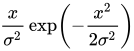
Probability densityxσ2exp⁡(-x22σ2){\ displaystyle {\ frac {x} {{\ sigma} ^ {2}}} \ exp \ left (- {\ frac {{x} ^ {2}} {2 {{\ \ sigma} ^ {2}} }} \ right)} {\ frac {x} {{{\ sigma} ^ {{2}}}} \ exp \ left (- {\ frac {{{x} ^ {{2}}}} {2 {{\ \ sigma} ^ {{2}}}}} \ right)
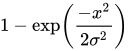
Distribution functionone-exp⁡(-x22σ2){\ displaystyle 1- \ exp \ left ({\ frac {-x ^ {2}} {2 \ sigma ^ {2}}} \ right)} 1- \ exp \ left ({\ frac {-x ^ {2}} {2 \ sigma ^ {2}}} \ right)
Expected valueπ2σ{\ displaystyle {\ sqrt {\ frac {\ pi} {2}}} \ sigma} {\ sqrt {{\ frac {\ pi} {2}}}} \ sigma
Medianσln⁡(four){\ displaystyle \ sigma {\ sqrt {\ ln (4)}}} {\ displaystyle \ sigma {\ sqrt {\ ln (4)}}}
Fashionσ{\ displaystyle \ sigma} \ sigma
Dispersion(2-π/2)σ2{\ displaystyle \ left (2- \ pi / 2 \ right) {{\ sigma} ^ {2}}} \ left (2- \ pi / 2 \ right) {{\ sigma} ^ {{2}}}
Asymmetry coefficient2π(π-3)(four-π)3/2{\ displaystyle {\ frac {2 {\ sqrt {\ pi}} (\ pi -3)} {(4- \ pi) ^ {3/2}}}} {\ frac {2 {\ sqrt {\ pi}} (\ pi -3)} {(4- \ pi) ^ {{3/2}}}}
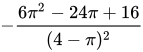
Excess ratio-6π2-24π+sixteen(four-π)2{\ displaystyle - {\ frac {6 \ pi ^ {2} -24 \ pi +16} {(4- \ pi) ^ {2}}}} - {\ frac {6 \ pi ^ {2} -24 \ pi +16} {(4- \ pi) ^ {2}}}
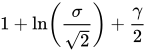
Differential entropyone+ln⁡(σ2)+γ2{\ displaystyle 1+ \ ln \ left ({\ frac {\ sigma} {\ sqrt {2}}} \ right) + {\ frac {\ gamma} {2}}} 1+ \ ln \ left ({\ frac {\ sigma} {{\ sqrt {2}}}} \ right) + {\ frac {\ gamma} {2}}
The generating function of momentsone+σteσ2t2/2π2(erf(σt2)+one){\ displaystyle 1+ \ sigma t \, e ^ {\ sigma ^ {2} t ^ {2} / 2} {\ sqrt {\ frac {\ pi} {2}}} \ left ({\ textrm {erf }} \ left ({\ frac {\ sigma t} {\ sqrt {2}}} \ right) \! + \! 1 \ right)} 1+ \ sigma t \, e ^ {{\ sigma ^ {2} t ^ {2} / 2}} {\ sqrt {{\ frac {\ pi} {2}}}} \ left ({\ textrm { erf}} \ left ({\ frac {\ sigma t} {{\ sqrt {2}}}} \ right) \! + \! 1 \ right)
Characteristic functionone-σte-σ2t2/2π2(erfi(σt2)-i){\ displaystyle 1 \! - \! \ sigma te ^ {- \ sigma ^ {2} t ^ {2} / 2} {\ sqrt {\ frac {\ pi} {2}}} \! left ({ \ textrm {erfi}} \! \ left ({\ frac {\ sigma t} {\ sqrt {2}}} \ right) \! - \! i \ right)} 1 \! - \! \ Sigma te ^ {{- \ sigma ^ {2} t ^ {2} / 2}} {\ sqrt {{\ frac {\ pi} {2}}}}!! Left ( {\ textrm {erfi}} \! \ left ({\ frac {\ sigma t} {{\ sqrt {2}}}} \ right) \! - \! i \ right)
f(x;σ)=xσ2exp⁡(-x22σ2),x⩾0,σ>0,{\ displaystyle f (x; \ sigma) = {\ frac {x} {\ sigma ^ {2}}} \ exp \ left (- {\ frac {x ^ {2}} {2 \ sigma ^ {2} }} \ right), x \ geqslant 0, \ sigma> 0,} {\ displaystyle f (x; \ sigma) = {\ frac {x} {\ sigma ^ {2}}} \ exp \ left (- {\ frac {x ^ {2}} {2 \ sigma ^ {2} }} \ right), x \ geqslant 0, \ sigma> 0,}

Whereσ {\ displaystyle \ displaystyle \ sigma} \ displaystyle \ sigma - scale parameter. The corresponding distribution function has the form

P(X⩽x)=∫0xf(ξ)dξ=one-exp⁡(-x22σ2),x⩾0.{\ displaystyle {\ mathsf {P}} (X \ leqslant x) = \ int \ limits _ {0} ^ {x} f (\ xi) \, d \ xi = 1- \ exp \ left (- {\ frac {x ^ {2}} {2 \ sigma ^ {2}}} \ right), x \ geqslant 0.} {\ mathsf P} (X \ leqslant x) = \ int \ limits _ {0} ^ {x} f (\ xi) \, d \ xi = 1- \ exp \ left (- {\ frac {x ^ { 2}} {2 \ sigma ^ {2}}} \ right), x \ geqslant 0.

Introduced for the first time in 1880 by John William Strett (Lord Rayleigh) in connection with the problem of adding harmonic oscillations to random phases.

Content

Application

  • In the tasks of gun sighting. If deviations from the target for two mutually perpendicular directions are normally distributed and uncorrelated, the coordinates of the target coincide with the origin, then designating the scatter along the axes asX {\ displaystyle X}   andY {\ displaystyle Y}   , we obtain the expression for the miss value in the formR=X2+Y2 {\ displaystyle R = {\ sqrt {{{X} ^ {2}} + {{Y} ^ {2}}}}}   . In this case, the valueR {\ displaystyle R}   has a Rayleigh distribution.
  • In radio engineering to describe the amplitude fluctuations of a radio signal.
  • The density distribution of the radiation of a black body in frequency.

Relationship with other distributions

  • If aX {\ displaystyle {X}}   andY {\ displaystyle {Y}}   - independent Gaussian random variables with zero mathematical expectation and the same varianceσ2 {\ displaystyle {{\ sigma} ^ {2}}}   then the random variableZ=X2+Y2 {\ displaystyle Z = {\ sqrt {{{X} ^ {2}} + {{Y} ^ {2}}}}}   has a Rayleigh distribution.
  • If independent Gaussian random variablesX {\ displaystyle {X}}   andY {\ displaystyle {Y}}   have nonzero mathematical expectations, in general, unequal, then the Rayleigh distribution passes into the Rice distribution .
  • The distribution density of the square of the Rayleigh value withσ=one {\ displaystyle {\ sigma = 1}}   has a chi-square distribution with two degrees of freedom.

See also

  • Rayleigh-Jeans Act
  • Rice Distribution
  • Normal distribution

Literature

  1. Perov, A.I. Statistical Theory of Radio Engineering Systems. - M .: Radio Engineering, 2003 .-- 400 p. - ISBN 5-93108-047-3 .


Source - https://ru.wikipedia.org/w/index.php?title=Raleigh distribution &oldid = 100548687


More articles:

  • Elizabethan Drama
  • Plasma Reactor
  • Zinoviev, Grigory Evseevich
  • Brandon Francis
  • Irmen Battle
  • Warsaw Open Championship 2009
  • Thonon-les-Bains
  • Maximin from Provence
  • Levin, Vladimir Pavlovich
  • Gray Forest Soils

All articles

Clever Geek | 2019