Nigella, nigella, chernukha ( lat. Nigella ) - a genus of herbaceous plants of the Ranunculaceae family , common in Western Europe , North Africa and Western Asia . About 25 species , of which 10 [2] -11 [3] are found in Russia and neighboring countries.
| Chernushka | |||||||||||||||||||||||
|---|---|---|---|---|---|---|---|---|---|---|---|---|---|---|---|---|---|---|---|---|---|---|---|
 Damask chernushka | |||||||||||||||||||||||
| Scientific classification | |||||||||||||||||||||||
| |||||||||||||||||||||||
| International scientific name | |||||||||||||||||||||||
Nigella L. | |||||||||||||||||||||||
Content
- 1 Biological Description
- 2 Types
- 3 Economic value and application
- 4 notes
- 5 Literature
- 6 References
Biological Description
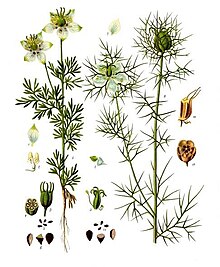
Representatives of the genus are annual herbaceous plants reaching a height of 30-60 cm.
The stems are straight, branched.
Leaves - double or triple pinnately dissected into thinly linear segments.
Flowers are solitary, bluish; calyx, five sepals ; petals 5-8 in the form of two-lipped formations; There are many stamens, pistils 2-10, more or less fused together.
The fruit is a many - leafed .
Views
There are about 25 species.
- Nigella arvensis L. typus [4] - Field Nigella
- Nigella bucharica Schipcz. - Chernushka Bukhara
- Nigella ciliaris
- Nigella damascena L. - Damask nigella
- Nigella gallica
- Nigella glandulifera Freyn et Sint. - Black chernous
- Nigella hispanica L. - Spanish Nigella
- Nigella integrifolia Regel - Chernushka whole-leafed
- Nigella latisecta PHDavis
- Nigella nigellastrum
- Nigella orientalis L. - Eastern Chernushka
- Nigella oxypetala Boiss. - chernushka acute-flaky
- Nigella papillosa
- Nigella sativa L. - Chernushka sowing , or Kaliningzhi
- Nigella segetalis M. Bieb. - Chernushka plow
Economic Significance and Application
All types of nigella are decorative ; good melliferous plants [5] .
Seeds of black sowing, field and damask contain up to 30-40% fatty oil [5] .
Damask chernushka contains essential oil , which can be used in perfumery [5] .
Up to 430 mg% of vitamin C is found in the leaves of sowing, field and damask seeds [5] .
Field chernushka seeds are eaten [5] .
Notes
- ↑ For the conventionality of specifying the class of dicotyledons as a superior taxon for the plant group described in this article, see the APG Systems section of the Dicotyledonous article .
- ↑ Cherepanov S.K. Vascular plants of Russia and neighboring states (within the former USSR) = Vascular Plants of Russia and Adjacent States (the former USSR). - Russian edition. - SPb. : Peace and Family, 1996 .-- S. 833.
- ↑ Krasheninnikov I.M. Genus 514. Chernushka - Nigella // Flora of the USSR : in 30 tons / chap. ed. V.L. Komarov . - M .; L .: Publishing House of the Academy of Sciences of the USSR , 1937. - T. 7 / ed. volumes B.K. Shishkin . - S. 62–72. - 792, XXVI p. - 5200 copies.
- ↑ NCU-3e. Names in current use for extant plant genera. Electronic version 1.0. Entry for Nigella L. (English) (Retrieved November 10, 2009)
- ↑ 1 2 3 4 5 Gubanov I.A. et al. Wild useful plants of the USSR / ed. ed. T.A. Rabotnov . - M .: Thought , 1976 .-- S. 125 .-- 360 p. - ( Reference guides to the geographer and traveler ).
Literature
- Chernushka // Chagan - Aix-les-Bains. - M .: Soviet Encyclopedia, 1978. - ( Great Soviet Encyclopedia : [in 30 vols.] / Ch. Ed. A. M. Prokhorov ; 1969-1978, vol. 29).
- Chernushka, plants from the Ranunculaceae family // Brockhaus and Efron Encyclopedic Dictionary : in 86 volumes (82 volumes and 4 additional). - SPb. , 1890-1907.
- Krasheninnikov I.M. Genus 514. Chernushka - Nigella // Flora of the USSR : in 30 tons / chap. ed. V.L. Komarov . - M .; L .: Publishing House of the Academy of Sciences of the USSR , 1937. - T. 7 / ed. volumes B.K. Shishkin . - S. 62–72. - 792, XXVI p. - 5200 copies.