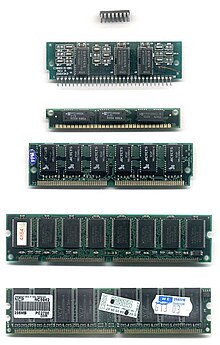
A small printed circuit board that houses the memory chips , usually RAM .
Depending on the form factor, the findings may
- implemented as pins (DIP, SIPP)
- located in the form of tracks that fit to the edge of the knife connector on one side of the board ( SIMM ), or two - DIMM .
The memory module and, accordingly, the connector for installing the memory module in the connection area, have a size of 133.35 mm (5¼ ") [1] .
For the correct installation of the memory module it is necessary: 1) to select a module of the appropriate type and 2) to orient it in the correct way.
To protect against incorrect orientation of the module in the connector, use:
- The “key” is a special recess in the group of contacts that mechanically prevents the installation of the module of the wrong generation in a particular connector.
- latches on the connector that tightly fix the module in the connector - if the module is inserted into the connector correctly and the latches are locked, a characteristic click should be heard.
In addition, the size and position of the key-dredging can encode additional features of the module: supply voltage different from the bulk of the modules, the presence of ECC circuits.

A key-notch on the module and latches on the connector prevent the incorrect installation of the memory module.

In various “generations” and types of DDR, the key-notch is located in a different location on the connector.

If necessary, the modules are equipped with individual cooling radiators.

Information about the parameters of the memory module chips is recorded in SPD - Serial presence detect


