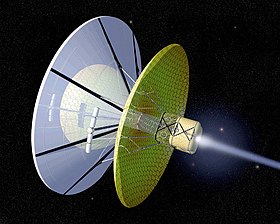
Bassard ramjet direct-flow interstellar engine is the concept of a rocket engine for interstellar flights, proposed in 1960 by physicist Robert Bassard ( Robert W. Bussard ).
Content
Engine device
The basis of the concept is the capture of an interstellar medium ( hydrogen and dust) by a spacecraft going at high speed and the use of this substance as a working fluid (or directly fuel) in a thermonuclear rocket engine of the ship. The interstellar medium is captured by a powerful electromagnetic field, in the approximation it has the configuration of a wide funnel, directed forward along the ship's velocity vector. Presumably, the diameter of the collecting field should be thousands or tens of thousands of kilometers. An essential feature of such a scheme will be the almost complete fuel autonomy of the ship: being dispersed by the available fuel supply on board to a certain speed, providing a sufficient influx of interstellar hydrogen into the input collector, that is, after entering the "direct-flow mode", the ship will be able to move further with constant acceleration, without turning off the drive and not switching to inertial flight.
Two main options for using trapped interstellar hydrogen are proposed:
- As a working fluid for TNRD , with its own stock of thermonuclear fuel on board (RAIR).
- Directly as a thermonuclear fuel.
Theory and Problems of Concepts
The interstellar medium contains matter in an amount of the order of 10 −21 kg / m³, the bulk - ionized and non-ionized hydrogen, a small amount of helium and practically no other gases in a noticeable amount. Accordingly, a space volume of the order of 10 18 m³ must be passed through the ship’s collector to collect one gram of hydrogen. Such a volume requires a huge diameter of an electromagnetic (electrostatic ion) collecting collector and an extremely large field strength.
R = 50,000 m Coverage = 7 853 981 633.97 m2 Speed (we take the maximum from the section Speed limit) = 35 700 000 m / s Time = 1 sec Sifted volume = 280 387 144 332 889 000 m3 The density of the medium = 1E-21 kg / m3 Received weight = 0.000 280 387 144 332 890 kg That is, a perfectly working field with a radius of 50 km at maximum speed will capture an average of 0.28 grams of interstellar gas per second (neglect the relativistic time dilation). |
Based on the composition of the interstellar medium (mainly hydrogen), it was thermonuclear fusion on the hydrogen reaction that was proposed by Bassard in the initial concept of the engine. Unfortunately, the proton-proton cycle is unsuitable for use due to the extreme difficulty of its implementation in a thermonuclear reactor. Accordingly, thermonuclear reactions of other types are more suitable, in particular 2 H + 2 H → 3 He + 1 n + 18 MeV, or 2 H + 3 H → 4 He + 1 n + 20 MeV, but the isotopes required for them are extremely rare in composition of the interstellar medium.
The solution, in principle, was proposed in the use of thermonuclear reactions of the CNO cycle , where carbon is a catalyst for thermonuclear combustion of hydrogen. Nevertheless, in any so-called. reactions occur extremely slowly in the catalytic cycle of nuclear fusion, and the power density is negligible (for comparison: in the center of the sun the energy release is only about 1 watt per cubic centimeter). During the flight of a substance, even under the most optimistic assumptions, only a negligible fraction of it can burn out.
In 1974, Alan Bond proposed the concept of RAIR (ram-augmented interstellar rocket), which solves the problem of difficult thermonuclear fusion on the proton-proton cycle. In this scheme, the proton stream entering the collector is inhibited to an energy of the order of 1 MeV and bombards the target from lithium-6 or boron-11 isotopes. The reaction of lithium-proton or boron-proton is simpler than proton-proton and gives a significant energy output, which increases the velocity of the working fluid from the engine nozzle. Such a thermonuclear reaction can also occur using small amounts of antimatter as a catalyst.
At the same time, Bassard’s engine concept has significant theoretical problems due to the interstellar medium’s resistance factor - impulse transmission from the oncoming flow of matter to the collector and further to the ship, which requires an excess of engine thrust over the resistance index.
Currently, work on the concept is being carried out as part of theoretical research.
The key problem of the “straight-through” is also that the “magnetic funnel” will by no means fulfill the function of a mass intake as intended by the author of the concept. Rather, it will behave like a “brake” (see “Magnetic plug”, “ Probkotron ”, “Adiabatic invariant”).
Speed Limit
Another drawback of a thermonuclear ramjet engine (even on the most efficient proton-proton cycle) is the limited speed that a ship equipped with it can achieve (no more than 0.119 s = 35.7 thousand km / s). This is due to the fact that during the capture of each hydrogen atom (which can be considered, as a first approximation, motionless relative to the stars), the ship loses a certain impulse, which can be compensated by engine thrust only if the speed does not exceed a certain limit. To overcome this limitation, the fullest possible use of the kinetic energy of trapped atoms is necessary, which seems to be a rather difficult task.
Let's say the screen has caught 4 hydrogen atoms. During the operation of a thermonuclear reactor, four protons turn into one alpha particle , two positrons and two neutrinos . For simplicity, we neglect the neutrino (accounting for neutrinos will require accurate calculation of all stages of the reaction, and neutrino losses are about a percent), and positrons can be annihilated with 2 electrons left from the hydrogen atoms after the protons are removed from them. Another 2 electrons will be used to turn an alpha particle into a neutral helium atom, which, thanks to the energy received from the reaction, will be accelerated in the nozzle of the engine.
The final reaction equation excluding neutrinos:
- 4 1
1 H → 4
2 He + (4 m H - m He ) c ² (≈27 MeV)
Let the ship fly at speed v . When capturing four hydrogen atoms in the ship's frame of reference, the momentum is lost:
The theoretically achievable momentum with which a ship can launch a helium atom can be obtained from the well-known relativistic relationship between mass, energy and momentum:
The energy of the helium atom (including the rest energy) cannot exceed the sum of the masses of four hydrogen atoms times the square of the speed of light:
Hence the square of the maximum achievable momentum of the helium atom:
If the ship as a result of trapping and using four hydrogen atoms has not accelerated or slowed down, then the momentum lost in trapping them is equal to the momentum acquired as a result of the ejection of a helium atom from the nozzle:
Bassard Engine Concepts
The problem of braking a Bassard ship with a counter flow of matter led to the emergence of the concept of magnetic sail (or parachute). In this case, the collector's electromagnetic field absorbs the energy of the oncoming stellar wind (or interstellar medium) and transmits a braking impulse to the ship. Thus, the requirements for fuel consumption for braking in the star system, the goal of interstellar flight, are reduced. The concept was proposed by Robert Zubrin in the late 1980s. [1] [2]
Accordingly, a magnetic sail can also be used to accelerate the ship in the direction from the star, on the flow of stellar corpuscular wind.
The development of this idea is the acceleration (braking) of a ship with a magnetic sail using a powerful stream of particles dispersed by a stationary planetary (orbital) accelerator. In this scheme, the requirements for the supply of on-board fuel used to disperse the ship are reduced.
The concept of a “prepared route” is also proposed, in which a stream of finely dispersed thermonuclear fuel is brought up in advance (through stationary installations) to the trajectory of a future direct-flow ship flight.
Bassard's Engine in Science Fiction
This concept is widely used in science fiction literature, in particular, the plot of Paul Anderson’s novel “ Tau Zero ” is built on it.
Bassard’s engine principle is used by aliens in Tom Ligon’s Eldorado. Their projectile, “The Absorber of Hydrogen Chaser of Light,” is aimed directly at the Sun to hit it and cause an explosion similar to a supernova explosion . The cover of If magazine , where Eldorado is published, shows one of Bassard's engine design options. [3]
Almost all Federation ships from the Star Trek universe use Bassard collectors to collect interstellar gas for later use in the ship’s propulsion system.
Engines of spacecraft in the Reynolds universe “Space Apocalypse” (in the novels they are called straight-through Konjoyner engines) use interstellar hydrogen as fuel.
The Theseus spaceship in Peter Watts’s novel False Blindness uses Bassard’s engine.
Bassard’s engine is mentioned many times in Larry Niven ’s Famous Cosmos series. In some works, the name "ramjet" is used.
The engine “absorbing interstellar matter” is used by the Strugatsky brothers in the story “ Private Assumptions ” on the photonic starship “Muromets”.
In the novel “ Fiasco ” by the writer Stanislav Lem , the Eurydice spaceship uses engines that are based on the fusion reaction, the fuel for which is hydrogen in outer space.
See also
- Fusion rocket engine
- Interstellar flights
Notes
- ↑ DG Andrews and R. Zubrin, “Magnetic Sails and Interstellar Travel,” Paper IAF-88-553, 1988
- ↑ http://path-2.narod.ru/design/base_e/msit.pdf MAGNETIC SAILS AND INTERSTELLAR TRAVEL, DANA G. ANDREWS and ROBERT M. ZUBRIN, Journal of The British Interplanetary Society, Vol 43, pp. 265—272,1990
- ↑ Announcement of issue 5 for 2008, the site of the If magazine (inaccessible link) . Date of treatment May 28, 2011. Archived June 9, 2012.