“ Bhagavad-gītā As It Is ” ( English Bhagavad-Gītā As It Is ) is a translation of the Hindu scripture “ Bhagavad Gita ” into English with commentaries in the spirit of the tradition of Gaudiya Vaishnavism and bhakti yoga . It was made in the 1960s by Bhaktivedanta Swami Prabhupada (1896-1977) - the founder of the Vaishnava religious organization International Society for Krishna Consciousness (ISKCON).
| Bhagavad-gita as it is | |
|---|---|
| Bhagavad-gita as it is | |
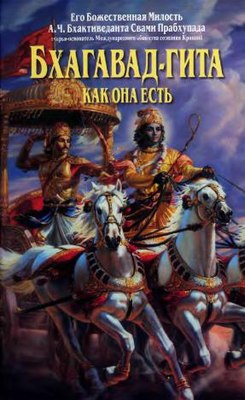 Cover of the third Russian-language edition of the Bhagavad-gita As It Is | |
| Author | A. C. Bhaktivedanta Swami Prabhupada |
| Original language | English |
| Original published | 1972 |
| Publisher | Macmillan publishers Bhaktivedanta Beech Trust |
The first edition of Bhagavad-gita As It Is was published in English in 1968 by Macmillan Publishers . In 1972, the first full edition of the book with genuine Sanskrit texts was published. Since the mid-1970s, the publication of the Bhagavad-gita As It Is has been carried out by the international publishing house Bhaktivedanta Buk Trust [1] . According to the publisher, the Bhagavad-gita As It Is has been translated into more than 80 languages and published over 100 million copies. [2] [3] This translation of the Bhagavad-gita is the most widespread outside India [4] and one of the most widespread in India. The first edition of Bhagavad-gita As It Is in Russian was published in 1984. In subsequent years, the book was repeatedly reprinted and sold in more than a million copies. [5] According to the Center for Indian Studies of the Institute of Oriental Studies of the Russian Academy of Sciences , this is the only Russian translation of the Bhagavad-gita, widely used. [6] Other scientific translations are known only to specialist scientists. [6]
In 2011-2012, the prosecutor’s office in Tomsk made an attempt to ban Bhagavad-gita as it is, recognizing it in court as extremist literature. The resulting lawsuit caused international resonance and led to the fact that for the first time in the history of Russian-Indian relations in India, anti-Russian protests took place.
Content
History of Bhagavad-gita translations into Russian
Bhagavad-gita is the core of Bhishmaparva , the sixth book of the ancient Indian epic Mahabharata . [7] In 1785, the Bhagavad-gita became the first work of Sanskrit literature translated into one of the European languages directly from the original. [7] This translation (into English) was done by Charles Wilkins . [7] The book immediately attracted the attention of a European reader and served as an impetus in Europe to arouse interest in the ancient cultural heritage of India. [7] In 1788, just three years after the advent of the English translation, N. I. Novikov published a Russian translation of the poem, made from English by A. A. Petrov. [8] Then, for more than a century, “no new Russian translations of the Bhagavad Gita” or any special studies about it appeared in Russia. [9]
In 1909, two Russian translations of the Bhagavad-gita were published at once, both done by Russian theosophists . [9] One was made by A. P. Kaznacheeva , the other by A. Kamenskaya and I. Manziarli. [9] The translation of Kaznacheeva was published in Vladimir , and Kamenskaya and Manziarli, first in the St. Petersburg journal The Bulletin of Theosophy, and then (in 1914) as a separate book in Kaluga . [9] S. D. Serebryany notes that Kaznacheeva “transferred the Bhagavad Gita” to rather helpless verses, apparently using some Western (maybe more than one) poetic translation. ” [9] B. L. Smirnov , in turn, writes that the translation was made "it is not known from which language" and that "it is difficult to recognize the Gita even to those who know this monument well." [8] Kamenskaya and Manziarli relied on the theosophical translation of Annie Besant . [8] It is hard to say what resonance these translations of the Bhagavad-gita received in Russian society. [9]
From the original, “Bhagavad-gita” was first translated in 1956 by an amateur sanctologist B. L. Smirnov, who noted that due to the poor quality of the three previous translations, “the Russian reader essentially does not know the Gita.” [8] The Indologist V. G. Erman himself later called Smirnov’s translation “in many respects the wonderful work of an amateur enthusiast.” [ten]
In 1984, the first confessional Russian edition of the Bhagavad-gita, Bhagavad-gita as it is, was published in India. As Sergey Serebryany subsequently noted, this commented edition of The Gita, in view of the double translation (from Sanskrit into English, and then from English into Russian), was not of high quality, and was aimed at propagating the ideas of Gaudiya Vaishnavism. [11] Despite all the shortcomings, the Bhagavad-gita as it is was destined to become the only widely distributed Bhagavad-gita in Russian.
In 1985, V. S. Sementsov’s translation came out, made and published as an appendix to the scientist’s monograph. [10] This was the second translation of the Bhagavad-gita directly from Sanskrit and the first translation into Russian made by a Sanskrit specialist. [10] Ehrman notes that Sementsov’s translation “pursues artistic goals and in some places conveys the text of the original quite freely.” [12] At the same time, Sementsov leaves so many Sanskrit terms without translation - in Russian transliteration. [12] Erman explains that “the chosen style of translation, as well as the preservation of Sanskrit terms without translation, is justified here by the fact that it is published as an appendix to a detailed study, where the reader will find the necessary explanations, and should be considered in unity with it, implying a preliminary familiarization with this kind of extended “introduction” to translation. ” [13] According to Ehrman, Sementsov’s translation was “a significant step forward in comparison with the work of B. L. Smirnov that preceded him.” [10] Sementsov corrected the mistakes of Smirnov and "gave the Russian reader a more accurate idea of the contents of the original." [ten]
Finally, in 2009, the first full-fledged scientific translation of the Bhagavad-gita from Sanskrit into Russian was released, which was carried out at the end of the 20th century by V. G. Erman, one of the leading Russian Indologists. This translation was published as part of the sixth book of the Mahabharata - Bhismaparva . [14]
The history of writing and publishing the Bhagavad-gita As It Is
Bhaktivedanta Swami Prabhupada first translated the Bhagavad-gita from Sanskrit and wrote commentaries on it in the 1940s in India. [15] However, a single copy of the manuscript disappeared under mysterious circumstances. [15] Prabhupada again began translating and commenting on the Bhagavad-gita already in 1965, shortly after arriving in New York. [15] As a rule, Prabhupada woke up at one in the morning, chanted the Hare Krishna mantra on the rosary for an hour, and then worked on the Bhagavad-gita As It Is and before translating and commenting on another classic Sanskrit text - Bhagavata Puranas . " [15] A chest was used as a table for Prabhupada, in which he brought his supplies from India a few months earlier. The first six chapters of the Bhagavad-gita As It Is, Prabhupada typed, and the remaining twelve dictated to the recorder.
Prabhupada already had publishing experience: in the early 1960s he published in India his commentary translation of the first of the twelve parts of the Bhagavata Purana. [15] However, publishing books in America was much more difficult than in India. [15] Although by the beginning of 1967 Prabhupada already had a group of followers, not one of them has so far shown any particular desire to reprint the manuscript, edit it, and engage in negotiations with American publishers. [15] The prospects for publishing the Bhagavad-gita As It Is were vague, but despite this, Prabhupada in January 1967 began to work on another book, which was later published under the heading “The Teachings of Lord Caitanya.” Satsvarupa Dasa Goswami in the biography of Prabhupada “ Srila Prabhupada-lilamrita ” describes the writing and translation activities of his guru as follows:
| Wearing reading glasses, Prabhupada opened his books and turned on the recorder. After carefully reading the Bengali and Sanskrit texts, he took a microphone in his hand, pressed the record button <...> and began to dictate. <...> At one time he uttered no more than one phrase, then paused, thought, and dictated the next. Prabhupada would either say or stop, turning the recorder on and off. At the same time, he sat, straightening his back, sometimes swaying slightly or nodding his head to the beat of the words. At times, he bent low over the pages and carefully studied them through his glasses. [sixteen] |
Prabhupada eventually commissioned his American student Hayagriva (Howard Wheeler), an English teacher at Ohio State University, to edit the text. By the summer of 1967, the Bhagavad-gita As It Is was ready for publication, and Prabhupada's disciple Brahmananda began searching for a publisher. [17] At the end of July 1967, while in India, Prabhupada received a letter from Brahmananda informing him that the prestigious Macmillan Publishers publishing house agreed to publish the Bhagavad-gita As It Is. [17] On August 1, Prabhupada (who was at that time in the Radha-Damodara Temple in Vrindavan ) [18] wrote a response asking Brahmananda to immediately sign a contract with the publishing house. [17] In the same year, the book was published, with a preface written by the beatnik poet Allen Ginsberg personally who knew Prabhupada. In 1972, the first full edition of the book was published with genuine Sanskrit texts and, this time, with a preface by the American Indologist Edward Dimok , who praised Prabhupada’s translation and commentary, calling them the true interpretation of the Bhagavad-gita in line with the Gaudiya Vaisnavism tradition. [19] In the same year, on the initiative of Prabhupada, the international publishing house Bhaktivedanta Buk Trust was founded, which has since been publishing the Bhagavad-gita As It Is . [20] The book gained immense popularity: according to the Hare Krishnas themselves, over four decades it has been translated into more than 80 languages and published in over 100 million copies. [2] [3]
The Bhagavad-gita As It Is came to Russia in June 1971 with Prabhupada, who was then in Moscow on a five-day visit. In the USSR, Prabhupada managed to meet with only two Soviet citizens: orientalist Grigory Kotovsky and Muscovite Anatoly Pinyaev . The latter turned to Gaudiya Vaishnavism and became an active preacher of this religion in the USSR. Pinyaev Prabhupada presented his personal copy of the Bhagavad-gita as it is in English. [5] From that moment began the "illegal circulation" of this book in the USSR. [5] In 1984, the first edition of the Bhagavad-gita As It Is was published in India in Russian. [21] Fearing arrest, the Hare Krishnas “copied it on a copy machine, typed it, copied it by hand, and even memorized it by heart”. [5] After ISKCON was legalized in the USSR in 1988, the book was reprinted several times. According to the Hare Krishnas, since 1984 in the countries of the former USSR, about a million copies of the Russian-language publication Bhagavad-gita As It Is have been sold. [5] According to the Center for Indian Studies of the Institute of Oriental Studies of the Russian Academy of Sciences , “Bhagavad-gita as it is” is the only widely distributed publication in the Bhagavad-gita in Russia - other translations of the “Gita” are known only to specialist scientists. [6]
Features and Significance
In the full edition of the Bhagavad-gita As It Is, all Sanskrit slokas are cited in Devanagari , with transliteration, literal and literary translation. Most of the slokas are accompanied by detailed comments by Bhaktivedanta Swami Prabhupada, which he wrote based on the writings of previous Vaisnava acaryas . These are, in particular, comments on the Bhagavad-gita by Ramanuji , Sarartha-varshini-tika by Visvanatha Chakravarti , Gita-bhushana-tika by Baladeva Vidyabhushana , as well as comments on Bengali Bhaktivinoda Thakura . Like most followers of other Hindu traditions , Hare Krishnas believe that the Bhagavad-gita reflects the basic essence of Hindu philosophy .
William Dadweiler notes that as a representative of the Sampradaya of Bengal Vaisnavas, Prabhupada was able to effectively pass on his tradition to future generations. [22] From the point of view of tradition, Prabhupada belonged to a chain of spiritual teachers going back to Krishna himself, and therefore could interpret and present the Hare Krishna texts as they are. [22] Prabhupada himself noted that by the time the “Bhagavad-gita As It Is” appeared for hundreds of years in the West, there were already many translations of this text into English and other languages. [22] Despite this, no one could understand the Bhagavad-gita, for one who understands the words of Krsna in the Bhagavad-gita, like Arjuna accepts Krsna as the Supreme Personality of Godhead and becomes his follower. [22] Deadweiler notes that only after Prabhupada introduced the Bhagavad-gita through the Hare Krishnas, did the people who read it begin to become followers of Krsna. [22] According to Deadweiler, this indicates that only when Krishna’s teaching is transmitted through a chain of spiritual teachers does it retain its spiritual strength. [22]
In Bhagavad-gita As It Is, Bhaktivedanta Swami Prabhupada emphasizes the paramount importance of the path of Krsna-bhakti and bhakti-yoga , and represents Krsna as the Supreme Personality of Godhead . Such an interpretation of the Bhagavad-gita in the framework of Gaudiya-Vaishnava theology is directly opposite to the monistic interpretation of advaita .
Criticism
Scientist reviews
American Indologist Edward Dimok , director of the American Institute of Indian Studies, professor at the University of Chicago , a leading Western expert on Bengal and Gaudiya Vaishnavism , wrote a preface to the first full edition of Bhagavad-gita As It Is, published by MacMillan in 1972. In it, he noted that Bhaktivedanta Swami comments on the text of the Bhagavad Gita in the spirit of the tradition of bhakti and Gaudiya Vaishnavism, which is “legitimate”. According to him, "in this translation, the Western reader has a unique opportunity to see how a devotee of Krishna interprets the text of his own tradition." Dimok noted that “Bhagavad-gita as it is” “can serve as a useful manual for many university students,” as it provides an opportunity “to hear a qualified interpreter explaining the text saturated with the deepest religious meaning” and allows “to get acquainted with original and very convincing ideas of the Gaudiya Vaisnava school. ” [23] [24]
As Ramakant Pandeya, director of the All India Association of Sanskritologists, a Sanskrit professor at the Benares Hindu University , a recognized Indian specialist in Indian philosophical systems, notes Bhaktivedanta Swami Prabhupada wrote his commentary in English, based on a 17th-century Gaudiya Vaishnava Sanskrit commentary, “ Gita Bhushana” ". At the same time, Prabhupada used many quotes and examples from the Srimad-Bhagavatam and other Puranas , which is in line with the Hindu tradition of compiling commentaries. At the same time, R. Pandeya noted that “Hinduism is a large body that consists of many parts, that is, sampradaya . <...> In India, from ancient times, a tradition of commentaries on the Gita has developed, where each sampradaya established its doctrine, giving its own interpretation of the Gita. Thus, all the traditional comments on the Gita correspond to the teachings of one or another sampradaya. <...> [Bhaktivedanta Swami Prabhupada] was a follower of the Gaudiya-Vaisnava-sampradaya , and it is natural that he gives an interpretation in the key of this sampradaya. A person can best describe the aspect of truth that he has most studied. However, it is wrong to say that because of his membership in sampradaya, he is a sectarian, that is, he has separated from the teachings of the Vedas and is no longer following sanatana-dharma. <...> About fifty verses that I looked through in his translation left me with the impression of a scrupulous approach. Of course, in order to make a judgment on all the details of this work, an in-depth analysis needs to be done, but I can confidently say that his Bhagavad-gita as it is "meets the tradition of Hinduism." [25] Samuel Atkins , professor and head of the Department of Classical Philology at Princeton University , called the Bhagavad-gita As It Is a “scientific, authoritative publication of the Bhagavad Gita,” which “made a deep impression on me.” According to Atkins, "this work is of great value for both the scientist and the average reader." [26]
Irina Glushkova , a leading researcher at the Center for Indian Studies of the Institute of Oriental Studies of the Russian Academy of Sciences , notes that [Bhagavad-gita] "is not considered outside the commentary tradition, fruitful from the VIII-IX centuries: from century to century, interpreting each line from a complex and opaque composition, thinkers of various philosophical and religious directions express their own views. Their debate with each other is picked up by their students and students of students who interpret the comments of their predecessors and create new ones. This is how the heterogeneous ritual and theological space of Hinduism has developed and is developing, which does not have a single founder, a single sacred text, a single object of veneration, or a cross-cutting hierarchy, or a church organization. That is how, already in the 20th century, Bhaktivedanta Swami Prabhupada, in the world of Abhay Charan De (1896-1977), created a new commentary - “Bhagavad-gita As It Is” - on the old text and founded the “International Society for Krishna Consciousness”. Its branch was registered in Russia, and in the 1990s the words "Bhagavad-gita" and "Hare Krishnas" firmly entered the Russian vocabulary. " [27]
In 1999, Russian indologist S. D. Serebryany negatively commented on the first Russian edition of the Bhagavad-gita As It Is, published in 1984. In his opinion, this edition of the Gita contains numerous distortions of the original text caused by a double translation (from Sanskrit into English, and then from English into Russian), and it should be called "Bhagavad Gita, whatever it would never be better." Serebryany distinguished “two characteristic features” of this publication: the predetermination of translation and commentary by “sectarian” views of ISKCON and “a certain, to put it mildly, peculiarity of the Russian style, due in large part to the undoubted“ mediation ”of the English version of this book published in 1968.” [eleven]
According to the publishers of the book, the stylistic flaws associated with the translation from English into Russian were eliminated in the third Russian-language edition of the Bhagavad-gita As It Is, published in 2006. [28]
In 2011, in connection with the lawsuit on the recognition of the book as extremist , S. D. Serebryany said that he felt awkward because he was quoted by proponents of recognition of the book as extremist. He noted that he had not changed his mind, but that the quote about the "sectarian" nature of the book, "being taken out of the context of the article and the context of the book as a whole ... sounds sharper than I would like. This applies primarily to the word "sectarian" ", which in the context of Hinduism is usually used to refer to" the constituent parts of Hinduism. " For Russian-speaking readers who want to get acquainted with the Bhagavad Gita, Serebryany recommended reading the Russian translation of Vsevolod Sementsov , or the translation of Vladimir Ehrman , “or better, both of them, because they are mutually complementary.” [29]
Testimonials from Indian statesmen
On April 5, 1998, Indian Prime Minister Atal Bihari Vajpayee spoke at the opening of the ISKCON Temple and Cultural Center in New Delhi. In his speech, Vajpayee, in particular, said that “the transcendental universal message of the Bhagavad-gita” is very vividly transmitted by Bhaktivedanta Swami Prabhupada in his book “Bhagavad-gita as it is.” [30] Vajpayee also noted that "if today the Bhagavad-gita is distributed in millions of copies in thousands of languages in all corners of our planet, the merit for this sacred service belongs mainly to ISKCON." [31]
On August 22, 2011, on the day of the popular Indian holiday “ Krishna-Janmashtami ” (the birthday of Krishna), the ISKCON temple in Moscow was visited by Indian Ambassador Ajay Malhotra . [32] Speaking to the Hare Krishna community, Malhotra pointed out the importance of the message of Krishna for humanity as set forth in the main scripture of the Hindus, the Bhagavad-gita. [32] The ambassador praised the “philosophical aspect of the appearance of Krishna,” expressed in “the great philosophy described in the Bhagavad-gita.” [32] Malhotra, in particular, noted that “the translation and commentaries of the Bhagavad-gita by A. C. Bhaktivedanta Swami Prabhupada are among the very best because they present the Bhagavad-gita as it is - citing original texts, word by word translation, literary translation and giving authoritative commentary in accordance with the very meaning of the verses of the Bhagavad-gita. ” [32] Malhotra also noted that "in the Bhagavad-gita, Lord Krishna speaks to Arjuna , teaches us selfless service to God and all of humanity." [33]
On November 4, 2011, Indian President Pratibha Patil sent a message to Russian Hare Krishnas on the occasion of the 40th anniversary of the International Society for Krishna Consciousness in Russia. [34] In her message, she noted in particular that "over the past few decades, the International Society for Krishna Consciousness has played an important role in popularizing the noble and eternal message of Srimad Bhagavad-gita and contributing to the establishment of spiritual harmony in many countries of the world." [34]
Criticism in India
The Bhagavad-gita As It Is has been criticized by a number of Hindu authors and figures. [ whom? ] . In response to this criticism, Bhaktivedanta Purports: Perfect Explanation of the Bhagavad-Gita, a disciple of Bhaktivedanta Swami Prabhupada and one of the spiritual leaders of the International Society for Krishna Consciousness, wrote the book Bhaktivedanta Purports: The Perfect Explanation of the Bhagavad-Gita published in English in 1998.
U.S. Congress Oath Use
Member of the US House of Representatives from the 2nd constituency of Hawaii, Tulsi Gabbard (a Hare Krishna by faith) [35] in 2013 and 2015 [36] took the oath of office at Bhagavad-gita As It Is. [37] [38] In September 2014, Gabbard presented a copy of the Bhagavad-gita As It Is, on which she took the oath in 2013, to Indian Prime Minister Narendra Modi , who was on an official visit to the United States at that time. [39]
See also
- The trial of the Bhagavad-gita as it is
- Githarthasangraha
Notes
- ↑ Dwyer, Cole, 2007 , p. 34.
- ↑ 1 2 Rajat Arora. Iskcon: If Gita is banned, we'll intensify protest // Hindustan Times . - December 20, 2011. Archived December 21, 2011.
- ↑ 1 2 The Tomsk court refused to recognize the Bhagavad-gita as extremist // Lenta.ru . - December 28, 2011.
- ↑ Dwyer, Cole, 2007 , p. 144.
- ↑ 1 2 3 4 5 Yuri Pleshakov. Facets of the Russian “Gita” // Portal –Credo.Ru. - October 24, 2005.
- ↑ 1 2 3 Andrey Melnikov, Lydia Orlova. The Case for Krishna // Independent Newspaper . - January 18, 2012.
- ↑ 1 2 3 4 Erman, 2009 , p. 336.
- ↑ 1 2 3 4 Smirnov, 1960 , p. 9.
- ↑ 1 2 3 4 5 6 Silver, 2009 , p. 306.
- ↑ 1 2 3 4 5 Erman, 2009 , p. 337.
- ↑ 1 2 Silver, 2009 , p. 308.
- ↑ 1 2 Erman, 2009 , p. five.
- ↑ Erman, 2009 , pp. 5-6.
- ↑ Erman, 2009 .
- ↑ 1 2 3 4 5 6 7 Satsvarūpa Dāsa Gosvāmī, 1981 , p. 7.
- ↑ Satsvarūpa Dāsa Gosvāmī, 1981 , pp. 7-8.
- ↑ 1 2 3 Satsvarūpa Dāsa Gosvāmī, 1981 , p. 180.
- ↑ Satsvarūpa Dāsa Gosvāmī, 1981 , p. 181.
- ↑ Robert D. Baird . Swami Bhaktivedanta and the Bhagavadgita 'As it Is' // Robert N. Minor Modern Interpreters of the Bhagavadgita. - Albany: State University of New York Press , 1986. - S. 200-221 .
- ↑ Sergey Bychkov . Tomsk prosecutors are watching. Krishnaites in Russia are again judged // Moskovsky Komsomolets . - November 28, 2011. Archived December 25, 2011.
- ↑ It was not possible to recognize the Bhagavad-gita as extremist the first time // Globalsib.com. - August 13, 2011.
- ↑ 1 2 3 4 5 6 Deadwyler, 1989 , p. 58.
- ↑ <> Along with the Bhagavata Purana , <...> The Gita is the most quoted text of the Gaudiya Vaisnava school, the school represented by Swami Bhaktivedanta, the last in a long chain of teachers . It can be said that this school of Vaishnavism was founded, or revived, by Sri Krishna-Caitanya Mahaprabhu (1486-1533) in Bengal. It is currently the most influential religious tradition in the eastern Indian subcontinent . In Gaudiya Vaishnavism, Krsna appears as the Supreme God , and not just as an incarnation of another deity; Bhakti is seen as the immediate and most powerful religious power of love between man and God. The religious discipline of this tradition consists in the individual dedication to the Divine of all his actions. The believer listens to Krishna stories from the sacred texts, chants the names of Krishna , bathes and dresses the murtis of Krishna, feeds Him and receives the remnants of the food offered to Him , thus absorbing His mercy; the believer does this and much more until he reaches the transformation: he becomes someone very close to Krishna and sees the Lord face to face. Swami Bhaktivedanta comments on the Bhagavad-gita from this point of view, and that is legitimate. Moreover, in this translation, the Western reader has a unique opportunity to see how a devotee of Krishna interprets the text of his own tradition. Here we are dealing with the rightfully famous Vedic tradition in action. This book is a valuable contribution from many points of view. It can serve as a useful tool for many university students. It gives us the opportunity to hear a qualified interpreter explaining a text saturated with the deepest religious meaning. It allows us to get acquainted with the original and very convincing ideas of the Gaudiya Vaisnava school. The Sanskrit text presented in the Devanagari and transliteration enables Sanskrit specialists to re-interpret or debate certain Sanskrit meanings - although, in my opinion, few will challenge the Swami [Bhaktivedanta] knowledge of Sanskrit and its scholarship. And in the end, for the layman, we have a readable English translation and a spirit of devotion [to God], which will surely touch the heart of a sensitive reader. We also have illustrations that, no matter how surprising it may seem to those who are already familiar with modern Indian religious art, were made by American devotees. Bhaktivedanta Swami provided a service to scholars studying Gaudiya Vaishnavism students, as well as an ever-growing number of Western readers interested in classical Vedic thought. Giving us a new and lively interpretation of already well-known text, he has repeatedly increased our understanding ...
- ↑ Dimock, 1972 , p. xv.
- ↑ Pandea, 2012 .
- ↑ Rosen, 2007 , p. xv.
- ↑ Glushkova, 2012 .
- ↑ Bhaktivedanta Swami Prabhupada, 2009 , p. 786.
- ↑ Shameful process . lenta.ru. Date of treatment March 17, 2019.
- ↑ Ivanenko, 1998 , p. 44
- ↑ “If today the Bhagavad-gita is distributed in millions of copies in a thousand languages in all corners of our planet, the merit for this sacred service belongs mainly to ISKCON. <...> The internal factor is, of course, the internal strength of the ISKCON message, based on the philosophy of Bhagavad-gita. And this message meets all the moral needs of the world - whether it is a person’s search for inner peace, his desire to somehow integrate into the society of people and nature, his concern for the environment, his attitude to activities, his attitude to death, the Bhagavad-gita gives comprehensive and internally very consistent answers to all these questions. This is what distinguishes ISKCON from various fashion movements, which also appealed to the minds of people in the sixties and seventies. All these quirks have come and gone, but the Krsna Consciousness Movement is building up and building up strength. The transcendental universal message of Bhagavad-gita is very vividly conveyed by Bhaktivedanta Swami Prabhupada in his book Bhagavad-gita as it is. The meaning of the Bhagavad-gita is universal and eternal. It provides comprehensive answers to three fundamental questions: who are we? what should we do? how do we live People pose these questions in all societies and at all times. And the Bhagavad-gita answers these questions. The Bhagavad Gita does not prescribe passivity. Bhagavad-gita is a radical call to action transforming the individual and society. That is why the Bhagavad-gita was able to breathe the revolutionary spirit into freedom fighters such as Mahatma Gandhi , Vivekananda , Lokamanya Tilak and others. ” Ivanenko, 1998 , pp. 43–44
- ↑ 1 2 3 4 Mikhail Kovalev. New Year in Indian // Moskovsky Komsomolets . - August 22, 2011. Archived on January 28, 2012.
- ↑ Hindus around the world celebrate Krishna's appearance on August 22 // NEWSru.com . - August 22, 2011.
- ↑ 1 2 President of India congratulated Russian Vaisnavas on their 40th birthday // NEWSru.com . - November 30, 2011.
- ↑ Gabbard's victory brought in instant jubilation among the Hindus across the United States . The Times of India (August 13, 2012). Date of treatment September 29, 2012. Archived October 28, 2012.
- ↑ Tulsi Gabbard . Official Facebook Page of Tulsi Gabbard (January 7, 2015). Date of treatment January 7, 2018.
- ↑ Tulsi Gabbard - Congressional Oath 2013 . YouTube (June 5, 2013). Date of treatment December 4, 2014.
- ↑ Jaweed Kaleem. Tulsi Gabbard, First Hindu In Congress, Uses Bhagavad Gita At Swearing-In . The Huffington Post (January 4, 2013). Date of treatment January 4, 2013. Archived January 12, 2013.
- ↑ US lawmaker gifts Gita to Modi . The Hindu (September 29, 2014). Date of treatment October 8, 2014.
Literature
- In Russian
- A. C. Bhaktivedanta Swami Prabhupada . Bhagavad-gita as it is. Full ed. with authentic. Skt. text., rus. transliterator., literally. or T. per. and details comm = Bhagavad-Gītā As It Is (1968). - 4th ed., Rev. - M .: The Bhaktivedanta Book Trust , 2015 .-- 976 p. - 18,000 copies. - ISBN 978-5-902284-89-5 .
- Glushkova I.P. Tomsk as Kurukshetra // Daily Journal . - 2012.
- Glushkova I.P. On Monuments to Gabriel Baten'kov, Uncle Kolya and the Bhagavad-gita // Daily Journal . - March 29, 2012.
- Prabhupada / Dubyansky A.M. // Semiconductors - Desert. - M .: Big Russian Encyclopedia, 2015. - ( Big Russian Encyclopedia : [in 35 vols.] / Ch. Ed. Yu. S. Osipov ; 2004—2017, vol. 27). - ISBN 978-5-85270-364-4 .
- Ivanenko S.I. Krishnaites in Russia. Truth and fiction . - M .: Philosophical book, 1998 .-- 296 p. - 1,500 copies - ISBN 5820500032 .
- Pandea, Ramakant. Professor Ramakant Pandeya: Can a secular court sort out the sacred texts? // Lenta.ru . - 2012.
- Serebryany S. D. “Bhagavad-gita”: on the paths to new interpretations // East . - 1993. - No. 4 . - S. 178-190 .
- Serebryany S. D. The Many-Revelation of the Bhagavad-gita // V. G. Erman Mahabharata. Book Six. Bhismaparva or a book about Bhisma. - M .: Nauka, 2009 .-- S. 291-335 . - ISBN 5862184023 .
- Serebryany S. D. Shameful process: Indologist-specialist on the lawsuit against “Bhagavad-gita as it is” // Lenta.ru . - 2011.
- Smirnov B.L. Mahabharata. Bhagavad Gita (Book VI, Ch. 25–42) . - Ashgabat: Academy of Sciences of the Turkmen SSR, 1960. - 400 p.
- Erman V. G. Mahabharata. Book Six. Bhismaparva or a book about Bhisma . - M .: Nauka, 2009 .-- 480 p. - 2000 copies. - ISBN 5862184023 .
- In English
- Adappur, Abraham. Religion and the Cultural Crisis in India and the West: An Ecumenical Inquiry . - New Delhi: Intercultural Publications, 2000 .-- xxviii, 482 p. - ISBN 8185574472 .
- Baird, Robert D. Swami Bhaktivedanta and the Bhagavadgita 'As it Is' // Robert N. Minor Modern Interpreters of the Bhagavadgita. — Albany: State University of New York Press , 1986. — С. 200—221 . — ISBN 0887062989 .
- Deadwyler, William H. Patterns in ISKCON's Historical Self-Perception // David G. Bromley , Larry D. Shinn Krishna Consciousness in the West. — Lewisburg, PA: Bucknell University Press , 1989. — С. 55—75 . — ISBN 083875144X .
- Dimock, Edward C. Foreword // AC Bhaktivedanta Swami Prabhupāda Bhagavad Gītā As It Is. — New York: Collier Books , 1972. — С. ix-x .
- Dwyer, Graham; Cole, Richard J. The Hare Krishna Movement: Forty Years of Chant and Change . — London: IBTauris , 2007. — ISBN 1845114078 .
- Eder, Milton. A Review of Recent "Bhagavadgita" Studies // Journal of South Asian Literature . — 1988. — Вып. 23 . - No. 2 . — С. 20—46 .
- Flood, Gavin . Book Review: The Bhaktivedanta Purports // ISKCON Communications Journal . — 1998. — Вып. 6 . - No. 2 . — ISSN 1358-3867 . (inaccessible link)
- Rosen, Steven J. Krishna's Song: A New Look at the Bhagavad Gita . — Westport, CT: Praeger , 2007. — ISBN 0313345538 .
- Satsvarūpa Dāsa Gosvāmī . Śrīla Prabhupāda-līlāmṛta, Vol. 3: Only He Could Lead Them . — Los Angeles: Bhaktivedanta Book Trust , 1981. — xx, 259 p. - 10,000 copies. — ISBN 0892131101 .
- Sharpe, Eric J. Western Images of the "Bhagavadgita", 1885-1985 // Journal of South Asian Literature . — 1988. — Вып. 23 . - No. 2 . — С. 47—57 .
- Surya, Gerald. Book Review: A Critique of AC Bhaktivedanta // ISKCON Communications Journal . — 1999. — Вып. 7 . - No. 2 . — ISSN 1358-3867 .
Links
- Электронная версия третьего русскоязычного издания «Бхагавад-гиты как она есть»
- «Бхагавад-гита как она есть» на русском языке — копия книги в формате djvu
- Официальный сайт Международного общества сознания Кришны в России
- О программе распространения «Бхагавад-гиты как она есть» в американских отелях (англ.)
- Аудиокнига «Бхагавад-гита как она есть»