Kurt Zadek Lewin ( German: Kurt Zadek Lewin ; September 9, 1890 - February 12, 1947 ) was a German and then an American psychologist whose ideas had a great influence on American social psychology and many other schools and trends, especially on the theory of cultural development of Lev Vygotsky and researchers of the “ Vygotsky circle ” [5] . Many of the questions he dealt with became fundamental for psychologists - the level of claims , group dynamics , social perception, game situations , the desire for success and avoidance of failures, field theory, and the time perspective .
| Kurt Levin | |
|---|---|
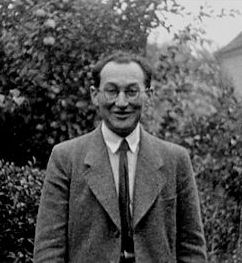 | |
| Date of Birth | |
| Place of Birth | |
| Date of death | |
| A place of death | Newton (Massachusetts) |
| A country | |
| Scientific field | Psychology |
| Place of work | Massachusetts Institute of Technology |
| Alma mater | University of Berlin |
| supervisor | and |
| Famous students | Bluma Zeigarnik , Tamara Dembo , Leon Festinger , Fritz Heider , Roger Baker , Morton Deutsch |
Content
- 1 Biography
- 2 Field Theory
- 3 Social Psychology
- 4 Scientific school
- 5 Publications by Kurt Levin in Russian
- 6 See also
- 7 notes
- 8 Literature
- 9 References
Biography
Kurt Zadek Levin was born in the Polish city of Mogilno into a Jewish family. At the beginning of World War I he was drafted into the German army, demobilized after being wounded. He continued his studies at the University of Berlin under the leadership of Karl Stumpf ( 1848 - 1936 ). In August 1933, after the Nazis came to power, he emigrated to the United States . Later, Levin headed the Research Center for Group Dynamics at the Massachusetts Institute of Technology . At the suggestion of Eric Trist of the Tavistock Institute of Human Relations , he participated in the creation of the scientific journal Human Relations (1947) (Tavistock Publications).
Field Theory
Kurt Levin developed field theory in the context of gestalt psychology. The concept of " field " in this theory is designated as "the totality of coexisting facts that are thought to be interdependent." A man, wrote K. Levin, lives and develops in the "psychological field" of the objects surrounding him. Each object has its own valency for a person - a kind of energy charge that causes a person to a specific voltage that requires discharge. Human behavior is divided into volitional and field . Volitional - caused by internal needs and motives, and field - due to the influence of external objects.
Here is a description of an experiment showing what the most striking field behavior looks like, independent of the human inner world [6]
The subject, who was supposedly invited to investigate his “intellect” or “memory,” was asked to wait a minute. “I forgot that I need to call,” said the experimenter, left the room, and he observed (through Gesell’s mirror ) what the subject would do, left alone. Without exception, all the subjects (and these were not only students, but also employees of the Berlin Institute of Psychology - professors, associate professors) made some manipulations with objects: some leafed through a book, touched the “cabinet”, dragging a finger across the bead curtain; without exception, everyone rang the bell.
In field theory, Levin tried to apply topology to create the geometry of the psychological description of human behavior - hodology .
Social Psychology
Levin’s work had a great influence on social psychology, conflict resolution technology, he belongs to the idea of conducting group trainings to change certain features of behavior. “It’s usually easier to change individuals in a group than to change each one individually.”
One of the areas of study by Kurt Levin, in social psychology, is the theory of leadership. In 1939, Kurt Levin led the created group of researchers whose goal was to study the phenomenon of leadership. The main result of the study is the allocation of three leadership styles: authoritarian, democratic and conniving. [7]
School of Science
Kurt Levine is known for much thanks to the work of his followers. The direct students of Kurt Levin were Bluma Zeigarnik (memory research, the so-called Zeigarnik effect is widely known), Tamara Dembo (experimental studies of anger), Gita Birenbaum (studies of forgetting intentions), Fritz Hyder (author of balance theory), Leon Festinger (author of the theory of cognitive dissonance ), Roger Baker ( environmental psychology research) and many others.
Kurt Levin's Publications in Russian
- Levin K. Field Theory in the Social Sciences / [Per. E. Surpina]. - SPb .: Speech, 2000.
- Levin K. Resolution of social conflicts / [Per. from English I. Yu. Avidon]. - SPb .: Speech, 2000.
- Levin K. Dynamic Psychology: Selected Works / Ed. ed. D. A. Leontiev and E. Yu. Patyaeva; [comp., trans. with him. and English. lang and scientific. ed. D. A. Leontiev, E. Yu. Patyaeva]. - M .: Sense, 2001.
See also
- Gatekeeping
- Group dynamics
- Field behavior
- Mental Satiety
- An experiment to study the influence of leadership styles on group behavior
- Zeigarnik effect
Notes
- ↑ 1 2 3 German National Library , Berlin State Library , Bavarian State Library , etc. Record # 118572431 // General regulatory control (GND) - 2012—2016.
- ↑ 1 2 BNF identifier : Open Data Platform 2011.
- ↑ 1 2 SNAC - 2010.
- ↑ Mathematical Genealogy - 1997.
- ↑ Yasnitsky, A. On the history of cultural-historical gestalt psychology: Vygotsky, Luria, Koffka, Levin, etc. // Psychological journal of the International University of Nature, Society and Man “Dubna”. - 2012. - No. 1 . - S. 60-97.
- ↑ Zeigarnik B.V. Theory of Personality K. Levin. - M.: Publishing House Mosk. Univ., 1981. - S. 18–32, 43–51.
- ↑ Kurt Levin: leadership styles . psixologiya.org. Date of treatment February 17, 2018.
Literature
- Levin, Kurt / Leontyev D.A. // Las-Tunas - Lomonos. - M .: Big Russian Encyclopedia, 2010. - P. 117. - ( Big Russian Encyclopedia : [in 35 vols.] / Ch. Ed. Yu. S. Osipov ; 2004—2017, vol. 17). - ISBN 978-5-85270-350-7 .
Links
- Hall C. S., Lindsate G. Field Theory Kurt Levine