Type "Niitaka" ( Japanese 新 高 型 軽 巡洋艦 Niitaka-gata keijunyo: kan , "Light cruisers of the type" Niitaka "") - a type of Japanese armored cruisers of the 2nd class. They took part in the Russo-Japanese and World War I.
| Armored cruisers of the Nititaka type | |
|---|---|
| 新 高 型 軽 巡洋艦 | |
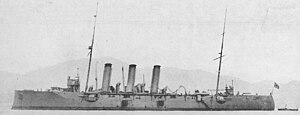 "Niitaka" in 1922 | |
| Project | |
| A country | |
| Main characteristics | |
| Displacement | 3420 t |
| Length | 104.1 m |
| Width | 13.44 m |
| Draft | 4.92 m |
| Reservation | deck: 37–63 mm conning tower: 102 mm |
| Engines | 2 vertical triple expansion steam engines 16 boilers Nikloss |
| Power | 9500 h.p. |
| Mover | 2 |
| Speed | 20 knots maximum |
| Sailing range | 4,000 miles 600 tons of coal |
| Crew | 287-320 people |
| Armament | |
| Artillery | 6 × 1 152 mm 10 × 1 76 mm 4 × 1 47 mm |

Ordered in 1897 under the Second Extraordinary Fleet Replenishment Program of 1896 due to the indemnity received after the Sino-Japanese War . They became the second type of cruisers designed and built in Japan (the unsuccessful experience in building cruisers of the Suma type forced them to temporarily abandon the construction of large ships in domestic shipyards). The lead ship of the series, the cruiser Niitaka, was built in two years by the Marine Arsenal in Yokosuka , which already had experience building large ships. The second ship, the Tsushima cruiser, was built at the new shipyard of the Marine Arsenal in Kura , so its construction was delayed and took 28 months.
Intended for reconnaissance and guard service.
The design did not differ much from the Suma cruiser, but they had a large displacement , which increased seaworthiness , and more powerful weapons (152 mm guns instead of 120 mm). 152 mm guns, to increase stability , were installed in the sponsons on the sides low to the water, as a result, in fresh weather, they were heavily flooded with waves. Mine artillery is located in the central part of the hull, the installation of military mars was not provided. According to the experience of the Spanish-American war , which showed a high explosive hazard of torpedo weapons, it was decided to abandon the installation of torpedo tubes .
The main drawback was the installed unsuccessful Nikloss system boilers. They were more perfect than locomotive boilers on the Suma, but their higher accident rate forced the construction of the Otova cruiser according to the amended design.
The relatively successful project ensured that the ships were in service for more than twenty years.
Representatives
| Title | Bookmark | Launching | Commissioning | Fate |
|---|---|---|---|---|
| Niitaka 新 高 | January 7, 1902 | November 15, 1902 | January 27, 1904 | 2nd class coastal defense ship from 1.09. 1921 . He died in a typhoon on August 26, 1922 off the coast of Kamchatka. |
| Tsushima 対 馬 | October 1, 1901 | December 15, 1902 | February 14, 1904 | 2nd class coastal defense ship from 1.09. 1921 . Excluded from the fleet lists on 04/01/1939. Sunk as a target in 1944 |
Literature
- Nenakhov Yu. Yu. Encyclopedia of the Cruisers 1860-1910. - M .: AST; Minsk: Harvest, 2006 .-- 464 p. ISBN 5-17-030194-4 (AST); ISBN 985-13-4080-4 (Harvest)
- Katorin Yu.F. Cruisers. Part 1. - St. Petersburg: Galeia Print, 2008 .-- 128 p. ISBN 978-5-8172-0126-0
- Conway's All The World's Fighting Ships 1860-1905 / E. Gardiner, R. Chesnau, EM Kolesnik. - London: Conway Maritime Press, 1979.- 448 p. - ISBN 0-85177-133-5 .