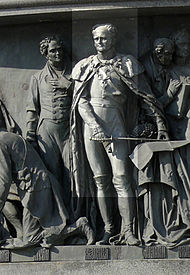
Ministerial reform is one of the reforms of public administration of the Russian Empire , carried out at the beginning of the XIX century under Emperor Alexander I. The first stage of the reform occurred in 1802-1803, the second stage was carried out in 1810-1811. As a result of the reform, the ministries replaced the archaic colleges .
Content
Background
The offensive of the nineteenth century brought public administration reforms to Russia: upon accession to the throne, the young emperor Alexander I created the State Council (“The Permanent Council ”), active work was underway on new laws, but a new management system was needed that could quickly solve many growing problems of public policy . September 8, 1802, Alexander I signed the manifesto " On the establishment of ministries ." Even then, the emperor reformer emphasized that “ we expect them to be loyal, active and zealous for the good of all ... ” [1] .
The origins of ministerial reform
The first transformative experiences
The first transformative experiments were associated with the initial period of the reign of Emperor Alexander I , whose accession to the throne was enthusiastically received by Russian society.
The new government hastened to immediately declare the direction in which it intended to act. In a manifesto on March 12, 1801, the emperor assumed the obligation to rule the people " according to the laws and to the heart of his wise grandmother ." In the decrees, as well as in private conversations, the emperor expressed the basic rule by which he will be guided: actively place strict law in place of personal arbitrariness. The emperor has repeatedly pointed out the main flaw with which the Russian state order suffered. He called this flaw "the arbitrariness of our rule ." To eliminate it, it was necessary to develop fundamental laws, which almost did not exist in Russia. It was in this direction that the transformative experiments of the first years were conducted.
From the first days of the new reign of the emperor, people surrounded by whom he urged to help him in the conversion work. These were former members of the grand-ducal circle: Count P. A. Stroganov , Count V. P. Kochubey , Prince A. Chartorysky and N. N. Novosiltsev . These people made up the so-called “ Secret Committee ”, which gathered in the secluded room of the emperor during 1801 - 1803 and worked out a plan of necessary transformations with it. The task of this committee was to help the emperor " in a systematic work on the reform of the shapeless empire management building ." It was supposed to preliminarily study the current situation of the empire, then to transform certain parts of the administration and complete these separate reforms with “the code established on the basis of the true national spirit ”. The “secret committee”, which functioned until November 9, 1803 , for two and a half years considered the implementation of the Senate and Ministerial reforms, the activities of the “ Permanent Council ”, the peasant question, the coronation projects of 1801 and a number of foreign policy events.
Started with central management. The Council at the Supreme Court , assembled at the personal discretion of Empress Catherine on March 30 ( April 11 ), 1801, was replaced by a permanent institution, called the “ Permanent Council ”, for the consideration and discussion of state affairs and decisions. It consisted of 12 high dignitaries without division into departments.
After a year and a half, the Peter's colleges were transformed, already under Catherine, having lost their original character. Then a personal decree was issued on the rights and obligations of the Senate .
Along with administrative reforms, public relations were also affected. It also sharply stated the direction in which it was supposed to act. This direction consisted in the equation of all social conditions before the law. Thus, the new central departments and ministries were the sole institutions, and the provincial institutions led by them maintained the former collegial system.
Preparation and development of ministerial reform
The discussion of the ministerial reform was devoted to 9 meetings of the Secret Committee (8 meetings from February 10 to May 12, 1802 and one meeting on March 16, 1803). The ministerial reform had both supporters (V.P. Kochubey, N.N. Novosiltsev, A. Chartorysky, P.A. Stroganov, etc.) and opponents (D.P. Troshchinsky, S.P. Rumyantsev, P. V. Zavadovsky and others).
The foundation for the establishment of a ministerial system of government in Russia was laid on September 8, 1802, with the manifesto on the establishment of ministries . With this document, the colleges were transformed into eight ministries - foreign affairs, military ground forces, naval forces, internal affairs, finance, justice, commerce and public education.
In addition to the eight new ministries, the Manifesto determined the position of two other public administration institutions that existed before - the “departments” of the State Treasurer and the Expedition on State Revenues. They continued to act “until the publication of the complete Charter for this part”, based on the Decree of October 24, 1780 . According to this decree, the Expedition on State Revenues was subordinate to the person performing the position of State Treasurer. Thus, the status of the State Treasury was confirmed as another, along with eight ministries, the central government administration institution.
According to the Manifesto of September 8, 1802, the former colleges and their subordinate places were reassigned to ministries or entered into them as departments; the main difference between the new central government bodies was the one-man management: each department was governed by a minister instead of the former collegial presence ; ministers were responsible to the Senate . Each subordinate body presented its minister with weekly memorials of current affairs and representations in special cases. The minister answered them with suggestions. In case of disagreement with the Minister’s proposals, the subordinate bodies presented reasoning to the Minister. If the latter insisted on his proposal, then it was executed, and the opinion of subordinate bodies was recorded in the journal.
Thus, the combination of two public administration systems — college and ministerial — was carried out, which was the result of a compromise decision made by Alexander I at a meeting of the Secret Committee on March 24, 1802 . In accordance with this decision, the collegiums were not abolished, but continued to act in subordination to the ministers and were subject to gradual abolition in the future, when experience shows their futility. To assist the ministers (except for the ministers of the military ground forces, naval forces, commerce and the State Treasurer), deputy deputies were appointed - comrades of ministers who could replace the latter during their absence. Ministers pledged to immediately engage in the formation of their offices and the compilation of their staffs.
The Manifesto’s last sentence briefly mentions a committee "composed solely" of ministers considering current affairs. Thus, an important government body was created - the Committee of Ministers , which had a significant impact not only on the ministerial system, but also on the entire system of state power of the Russian Empire .
Speransky Conversion Plan
In the first years of the reign of Alexander I, M. M. Speransky still remained in the background, although he prepared some documents and projects for members of the “ Secret Committee ”, including on ministerial reform. A week after the accession of Alexander I to the throne, Speransky was appointed Secretary of State under D.P. Troshchinsky, who, in turn, performed the work of the Secretary of State under Alexander I. Thus, Speransky was in the circle of people who largely determined the state’s policy . The abilities of the assistant Troshchinsky attracted the attention of members of the “Secret Committee”. In the summer of 1801, V. P. Kochubey took Speransky to his "team." At that time, work was under way in the Secret Committee on the development of ministerial reform.
After the reform, Kochubey, who headed the Ministry of the Interior, transferred him to his office. In June 1802, Speransky headed the department at the Ministry of the Interior, which was instructed to prepare draft state reforms.
In 1802-1804, Speransky prepared several of his own political notes: “On the fundamental laws of the state”, “On the gradual improvement of public opinion”, “On the power of public opinion”, “Something else about freedom and slavery”. In these documents, he first stated his views on the state of the Russian state apparatus and substantiated the need for reforms in the country.
February 20, 1803 with the direct participation of Speransky published the famous decree "on free (free) cultivators." According to this decree, the landowners received the right to release the serfs into "freedom", giving them land. Inspired by the “notes” of the young leader, the tsar, through V.P. Kochubey, instructs Speransky to write a capital treatise - a plan for transforming the state machine of the empire, and he enthusiastically devotes himself to a new job.
In 1803, on behalf of the emperor, Speransky compiled a “Note on the structure of judicial and governmental institutions in Russia”, in which he proved himself to be a supporter of the constitutional monarchy , created by the gradual reform of society on the basis of a carefully developed plan. However, this Note did not have practical value. Only in 1807 , after unsuccessful wars with France and the signing of the Tilsit Peace , in the context of the domestic political crisis, did Alexander again turn to reform plans.
Speransky was essentially a zealous and diligent official, independent by virtue of his descent from one or another group of high-ranking aristocracy. He was to develop and implement a reform plan based on the ideas and principles prompted by the emperor.
Speransky did not immediately receive his new role. At first, the emperor entrusted him with some "private affairs." Already in 1807, Speransky was invited several times to dinner at the court, this fall, he accompanied Alexander to Vitebsk , for a military review, and a year later, to Erfurt , to a meeting with Napoleon . It was already a sign of high confidence. In Erfurt, Speransky, who was fluent in French, became close to representatives of the French administration, looked closely at them, and learned a lot from them. Upon returning to Russia, Speransky was appointed a fellow of the Minister of Justice and, together with the emperor, began working on a general plan of state reforms.
The most complete reformist views of M. M. Speransky were reflected in a note in 1809 - "Introduction to the enactment of state laws." The reformer attached great importance to the regulatory role of the state in the development of domestic industry and, through its political transformations, strengthened the autocracy in every way. Speransky writes: "If the rights of state power were unlimited, if the state forces were united in sovereign power and they did not leave any rights to subjects, then the state would be in slavery and the government would be despotic."
The reform plan drawn up by Speransky was, as it were, an exposition of the thoughts, ideas and intentions of the sovereign himself. As the contemporary researcher of this problem, S. V. Mironenko , correctly notes, “independently, without the tsar’s sanction and approval, Speransky would never have decided to propose measures that would be extremely radical in the conditions of then-Russia.”
Final Stage of Ministerial Reform
Central Management Unit Speransky
On March 28, 1806, Minister of the Interior V.P. Kochubey submitted to Alexander I a “Note on the Establishment of Ministries”. It noted a " perfect confusion " in public administration, which " reached the highest degree " after the ministerial reform of 1802 . The Minister proposed the following corrective measures:
- the selection of like-minded ministers;
- determining the attitude of ministries to the Senate, the Committee of Ministers, the Permanent Council, the provincial administration;
- regulation of relations between ministries;
- empowering ministers to resolve substantive cases;
- definition of ministerial responsibility.
The foreign political events of 1805-1808 (the war with France as part of the third coalition in 1805 and the fourth coalition in 1806-1807 , the Russian-French negotiations in Tilsit in June 1807 and in Erfurt in October 1808) diverted Alexander I's attention from affairs of internal management. But it was precisely at this time that M.M. Speransky , the true author of the report of July 18, 1803 and the note of March 28, 1806, began to take an increasingly active part in the implementation of the ministerial reform.
Legislative Reform
Since the end of 1808, M. M. Speransky became the closest associate of Alexander I, who, with the sanction of the latter, was engaged in “ subjects of higher governance ”. By October 1809, the shortcomings of the ministerial reform were systematized by M. M. Speransky in his “ Introduction to the Enforcement of State Laws ” - an extensive plan of reforms of the entire domestic political structure of the country, drawn up on behalf of Alexander I.
In this project, Speransky identifies three main disadvantages of ministerial reform:
- lack of responsibility of ministers;
- some inaccuracy and disproportion in the division of affairs between the ministries;
- lack of precise rules or institutions [2] .
A new transformation of the ministries of 1810-1811 was aimed at eliminating these shortcomings. Ministerial reform has entered its final period. Its beginning was already proclaimed in the Manifesto “On the Establishment of the State Council”: “The various units entrusted to the Ministries require different additions. At the initial establishment, it was supposed, gradually and considering their very action, to bring these establishments to perfection. Experience has shown the need to complete their most convenient division. We will propose to the Council the beginnings of their final arrangement and the main foundations of the General Ministerial Order, which accurately defines the relations of the Ministers to other State Establishments and their limits of action and the degree of their responsibility will be indicated . ”
The legal basis for the final period of the ministerial reform was three legislative acts:
- The manifesto " On the division of state affairs into special departments, with the designation of objects belonging to each department " of July 25, 1810 ,
- “The Highest Approved Division of State Affairs into Ministries ” of August 17, 1810, and
- " General institution of the ministries " of June 25, 1811 .
These acts were previously discussed in a specially created committee for consideration of proposals to transform ministries, the Senate and the new recruitment procedure for the Committee of Chairmen of Departments of the State Council, which operated from May 27, 1810 to November 28, 1811 . Further, the projects were approved at a general meeting of the State Council and submitted to the emperor for approval. The projects of all three acts were developed by M. M. Speransky [3] .
The manifesto of July 25, 1810 divided all state affairs “ in executive order ” into five main parts:
- foreign relations under the jurisdiction of the Ministry of Foreign Affairs;
- external security device, which was entrusted to the military and naval ministries;
- state economy, which was in charge of the ministries of internal affairs, education, finance, the State Treasurer, the audit of state accounts, the Main Directorate of Railways;
- the arrangement of the civil and criminal court, which was entrusted to the Ministry of Justice;
- internal security device, which came under the competence of the Ministry of Police.
The manifesto proclaimed the creation of new central government bodies - the Ministry of Police and the General Directorate of Spiritual Affairs of various confessions [2] .
The competence of the Ministry of the Interior has changed significantly: its main subject has become " care for the dissemination and promotion of agriculture and industry ." All cases related to the “ precautionary ” and “ executive ” police were transferred to the Ministry of Police. The title of State Comptroller was established - the head of the audit of state accounts.
Details and controversial issues arising from the direct distribution of cases were discussed in the Committee of Ministers at a meeting on August 4, 1810 . The reports of the ministers of foreign affairs, finance, public education, justice, as well as the comrade of the Minister of the Interior were heard. The result of this discussion was the "Highest Approved Separation of State Affairs into Ministries" of August 17, 1810 . This act specified the composition of the ministries of internal affairs, the police, public education, finance, the General Directorate of Spiritual Affairs of Foreign Confessions, and also recorded the liquidation of the Ministry of Commerce.
The Manifesto of January 28, 1811 became a continuation of concretization in the field of public administration. “On the structure of the General Directorate for the Audit of State Accounts.”
The "General Establishment of Ministries" of June 25, 1811 became the main legislative act of the ministerial reform. Structurally, it consisted of two parts:
- “Education of Ministries”;
- "General mandate to ministries."
The manifesto determined the general division of state affairs and subjects of each ministry and the main administration, largely repeating textually the provisions of the manifesto on July 25, 1810 . He established a single overall organizational structure of the central governing bodies. The ministry was headed by the minister and his comrade (deputy). Under the minister were the office and council of the minister. The apparatus of the ministry consisted of several departments, divided into departments, which, in turn, were divided into tables. The rigid principle of unity of command was established. The minister obeyed the emperor, being appointed and deposed of his choice. Directly subordinate to the Minister of Directors of Departments and Chancellery. The directors of the departments were subordinate to the heads of departments. The heads of the departments were subordinate to the heads of the capitals.
Thus, in 1810 - 1812, the legal foundations were laid and an industry-wide management system was created in the country. The further development of the ministries was already built taking into account the managerial needs of the state. Changes in the composition of ministries in the first half of the 19th century were associated with the search for the most rational system of central administration of the empire.
All the parts of Speransky’s transformational plan that were implemented belong to the central administration, and it was their implementation that informed the latter of a more harmonious appearance. This was the second, more decisive approach to the establishment of a new state order, which was preceded by two private measures that had an internal connection with the forthcoming reforms, as they set the spirit and direction of this reform, indicating what kind of people are required for new government institutions. April 3, 1809 was issued "Decree on the court ranks." This document changed the position of the nobles who wore the ranks of chamberlain and junk chamber , who did not combine with certain and permanent official duties, but provided important advantages. The decree ordered everyone who wore these ranks, but were not in any service, to enter such a service within two months, stating which department they wished to serve in. Themselves these ranks henceforth became a simple distinction, not connected with any official rights.
Указ 6 августа того же года установил порядок производства в гражданские чины коллежского асессора (8-й класс) и статского советника (5-й класс). Эти чины, которыми в значительной степени обусловливалось назначение на должности, приобретались не только заслугой, но и простой выслугой, то есть установленным сроком службы. Новый указ запретил производить в эти чины служащих, которые не имели свидетельства об окончании курса в одном из российских университетов или не выдержали в университете экзамена по установленной программе, которая и была приложена к указу. По этой программе от желавшего получить чин коллежского асессора или статского советника требовалось знание русского языка и одного из иностранных, знание прав естественного, римского и гражданского, государственной экономии и уголовных законов, основательное знакомство с отечественной историей и элементарные сведения в истории всеобщей, в статистике Русского государства, в географии, даже в математике и физике.
1 января 1810 года открыт был преобразованный Государственный совет . Значение его в системе управления было выражено в Манифесте 1 января определением, что в нём « все части управления в их главном отношении к законодательству сообразуются и чрез него восходят к верховной власти ». Это значит, что Государственный совет был призван обсуждать все стороны государственного устройства, решать, насколько они нуждаются в новых законах, и представлять свои соображения на усмотрение верховной власти.
Memory
- Банк России отметил юбилей реформы выпуском памятной монеты « 200-летие образования российских министерств »
Notes
- ↑ Predtechensky A.V. Essays on the socio-political history of Russia in the first quarter of the 19th century. - M.-L., 1957.
- ↑ 1 2 Klyuchevsky V. O. Selected lectures on the Course of Russian History. - Rostov-on-Don, 2002.
- ↑ Prikhodko M. A. Preparation and development of ministerial reform in Russia (February - September 1802). - M., 2002.