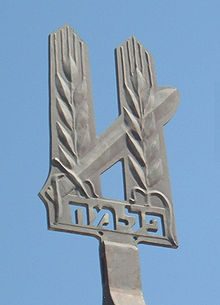
Palmah ( Hebrew פַּלְמַ"ח , acronym for פְּלוּגּוֹת-מַחַץ, Plowot Mahatz — shock companies), special units of the Haganah , later part of the Israel Defense Forces . Spelling variant - Palm . Created in coordination with the authorities of the British Mandate in Palestine . It existed from May 15, 1941 to November 7, 1948 .
By the beginning of the War of Independence in 1948, it consisted of three combat brigades and a number of auxiliary air, sea and reconnaissance units. Its commanders formed the backbone of the Israel Defense Forces and its supreme command. Palm trees made a significant contribution to Israeli culture. For many years, members of the Palmach have occupied a prominent place in Israeli politics, literature, and art.
Content
- 1 Creation
- 1.1 Formation
- 1.2 Ideology
- 2 Participation in joint hostilities (1941-1943)
- 3 Termination of cooperation with the British
- 4 Development and strengthening
- 5 Resistance to the British authorities
- 5.1 The most famous Palmach operations
- 6 Participation in the operation "Season"
- 7 Participation in the War of Independence (1948)
- 8 Disbandment
- 9 Anthem of the Palmach
- 10 notes
- 11 Links
Creation
Formation
After the outbreak of World War II, the joint command of the Haganah decided to create shock detachments, which would become a reserve, at any moment ready for military action. The palm tree was created on May 15, 1941 in agreement with the British command, as a regular formation of the Haganah as part of the preparations for the possible invasion of Yishuv by Germany. Unlike the British authorities in Palestine, who were distrustful of the Jews, the British Special Operations Office collaborated with Hagana. The threat of German invasion of Palestine became quite real during the days of Rommel's first offensive in Libya . Palm trees were intended to conduct a guerrilla war behind the rear of German troops, to assist the Allies in planned invasions of Syria and Lebanon.
Initially, 6 units were formed. British experts trained Palmach fighters in the use of small arms and the use of explosives. The British allowed the creation of two bases - next to the kibbutz Ginosar near Lake Kineret and near the kibbutz Beit Oren on Mount Carmel . These camps lacked the most basic amenities, there were no tents, no kitchens, and the young soldiers slept right on the ground.
As a result, the Palms were financed by the British, who believed that its number was 500 people. In fact, since the fighters were given only pocket money, the command of Palmach managed to recruit about one and a half thousand volunteers into the organization.
The command of Palmach organized the " Paliam " (short for Plugot Yam - Marine units), which trained divers, demolitionists, paratroopers and sailors. Under the guise of an aero club, the Palavir , which was the forerunner of the future Israeli air forces, was created with sports planes and gliders.
Ideology
With these weapons, handed to me by Hagana in the land of Israel, I will fight for my country against the enemies of my people, not giving up and not retreating, with complete dedication.
- (From the oath of a Palmach fighter)
The Palmists were created by the Zionist socialists . They took care of the political education of Palmach. Accordingly, they appointed his commanders and "political officers". The palm tree was brought up in the spirit of ideological discipline and was considered as a fighting detachment of socialist Zionism. He was ready to act both against the Arabs and the British, and against the "rebellious" of Ezel and Lehi . It is no coincidence that Palm was the shock force of the "Season" .
Palmahnikov was brought up in a selfless faith in Stalin and Soviet Russia, in admiration for the Red Army. PALMAH was to become a party militia, ready to do a lot (if not all!) According to the party, and it was to become the basis of the emerging army of the emerging state. It was projected that this army would also be party and class. - - Love for the USSR was not completely disinterested. True, the left Zionists did not receive money from the Soviet Union, but they could use the authority of his “successes” for their own purposes and shine with the reflected light of his labor and military victories. The "reflection" of the victorious and proletarian Red Army was PALMAH. -
- Ben-Gurion stopped this process, having dismissed the PALMAX, which he has not been forgiven until now.
- Uri Milstein. “Rabin: the birth of myth”
Participation in joint hostilities (1941-1943)
One of the first operations of Palmach was the sending in May 1941 of 23 fighters to the coast of Lebanon , in order to carry out sabotage at oil refineries in the Lebanese city of Tripoli . The participants in the operation went missing, and their fate is unknown to this day.
As a result of the defeat of Turkey in World War I, Syria and Lebanon came under the rule of the French mandate, similar to the British mandate over Palestine. In 1940, after the defeat of France in World War II, the governments of Syria and Lebanon remained faithful to the French government of Vichy , who collaborated with the German occupiers. Italy and Germany set about creating military bases in Syria and Lebanon that threatened British rule in the region. In response to this, in June 1941, the forces of Britain and the “ Fighting France ”, with the participation of Palmach, invaded the territory of Syria and Lebanon. After short exercises, two detachments were sent to the rear of the enemy for sabotage: the destruction of the main bridges, damage to telephone lines and the seizure of strategic objects. Palmach fighters penetrated the deep Syrian rear and laid mines near concentration camps and other objects. Together with parts of the Allied countries , 40 members of the Palmach, acting as sappers and guides, participated in the invasion of Syria. During one such operation in Syria, Moshe Dayan was injured and lost his left eye.
In 1942-1943, special parts of the Palmach were finally formed: the German Brigade , the Balkan Brigade , and the Arab Brigade . The "German Brigade" was created to resist the Nazis in the event of their invasion of Palestine. The goal of the Balkan Brigade was to work in the Balkan countries, in particular, to support local youth anti-fascist movements. The functions of the "Arab Brigade" included collecting intelligence information in Syria, Lebanon and among the Arab population of Palestine and transmitting data to Hagan and the British authorities.
In the summer of 1942, Yishuv leaders turned to the British with a proposal to organize training in the British military camps of Jewish paratroopers - men and women - in order to then throw them into enemy territory. The tasks of such agents were supposed to include assistance to the Jewish underground, the organization of acts of sabotage against the Nazis and the transfer of intelligence to the hands of allied countries. The British taught a group of volunteers from the ranks of Palmach. 32 boys and girls were abandoned in Romania, Yugoslavia, Hungary, Slovakia and Italy. 12 paratroopers fell into the hands of the Nazis or their accomplices. Seven of them were executed. Among the dead were two of the three paratroopers who served in the unit. The remaining paratroopers safely returned from the combat mission.
Termination of Cooperation with the British
The British considered their alliance with the Palm temporary. Palm trees sought to maintain independence and subordinated exclusively to Hagan. In May 1943, after the second battle of El Alamein, the British began to demand the dissolution of Palmach. They liquidated training camps and confiscated the weapons that had once been delivered to Hagan. A few days later, Palmach fighters sneaked into the British arsenal at night and carried away all the selected weapons. Collaboration with the British was put to an end. The organization went underground.
Development and Strengthening
As funding from the British was discontinued, Palms faced serious difficulties. Yitzhak Tabenkin , one of the leaders of the kibbutz movement, offered Palmach work in kibbutzim. Each kibbutz will take over the maintenance of the Palmach platoon, and the fighters guarantee the fulfillment of all necessary agricultural work. Then it was decided that each soldier would have 14 working days a month, 8 days of study and training in combat training, and 7 days off for rest.
Combining military training with agricultural work provided the following benefits:
- An independent, easily mobilized group of troops was maintained.
- Agricultural work provided 80% of the budget of Palmach.
- Funding from Hagana was used for armament and military training of personnel.
- Difficulties in finding a group of troops by the British.
- The recruitment of kibbutzim and moshavim residents into the ranks of Palmach was simplified.
- Groups were created that could become the basis for future settlements.
- The curriculum combined military training, training in the basics of farming, and training fighters in the spirit of Zionist values.
It was later agreed with the Zionist youth movements that each young person would undergo such training. This allowed Palm to sharply increase the number of members of the organization. So, by the beginning of 1948, Palmach totaled 3,000 trained fighters.
Initial training of a fighter included physical training, the study of small arms, day and night shooting, martial arts, the basics of naval affairs, rowing, swimming, orientation and topography, first aid in the field. The fighters were taught the skills of action as part of small combat groups. Further, there was a specialization in reconnaissance, sabotage and sabotage, in the use of explosives, radio communications, and firing from 2- and 3-inch mortars. The training included mandatory multi-kilometer marching throws in combination with live shooting, exercises supported by light artillery, machine guns and mortars.
Palm trees paid special attention to the training of field commanders - independent, with a broad outlook, who would be able to take the initiative and set an example for their fighters. The main courses were at Palm and the Hagana commanders also studied at them. Many of these field commanders later became the basis of the Israeli Defense Forces command.
Resistance to the British authorities
Between 1945 and 1946, Palms joined Yishuv’s active resistance to the British Mandatory authorities. Acts of sabotage were committed at enterprises, attacks on infrastructure (bridges, railway stations), on radar stations and police stations.
Palm's most famous operations
- October 9, 1945 - The release of 210 illegal immigrant prisoners from the prison camp in Atlite and their transfer to the kibbutz Yagur.
- November 1, 1945 - Blasting of the railway on 153 sections of the road, capture and hijacking of three patrol boats ( Haifa , Jaffa ).
- November 25, 1945 - Attack on a British police station in Givat Olga ( Hadera ).
- January 20, 1946 - Blasting a radar station on Mount Carmel .
- June 16, 1946 - The demolition of 11 railway and road bridges.
On July 26, 1946, the British authorities conducted an operation to detain members of the resistance, known as Black Saturday . It was attended by over 17,000 soldiers and police officers. About 2700 people from various military organizations of Yishuv were detained, including a number of commanders and fighters of Palmach. Active resistance had to be temporarily stopped.
Participation in Operation Season
In early 1945, the Yishuv leadership took a series of actions against the radical Jewish underground organizations of the Zionist revisionists Ezel (Irgun) and Lehi .
With the help of the Hagana intelligence service, Shai , lists of suspects were compiled; the lists were handed over to the authorities, in addition, Hagan, and in particular her strike detachments, Palms, abducted the fighters Irgun and Lehi and either handed them over to the British or kept them in hastily equipped prisons in kibbutzim. The practice of abductions caused widespread condemnation in Jewish society; it was sharply condemned in a statement by the Chief Rabbinate.
Arrested by the British were mainly deported to camps in Eritrea. In addition to those who were arrested, many people were fired from their jobs and expelled from educational institutions. One way or another, by March 1945, the combat activities of the revisionists were paralyzed.
Some Palmach officers (among them the future Foreign Minister Yigal Alon ) refused to participate in such an operation. The operation was discontinued after such disobedience threatened to become widespread.
In May 1945, Irgun resumed the struggle against the British, and in October of the same year the Hagana joined it, forming the United Resistance with Irgun and Lehi.
Participation in the War of Independence (1948)
By the beginning of the War of Independence, Palm consisted of three brigades - Iftah , Harel and Negev . In its ranks, there were 3,100 people, including 1,000 reservists. These were the most trained fighters of Hagana. They took part in almost all the important battles of the War of Independence. Especially the Palmach brigades excelled in Operation Iftah , as a result of which the Upper Galilee and Safed were liberated, the offensive of the Syrian and Lebanese forces was repelled. Subsequently, the Iftah brigade fought along with the Negev brigade on the southern front. The Harel team took the main blow in the operation of the same name to establish and expand the Jerusalem corridor, participated in the hostilities in Jerusalem, and later in the liberation of the Negev and the occupation of North Sinai.
Disbandment
Despite the fierce resistance of the leadership of Palmach, David Ben-Gurion , then the Prime Minister and Minister of Defense of the Provisional Government, considered it necessary to disband this organization. Before that, Irgun tsvai leummi and Lehi were also dissolved. These groups could potentially lead to a split, and Ben-Gurion strove for national unity and the creation of a single army. The commitment of the command staff of Palmach to left-wing socialist ideology with the resulting loyalty of the MAPAM party did not correspond to the concept of a non-party army.
On November 7, 1948, the headquarters of the Palmach was disbanded, and the Palm completely merged with the IDF .
Palm Anthem
Poems of the anthem of the Palmach “Misaviv yechom ha-saap” (Thunderstorm rustles around) was written by Zrubavel Gilad in 1942 . The anthem was first published in the Be-Maale newspaper in June 1943, and later in the Palmach bulletin ( Hebrew עלון הפלמ"ח ) [1] . First, the anthem was sung on a song tune Along the valleys and on the hills [ 2] , and later David Zahavi wrote the original melody for the anthem [1] .
Notes
- ↑ 1 2 המנון הפלמ"ח לחן זהבי (Anthem of Palmach, music by David Zahavi) (Hebrew) זמרשת (website Zameretet) - performance and story of the creation of the anthem of Palmach. Date of access October 31, 2015.
- ↑ "המנון הפלמ"ח לחן" הלוך הלכה החבריא (Anthem of the Palmach, tune of the song "Friends hit the road") (Hebrew) . זמרשת (site Freezes). - original tune - song "Through the valleys and along the hills." October 2015.
Links
- Palmach - an article from the Electronic Jewish Encyclopedia
- Uri Milstein. "Rabin - the birth of myth"
- Yigal Alon and Palm Trees
- Palmach Museum
- Paljama Museum