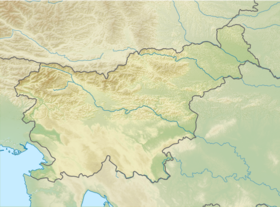
Tserknitsa ( Slovenian. Cerkniško jezero ) is a lake in Slovenia , located on the Karst plateau, in the territory of the Tserknitsa community of the region of Notranska Kraška . It is known for its pulsating regime - the karst field is periodically filled with water, which “merges” through karst funnels in spring or early summer. Around the lake there are several settlements (especially from the north and east), the largest of which is the city of Tserknitsa with 3 thousand inhabitants. About 10 km west of the lake is the city of Postojna , famous for the karst cave of Postojnska Jama .
| Lake | |
| Church girl | |
|---|---|
| Slovene. Cerkniško jezero | |
 | |
| Morphometry | |
| Absolute height | 546-553 m |
| Dimensions | 10 × 5 km |
| Area | 30 km² |
| Swimming pool | |
| Flowing river | Ljubljana |
| Location | |
| A country |
|
| Regia | Notranska Crashka |
| Community | Church girl |


Content
- 1 Hydrology
- 2 Flora and fauna
- 3 History
- 4 notes
- 5 Links
Hydrology
A lake is filled when water from an aquifer and underground streams rises and pours out through karst holes located on the field. A subsequent decrease in rainfall and groundwater influx causes water to flow into Karst caves, abundant in stalactites and stalagmites . At different periods of the annual cycle, depending on the weather in the region, the lake basin can be almost completely dry and completely full. In early summer, as a rule, there is not much open water in the reservoir. In August, peasants mow grassy meadows at the former bottom of the lake and use grass as livestock feed. In autumn, the field is filled with rainwater, especially from the south-western side, and in spring it is replenished with meltwater. In historical times, the lake has never spilled into the northeastern part of the field, whose land is very fertile, which differs from other areas of the karst plateau. [one]
The height of the water level in the lake changes by 7 m (from 546 to 553 m above sea level). With high water, the lake has a size of 10x5 km and an area of 30 km², which makes it the largest lake in the country during these periods (the largest permanent lake is Bohinjsko ). Part of the water flowing from the lake comes to the surface in the form of the sources of the Ljubljana river. [2]
Flora and Fauna
On Lake Tsercnitsa there are large thickets of reeds and sedges , as well as extensive wet meadows . In the eastern part there are remains of a swamp .
The human impact on the representatives of the fauna of the lake is small. Fish is found in the Church, and it is also an important nesting site for many bird species, including the endangered coronet . In total, 230 bird species were recorded in the lake area, including a white-eyed dive and a white-tailed eagle . [3]
History
The lake was already known in antiquity ; the ancient Greek geographer Strabo wrote about it. In his work “Geography” (7.5), he mentions “ marches called Lugeon” ( Greek helos Lougeon kaloumenon ), which were identified as Lake Tsercnitsa. [4] The name Lougeon is the translation by Strabo into Greek of the local toponym , possibly of Illyrian origin, which later became Latin as Lugeum .
The Church became world famous when the pulsating mechanism was first described by the Slovenian universal scientist Janez Valvazor (1641–1693). This description, for which he was accepted into the Royal Society of London , was included in his main work “Glory of the Duchy of Krajna” ( Slovenian. Slava vojvodine Kranjske , German: Die Ehre deß Herzogthums Crain ). [2]
The lake area is currently a popular holiday destination. Depending on the water level on the lake, you can go fishing , caving , windsurfing , swimming and ice skating.
Notes
- ↑ Cathie Carmichael The Fertility of Lake Cerknica Neopr (Link unavailable - history ) . , Social History, Vol. 19, No. 3 (Oct., 1994), pp. 305-317
- ↑ 1 2 Cerknica Lake - Lake that vanishes - slovenia.si
- ↑ Lake Cerknica - BirdLife IBA Factsheet
- ↑ Strabo, Geography - Perseus Digital Library