Marc Anthony Gordian Sempronian Roman African ( Latin Marcus Antonius Gordianus Sempronianus Romanus Africanus ), better known in Roman historiography as Gordian II , was the Roman emperor in 238.
| Marc Anthony Gordian Sempronian Roman African | |||||||
|---|---|---|---|---|---|---|---|
| lat Marcus Antonius Gordianus Sempronianus Romanus Africanus | |||||||
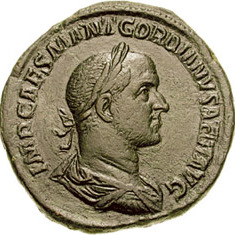 Portrait of Emperor Gordian II at the Sisters. | |||||||
| |||||||
| Together with | Gordian I | ||||||
| Predecessor | Maximin Thrace | ||||||
| Successor | Balbin and Pupien | ||||||
| Birth | circa 192 | ||||||
| Death | beginning of spring 238 Carthage | ||||||
| Father | Gordian I [1] | ||||||
| Mother | Fabia Orestilla (?) | ||||||
As a legate with his elderly father , proconsul of Africa, Gordian II was proclaimed emperor in 238 along with him as a result of an uprising of the local population against Maximin Thracian . Although Gordian II was warmly received in Carthage, he ruled for a very short time. Three weeks after the proclamation of the emperor, the emperor was killed near the borders of Carthage during an unsuccessful attempt to defend the city from military units loyal to Maximin [2] .
Content
Biography
Life before coming to power
The future emperor Mark Anthony Gordian Sempronian Roman Afrikan was born about 192 years. This date is calculated from the History of Augustus, according to which at the time of the death of Gordian II was 46 years old [3] . His father, whose family may have come from Asia Minor , made a successful career. The real name of Gordian's mother is unknown. The History of Augustus reports that her name was Fabius Orestilla and that she was the great-granddaughter of Emperor Antoninus Pius [4] , however, these data are considered fictitious by modern historians [2] . If Gordian II can be identified with that Anthony Gordian, to whom the work of Philostratus the Elder “The Life of the Sophists” is dedicated, then his mother was supposedly the granddaughter of the famous sophist and politician of the 2nd century Herod Attica . Little is known of reliable information about the life of Gordian II and his career before the uprising in Africa, which elevated him to the throne. The source providing the most complete information is the biography of the three Gordians in the History of Augustus, which is filled with various unreliable facts, because of which it is necessary to separate the truth from fiction [2] .
The History of Augustus claims that Gordian II was the pupil of the son of the famous writer of the Northern Dynasty, Seren Sammonic , who bore the same name (modern historians consider this data not trustworthy), which left him a library of 62 thousand scrolls. The career of Gordian presented in the same work - the questor under Heliogabal , the praetor and consul-suffix under Alexander North, may have been indicated correctly, but there is no other confirmation of this message, except for one inscription from the Palestinian city of Caesarea , which confirms the fact that Gordian was on the post of consul- Suffect [5] [2] .
If Gordian II is the person to whom the work “The Life of the Sophists” is dedicated, then in this case he was obviously the commander of the IV Scythian Legion , stationed near Antioch in Syria, and the governor of Achaia . Gordian II also held the post of consul- suffice until his father arrived in Africa in 237, most likely at the very end of the reign of Alexander Severus or during the reign of Maximin Thracian. In 237, he became a legate of Africa under Gordian the Elder [6] . Although it was unusual that the former consul served as a legate with the governor, at that time the sons of the governors were often at some posts with their fathers. In this particular case, Gordian I, who was almost 80 years old, was very profitable and convenient to have a consular son as an assistant [2] .
Appearance and personal qualities
The most complete description of Gordian II was left by the author of his biography in The History of Augustus :
“In the sciences, Gordian showed great promise, he stood out for his appearance. He possessed exceptional memory, was distinguished by remarkable kindness: when one of the boys was slaughtered at school, he could not help but cry ” [7] .
“He was extremely greedy for fruits and vegetables, but in general - very moderate in food; he constantly consumed some fresh fruit. He really liked cold drink, in the summer he readily drank only cold and, moreover, in large quantities. He was distinguished by a large physique and therefore preferred a cold one ” [8] .
On a few coins, Gordian II is represented completely bald and much more complete than his father [9] .
Board and death
At the beginning of 235, Alexander Sever died at the hands of rebel soldiers in Mogontziac in Lower Germany . As a result, Maximinus the Thracian became emperor [10] . Faced with the local elite that killed the procurator Maximin, Gordian I was forced to take part in a full-scale rebellion against Maximin and was proclaimed emperor [11] .
It is not known for sure whether Gordian II was in Tisdra (modern El Jem , Tunisia ) in late winter or early spring of 238 on the day when the procurator Maximinus of Thrace was killed and Gordian I was proclaimed emperor. In the biography of Maximin and his son, The History of Augustus tells us that Gordian II was publicly declared emperor with his father in Tisdra before both princesps went to Carthage [12] . However, the biography of the three Gordians claims that Gordian II became emperor a few days later already in Carthage [13] . One fragmentedly preserved papyrus from Egypt reports that the assumption of office of Gordian II did not occur simultaneously with his father, but the interpretation of the text is presumptive [2] . The Greek historian Herodian, the author of contemporary events, does not mention Gordian II in the description of the events in Tisdra at the beginning of the uprising, but he also indicates that when the news of the uprising reached Rome a few days later, the father and son were already declared together by the emperors as the Senate [14] . Together with imperial dignity, Gordian, like his father, received the title African [15] [2] .
Despite the enthusiastic support of the inhabitants of Carthage and the success in Rome, which welcomed the news of the uprising, Gordian II and his father faced a serious danger that threatened their power. Capellian, governor of the neighboring province of Numidia , was the personal enemy of Gordian I [16] and at his disposal was a large number of troops. Upon learning of the proclamation of the Gordians as emperors, Capellian gathered together all his soldiers, confirming allegiance to Maximinus, and advanced to Carthage [17] . Gordian II was appointed commander of the forces of the detachment (including volunteers from among the inhabitants of Carthage), organized to defend the city. However, the Carthaginians could not resist the experienced army under the command of Capellian. Here is what Herodian tells about the battle:
“During the clash the numerical superiority was on the side of the Carthaginians, but they did not have a military order, were not trained in military affairs <...> and were deprived of weapons and military tools. Each of them grabbed from the house either a small sword, or an ax, or darts used for dog hunting; cutting the skins that were at hand and sawing logs into pieces of random shapes, each, as best he could, made covers for the body. The Numidians, on the other hand, are well-aimed lance throwers and so magnificent riders that they control the running of horses without a bridle, with just one stick. With great ease they turned the mass of the Carthaginians, who, unable to withstand their pressure, abandoning everything, took to flight. By squeezing and trampling each other, they were more ruined by their own than by their enemies ” [18] .
During the battle, Gordian II was killed. His body was never found [19] . Carthage was captured by Capellian, and Gordian I committed suicide. Both Gordian ruled for only three weeks [2] . The Numidian governor staged a real pogrom in Carthage, and plundered the province of Africa. The Gordian insurgency is a clear illustration of the fact that any rebellion is doomed to collapse if it does not rely on the support of the regular army [9] .
Gordian II was not the last representative of the descendants of his father to occupy the throne. The uprising against Maximinus of Thrace continued in Rome, led by Senate proteges Balbin and Pupien , proclaimed emperors, and the son of Gordian II’s sister Gordian III , who was proclaimed Caesar [20] . By the end of 238, Gordian III became the sole ruler of the Roman state. Gordian II will be deified on the orders of his nephew, thus receiving recognition after death, which he was not able to achieve during his lifetime [2] .
Notes
- ↑ Gordian // Brockhaus and Efron Encyclopedic Dictionary : in 86 volumes (82 volumes and 4 additional). - SPb. , 1890-1907.
- ↑ 1 2 3 4 5 6 7 8 9 Meckler, 2001 .
- ↑ Julius Capitoline . "History of Augustus." Three Gordianov. Xv. 2.
- ↑ Julius Capitoline . "History of Augustus." Three Gordianov. Xvii. four.
- ↑ Birley, 2005 , p. 341.
- ↑ Canduci, 2010 , p. 63.
- ↑ Julius Capitoline . "History of Augustus." Three Gordianov. Xviii. one.
- ↑ Julius Capitoline . "History of Augustus." Three Gordianov. XXI. 1-2.
- ↑ 1 2 Grant, 1998 .
- ↑ Potter, 2004 , p. 167.
- ↑ Southern, 2001 , p. 66.
- ↑ Julius Capitoline . "History of Augustus." Two Maksiminov. Xiv. 3.
- ↑ Julius Capitoline . "History of Augustus." Three Gordianov. IX. 6.
- ↑ Herodian . The history of imperial power after Mark. VII. 7.2.
- ↑ Herodian . The history of imperial power after Mark. VII. 4-5.
- ↑ Potter, 2004 , p. 170.
- ↑ Southern, 2001 , p. 676.
- ↑ Herodian . The history of imperial power after Mark. IX. 5-7.
- ↑ Herodian . The history of imperial power after Mark. VII. 9.7-11.
- ↑ Southern, 2001 , p. 68.
Literature
Sources
- Julius Capitoline. History of Augustus // Three Gordianov . - M .: Science, 1992.
- Herodian. The history of imperial power after Mark // Book VII.
Literature
- Grant, M. Roman Emperors. Gordian II . - 1998.
- Southern, Pat. The Roman Empire from Severus to Constantine. - London, New York: Routledge, 2001.
- Potter, David Stone. The Roman Empire at Bay, AD 180-395. - Routledge, 2004.
- Birley, Anthony. The Roman government of Britain. - Oxford University Press, 2005.
- Meckler, Michael. Gordian II (238 AD) An Online Encyclopedia of Roman Emperors (2001).
- Canduci, Alexander. Triumph & Tragedy: The Rise and Fall of Rome's Immortal Emperors. - 2010.
Links
- Coins of Gordian II . Date of treatment September 11, 2013.