
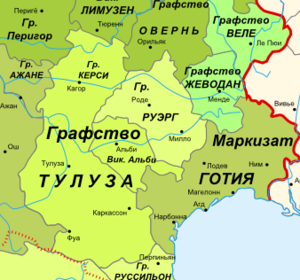
Marquis of Gothia ( French: Marquis de Gothie , lat. Gothiæ marchio ) - the title of the ruler of the Gothic brand, which was located in the historical region of Septimania in southern France, which later became part of the Languedoc . The brand included the cities of Narbonne , Agde , Beziers , Melgoy , Nimes and Uzes . The title of Marquis of Septimania ( lat. Dux Septimaniæ ) or Duke of Septimania ( lat. Dux Septimaniæ ) was often often used, Flodoard refers to this title as the princeps of Gothia lat. princeps Gothiæ or princeps Gothorum . Gradually, the name of the region of Septimania was supplanted by the name Gothia .
Content
History
The Septiman (Gothic) mark was founded by the emperor Charlemagne in 801 . In addition, a Spanish brand was formed south of the Pyrenees , consisting of a number of counties. Together, both brands represented a milestone to protect the Aquitaine kingdom from the Arabs. Earl of Toulouse Guillaume Zhelonsky , who actually led campaigns against the Arabs, was appointed the first ruler of the Septiman mark [1] . The capital of the brand was Toulouse , the counts of which originally bore the title of Marquis of Septimania. The Marquis (Duke) of Septimania was the chief representative of the emperor in the region, directly reporting to the king of Aquitaine. After Guillaume Zhelonsky retired to the monastery in 806 , he was succeeded by Bego of Paris , married to the illegitimate daughter of Louis the Pious.
However, after the death of Charlemagne, the situation in the region changed. Having become emperor, Louis the Pious appointed his son Pepin I , who was too young and inexperienced to effectively manage his kingdom, as king of Aquitaine. In 816, the Basques revolted, the rebellion quickly spread to Vasconia . In order to more effectively suppress the uprising, Louis divided the Septiman brand into 2 parts. At the head of the Toulouse brand was Berenguer the Wise , who actually became the vice-king of Aquitaine, while Septimania came under the direct control of the emperor, who appointed Count of Provence Leibulf to control it.
After the death of Leibulf (in 828), Septimania was in the hands of Bernard Septimansky , who at that time owned part of the Spanish mark. However, after participating in the rebellion of Pepin I against the emperor, Bernard was deprived of his possessions transferred to Berenguer of Toulouse, thus uniting the Toulouse and Septiman stamps, as well as joining part of the Spanish mark to them. After the death of Berenguer, his possessions passed to Bernard Septimansky, who was often absent from his possessions, entrusting the administration of the provinces to his Viscounts.
After the death of Louis the Pious in 840, a war broke out again between his sons. Bernard, who recognized Pipin II of Aquitaine as his overlord, the son of the deceased Pipin I, did not initially participate in the war, but in 842 he joined Pipin, who fought against Charles II the Bald , who declared himself king of Aquitaine. After Lothar I , Louis II of Germany and Charles II the Lysy in Verdun concluded peace in August 843 (the Treaty of Verdun ), according to which the empire was divided between brothers, Pipin’s interests were not taken into account. Septimania was in the kingdom of Karl Lysy - except for the county of Uzes, which entered the kingdom of Lothar. In 844, Carl invaded Aquitaine. Bernard was captured by him and in May 844 he was executed. The brand was split between several columns. In fact, Septimania was subordinated to the counts of Barcelona, and the title of Marquis of Septimania was actually abolished.
In 849, at the assembly in Narbonne, Charles II Lysy authorized the counts of Aledram I de Trois and Isembart Otensky to subordinate the territories that supported Pipin II of Aquitaine, who had fought against him. At the same time, Isembart and Aleran received the title of Marquis of Gothia. They managed to capture Guillaume , the son of Bernard Septimansky, and gain a foothold in the region, after which the title of Marquis of Gothia was actually assigned to the counts of Barcelona before the rebellion of Bernard of Gotha, uniting huge possessions in his hands. After the suppression of the rebellion in 878, Bernard's possessions were divided. The title of Marquis of Gothia was given to Bernard Plantwell , who in 885 became Margrave of Aquitaine. After the death of Bernard, the title was inherited by his son Guillaume I the Pious , who created a virtually independent duchy in Aquitaine.
However, after the death of Guillaume in 918, King Charles III of Prostovy granted the title to the Counts of Toulouse and Ruerg, who actually included Gothia in their possessions. However, in the XI century, the title lost its meaning and actually disappeared, supplanted by the title of Marquis of Provence .
Marquises (Dukes) of Septimania
- 801 - 806 : Guillaume Zhelonsky (c. 750 - 812), Count of Toulouse 790–806, Marquis of Septimania 801–806
- 806 - 816 : Bego (c. 755/760 - 816), Count of Paris from 811/815, Count of Toulouse and Marques of Septimania c. 806-811 / 815
- 817 - 828 : Leibulf of Provence (d. 828), Count of Provence and Marquis of Septimania
- 828-832: Bernard Septimansky (c. 795-844), Marquis Septimania 828-832, 835-843, Count of Barcelona and Gerona 826-832, 835-844, Count of Toulouse 835-842, Count of Otun 830-844, chamber of the emperor Louis I the Pious
- 832-835: Berenguer the Wise (c. 790/795-835), Margrave of Toulouse with 816, Count of Pallars and Ribagorsa 816-833, Count of Barcelona, Gerona, Besalu and Marquis of Septimania with 832, Count of Ampurias and Roussillon 832-834
- 835 - 844 : Bernard Septimansky (second)
Gothia Marquises
- 849 - 852 : Aleran (Aledram) de Trois (d. 852), Count de Trois with 820 , Count of Barcelona, Ampuria and Roussillon with 850, Marquis of Gothia with 849
- 849 - 852 : Isembart (815-858) (co-ruler), Count of Barcelona, Gerona, Ampurias and Roussillon 850 - 852 , Marquis of Gothia 849-852, Count of Autun, Chalon, Dijon and Macon with 853
- 852 - 857/858: Odalric (d. 859), Marquis of Gothia and Count of Barcelona, Gerona, Ampurias and Roussillon 852-857 / 858
- 857/858 - 864 : Humphried (Onfroix) (d. After 876), Earl of Bon 856–863, Autun, Chalon, Macon (858–863), Marquis of Burgundy 858–863, Gothic 858–864, Earl of Barcelona, Roussillon and Narbonne 857/858-864, Count Ampurias, Gerona and Besalu 857/858-864, Count Toulouse and Ruerg 863-864, Limoges 862-862, Count in Zurich in 872-876
- 865-878: Bernard II of Gotha (d. C. 879) - Marquise of Gothia 865-878, Count of Barcelona, Gerona, Roussillon, Narbonne, Agda, Beziers, Melgey and Nimes 865-878, Count of Poitiers 866-878, Count of Autun 877 —878
- 878-886: Bernard III Plantwell (841–886), Earl of Autun 863–864, Earl of Rode 864–874, Earl of Ormois 864–868, Earl of Auvergne with 868, Earl of Ruerg, Toulouse and Limousin with 872, Earl of Bourges and Marquise of Gothic from 878, Count of Macon from 880, Count of Lyon from 885, Margrave of Aquitaine from 885
- 886–918: Guillaume I the Pious (860 / 865–918), Count of Auvergne, Macon, Bourges and Lyons from 886, Duke of Aquitaine from 893
- 918 : Ed of Toulouse (d. 918), Count of Toulouse from 886, Count of Ruerg and Kersey 872–898, Marquis of Gothia from 918 [2]
- 918–924 : Raimund II of Toulouse (d. 923/924), Earl of Albi and Nimes 886–918, Earl of Ruerg and Kersey 898–906, Earl of Toulouse from 906 (up to 918 co-ruler of his father), Marquis of Gothia from 918 [2]
- 924 - 935/937: Ermengol (d. 935/937), Earl of Ruerg and Kersey with 906, Earl of Albi and Nimes with 918, Marquis of Gothia from 924
- 924 - 944/950: Raimund III Pons of Toulouse (d. 944/950), Count of Toulouse and Marquis of Gothia from 924, Duke of Aquitaine and Count of Auvergne 932–936
- 935/937 - 961/965: Raimund II of Rueerga (d. 961/965), Count of Ruerg and Kersey, Marquis of Gothia from 935/937, Duke of Aquitaine and Count of Auvergne 936–950
- 944/950 - before 972 : Raimund (IV) of Toulouse (d. Before 972), Count of Toulouse and Marquis of Gothia from 944/950 [3]
- 961 / 965-1008 : Raimund III of Rueerga (d. 1008), Count of Ruerg and Kersey, Marquis of Gothia from 944/950
- to 972–972 / 979 : Raimund (V) of Toulouse (d. 972/979), Count of Toulouse and Marques of Gothia from to 972 [3]
- 972/979 - 1037 : Guillaume III Tyler of Toulouse (d. 1037), Count of Toulouse and Marquis of Gothia from 972/979
- 1008 - 1054 : Hugo of Ruergas (d. 1054), Count of Ruerg and Kersey, Marquis of Gothia from 1008
- 1037 - 1060 : Pons of Toulouse (d. 1060), Count of Toulouse and Marques of Gothia from 1037
- 1054 - 1065 : Berta Ruergas (d. 1065), Countess Ruerga and Kersey, Marquise of Gothia from 1054
See also
- County Toulouse
- Spanish brand
- List of Counts of Toulouse
- County Ruerg
Notes
- ↑ Formally, the campaigns were led by the King of Aquitaine Louis the Pious , the future emperor, the son of Charlemagne
- ↑ 1 2 Information that he was the Marquise of Gothia is built on later reconstructions.
- ↑ 1 2 Not indicated in the traditional genealogy of the Counts of Toulouse, compiled by the Benedictines and cited in the Histoire Générale du Languedoc. Recent studies have shown that between the Raimund III Pons and Guillaume III (which, according to the traditional version of the rules for about 80 years), another two counts ruled by the name of Raimund ruled.
Literature
- Lewis, Archibald R. The development of southern french and catalan society, 718-1050 . - Austin: University of Texas edition, 1965.
- The Carolingian Legacy. IX-X centuries / Per. with fr. T.A. Chesnokova . - M .: Scarab, 1993 .-- T. 2 .-- 272 p. - (A new history of medieval France). - 50,000 copies. - ISBN 5-86507-043-6 .
Links
- Gascony, Septimania and Catalonia in 778-828 Reconquista . Date of treatment June 11, 2009. Archived January 31, 2011.