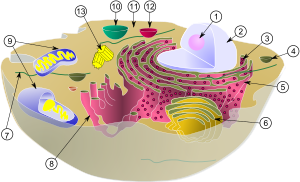
(1) Nucleolus
(2) The core
(3) Ribosome (small dots)
(4) Vesicle
(5) Rough endoplasmic reticulum (ER)
(6) Golgi apparatus
(7) Cytoskeleton
(8) Smooth endoplasmic reticulum
(9) Mitochondria
(10) Vacuole
(11) Cytoplasm
(12) Lysosome
(13) Centriol and Centrosoma


The lysosome (from the Greek. Λύσις - decomposition and σώμα - body) is a cell organelle surrounded by a membrane, in the cavity of which an acidic environment is maintained and there are many soluble hydrolytic enzymes [1] . The lysosome is responsible for intracellular digestion of macromolecules, including in autophagy ; the lysosome is capable of secretion of its contents during lysosomal exocytosis ; also, the lysosome is involved in some intracellular signaling pathways associated with metabolism and cell growth [2] .
The lysosome is a type of vesicle and belongs to the endomembrane system of the cell [3] . Different types of lysosomes can be considered as separate cell compartments .
Lysosomes were discovered in 1955 by the Belgian biochemist Christian de Duve [4] . Lysosomes are found in all mammalian cells, with the exception of red blood cells [5] . In plants, vacuoles are close to lysosomes by the method of formation, and partly by function. Most protists (with both phagotrophic and osmotrophic types of nutrition) and fungi also have lysosomes. Thus, the presence of lysosomes is characteristic of cells of all eukaryotes . Prokaryotes lack lysosomes, since they lack phagocytosis and do not have intracellular digestion.
A number of hereditary diseases in humans, called lysosomal storage diseases, are associated with dysfunction of lysosomes [6] .
Discovery History
In 1949-1952, the biochemist Christian de Duve and his students, studying the action of insulin in rat liver cells, accidentally discovered an unexpected difference in the activity of acid phosphatase depending on the method of excretion. Acid phosphatase was used by them as a standard, the main subject of their study was the enzyme glucose-6-phosphatase , which is involved in the metabolism of insulin. During the experiments, it was found out that when fractionating the cell contents in a centrifuge, acid phosphatase was associated with the microsomal fraction, but showed only a tenth of the activity compared to a simple cell extract , and after several days of storing the microsomal fraction in the refrigerator, acid phosphatase activity increased. When this phenomenon was discovered, the first explanation was that some kind of technical error occurred. However, the repetition of the experiment invariably reproduced the original picture. This suggests the existence of certain cell particles surrounded by a membrane that contain an enzyme inside themselves. From 1952 to 1955, several more acidic hydrolases associated with the microsomal fraction were discovered. In 1955, which is considered the year of discovery of lysosomes, C. de Duve proposed the name "lysosome" for a cell organelle, which is surrounded by a membrane inside which a low pH is maintained and inside which there are a number of enzymes that work optimally in an acidic environment [7] [8] . In the same 1955, American cytologist Alex Novikov from the University of Vermont , who was brilliant in microscopy, visited the laboratory of C. de Duve and was able to get the first electronic photographs of these organelles using a preparation of partially purified lysosomes. Later in 1961, Alex Novikov, using histochemical detection of acid phosphatase and electron microscopy, confirmed the localization of this enzyme in lysosomes [9] [10] . In 1963, the Belgian biochemist Henry Hears , who previously worked in the C. de Duve group, discovered a deficiency of the lysosomal enzyme α-glucosidase in patients with Pompe disease and suggested other genetic diseases to be associated with impaired lysosome function [11] . Currently, more than 50 hereditary diseases are associated with lysosomal insufficiency [12] .
In 1974, K. de Duve was awarded the Nobel Prize in medicine for his contribution to the discovery of the structural and functional organization of cells [13] .
Symptoms of lysosomes
Lysosomes are heterogeneous in shape, size, ultrastructural and cytochemical features. In animal cells, the size of the lysosomes is usually less than 1 μm, although in some types of cells, for example, in macrophages , the size of the lysosomes may exceed several microns . Lysosomes, as a rule, have a spherical, oval, sometimes tubular shape [14] . The number of lysosomes varies from one (large vacuole in many cells of plants and fungi) to several hundred or thousands (in animal cells). Animal lysosomes usually make up no more than 5% of the intracellular volume [15] .
One of the signs of lysosomes is the presence of a number of enzymes (acid hydrolases ) in them that can break down proteins , carbohydrates , lipids, and nucleic acids . Among the enzymes of lysosomes are cathepsins (tissue proteases ), acidic ribonuclease , phospholipase , etc. In addition, there are enzymes in the lysosomes that can remove sulfate (sulfatase) or phosphate ( acid phosphatase ) groups from organic molecules. In total, the lysosome cavity contains about 60 soluble acidic hydrolytic enzymes [2] .
Lysosomes are characterized by an acidic reaction of the internal environment , which ensures the optimal functioning of lysosomal hydrolases [14] . Typically, the pH in lysosomes is about 4.5-5, that is, the concentration of protons in them is two orders of magnitude higher than in the cytoplasm. This is ensured by the active transport of protons, which is carried out by the proton ATPase integrated into the lysosome membranes of the protein pump [15] . In addition to the proton pump, carrier proteins are integrated into the lysosome membrane for transporting the products of hydrolysis of macromolecules into the cytoplasm: amino acids , sugars, nucleotides , lipids [16] .
The high activity of acid phosphatase was previously used as one of the markers of lysosomes. Currently, the presence of specific membrane glycoproteins, LAMP1 and LAMP2, is considered a more reliable marker. They are present on the membrane of lysosomes and late endosomes , but are absent on the membranes of other vacuum compartments .
Lysosome formation and types
Lysosomes are formed from vesicles (vesicles), which separate from the Golgi apparatus , and vesicles (endosomes) into which substances enter during endocytosis [17] . Membranes of the endoplasmic reticulum take part in the formation of autolysosomes (autophagosomes). All lysosome proteins are synthesized on “sitting” ribosomes on the outside of the endoplasmic reticulum membranes and then pass through its cavity and through the Golgi apparatus.
There is no generally accepted classification and nomenclature for different stages of maturation and types of lysosomes. Distinguish between primary and secondary lysosomes. The former are formed in the region of the Golgi apparatus, in them are enzymes in an inactive state, while the latter contain active enzymes. Typically, lysosome enzymes are activated by lowering the pH. Among lysosomes, one can also distinguish heterolysosomes (digesting material entering the cell from the outside by phage or pinocytosis) and autolysosomes (destroying the cell’s own proteins or organelles). The most widely used classification of lysosomes and related compartments:
- Early endosome - endocytotic (pinocytotic) vesicles enter it. From the early endosome, receptors that donate (due to low pH) their load return to the outer membrane.
- Late endosome - bubbles from the material absorbed during pinocytosis and bubbles from the Golgi apparatus with hydrolases enter it from the early endosome. Mannose-6-phosphate receptors return from the late endosome to the Golgi apparatus.
- Lysosome - bubbles from the late endosome enter it with a mixture of hydrolases and digested material.
- Phagosome - larger particles (bacteria, etc.) get into it, absorbed by phagocytosis. Phagosomes usually fuse with the lysosome.
- Autophagosome - a region of the cytoplasm surrounded by two membranes, usually including any organoids and formed during macroautophagy. Merges with a lysosome.
- Multivesicular bodies - usually surrounded by a single membrane, contain smaller bubbles surrounded by a single membrane inside. They are formed as a result of a process resembling microautophagy (see below), but contain material obtained from the outside. Outer membrane receptors (for example, epidermal growth factor receptors) usually remain in small vesicles and then degrade. According to the stage of formation, they correspond to the early endosome. The formation of multivesicular bodies surrounded by two membranes by budding from the nuclear membrane is described.
- Residual bodies (telolysosomes) are vesicles containing undigested material (in particular, lipofuscin ). In normal cells, fuse with the outer membrane and exocytosis leave the cell. With aging or pathology accumulate.
Lysosome functions
The functions of lysosomes are:
- digestion of substances or particles (bacteria, other cells) captured by the cell during endocytosis
- autophagy - the destruction of structures unnecessary to the cell, for example, during the replacement of old organelles with new ones, or the digestion of proteins and other substances produced inside the cell
- autolysis - self-digestion of the cell, leading to its death (sometimes this process is not pathological, but accompanies the development of the body or differentiation of some specialized cells). Example: When a tadpole turns into a frog, the lysosomes located in the cells of the tail digest it: the tail disappears, and the substances formed during this process are absorbed and used by other cells of the body.
- dissolution of external structures (see, for example, osteoclasts )
Intracellular Digestion and Metabolism
In many protists and in animals with intracellular digestion , lysosomes are involved in the digestion of food captured by endocytosis. In this case, lysosomes merge with digestive vacuoles. In protists, undigested food debris is usually removed from the cell when the digestive vacuole merges with the outer membrane.
Many animal cells in which abdominal digestion predominates (for example, chordates) receive nutrients from intercellular fluid or blood plasma using pinocytosis. These substances are also involved in the metabolism of cells after their digestion in lysosomes. A well-studied example of such a participation of lysosomes in the metabolism is the production of cholesterol by the cells. The cholesterol brought by blood in the form of LDL enters the pinocytous vesicles after the LDL is connected to the LDL receptors on the membrane. Receptors return to the membrane from the early endosome, and LDL enters the lysosomes. After this, LDL is digested, and the released cholesterol through the lysosome membrane enters the cytoplasm.
Indirectly, lysosomes participate in the exchange, providing desensitization of cells to the effects of hormones. With the prolonged action of the hormone on the cell, part of the receptors that bind the hormone enter the endosomes and then degrade inside the lysosomes. A decrease in the number of receptors lowers the sensitivity of the cell to the hormone.
Autophagy
Two types of autophagy are usually distinguished - microautophagy and macroautophagy. In microautophagy, as in the formation of multivesicular bodies, an indentation of the endosome or lysosome membrane is formed, which is then separated in the form of internal vesicles, only substances synthesized in the cell enter them. In this way, the cell can digest proteins with a lack of energy or building material (for example, during starvation). But the processes of microautophagy occur under normal conditions and are generally indiscriminate. Sometimes during microautophagy, organoids are also digested; for example, microautophagy of peroxisomes and partial microautophagy of nuclei in which the cell remains viable is described in yeast .
In macroautophagy, a portion of the cytoplasm (often containing any organoids) is surrounded by a membrane compartment, similar to a cistern of the endoplasmic reticulum. As a result, this site is fenced off from the rest of the cytoplasm by two membranes. Then this autophagosome merges with the lysosome, and its contents are digested. Apparently, macroautophagy is also indiscriminate, although it is often emphasized that with the help of it the cell can get rid of organoids that have "outdated" (mitochondria, ribosomes, etc.).
The third type of autophagy is chaperone-dependent. In this method, directed transport of partially denatured proteins from the cytoplasm through the lysosome membrane to its cavity occurs.
Autolysis
Enzymes of lysosomes are often released upon destruction of the lysosome membrane . Usually at the same time they are inactivated in a neutral cytoplasmic medium. However, with the simultaneous destruction of all lysosomes of the cell, its self-destruction can occur - autolysis. Distinguish between pathological and conventional autolysis. A common variant of pathological autolysis is post-mortem tissue autolysis.
Normally, the processes of autolysis accompany many phenomena associated with the development of the body and differentiation of cells. Thus, autolysis of cells is described as a mechanism of tissue destruction in insect larvae during complete transformation , as well as when the tail is resorbed in the tadpole. True, these descriptions relate to the period when the differences between apoptosis and necrosis have not yet been established, and in each case it is necessary to find out whether apoptosis, which is not associated with autolysis, is actually the basis for degradation of an organ or tissue.
In plants, autolysis is accompanied by the differentiation of cells that function after death (for example, tracheid or vascular segments). Partial autolysis also occurs during the maturation of phloem cells - segments of the sieve tubes.
Clinical Importance
Sometimes, due to improper functioning of lysosomes, accumulation diseases develop in which enzymes do not work or work poorly due to mutations. An example of lysosomal storage diseases is Gaucher disease, Pompe disease , Tay-Sachs disease . In total, more than 50 hereditary diseases associated with dysfunction of the lysosome are known [12] .
Damage to lysosomes of necrotic cells, including granulocytes , gives rise to an inflammatory process [18] .
See also
- Vacuole
- Phagocytosis
- Endocytosis
- Lysosomal storage diseases
- Waxy lipofuscinosis of neurons
Notes
- ↑ Alberts et al., 2013 , p. 1196.
- ↑ 1 2 Settembre C. et al. Signals from the lysosome: a control center for cellular clearance and energy metabolism. (Eng.) // Nat. Rev. Mol. Cell Biol. - 2013 .-- Vol. 14. - P. 283-296. - DOI : 10.1038 / nrm3565 .
- ↑ Brighouse A., Dacks JB, Field MC Rab protein evolution and the history of the eukaryotic endomembrane system (Eng.) // Cellular and molecular life sciences. - 2010 .-- Vol. 67, no. 20 . - P. 3449-3465. - DOI : 10.1007 / s00018-010-0436-1 . Archived January 6, 2015.
- ↑ De Duve C. The lysosome turns fifty (Eng.) // Nature cell biology. - 2005. - Vol. 7, no. 9 . - P. 847-849.
- ↑ Lüllmann-Rauch R. History and morphology of the lysosome // Lysosomes / P. Saftig. - Springer US, 2005 .-- P. 1-16. - ISBN 978-0-387-25562-0 .
- ↑ Platt FM, Boland B., van der Spoel AC Lysosomal storage disorders: The cellular impact of lysosomal dysfunction (Eng.) // The Journal of cell biology. - 2012. - Vol. 199 , no. 5 . - P. 723-734 . - DOI : 10.1083 / jcb.201208152 .
- ↑ De Duve C. et al. Tissue fractionation studies. 6. Intracellular distribution patterns of enzymes in rat-liver tissue (Eng.) // Biochemical Journal. - 1955. - Vol. 60, no. 4 . - P. 604-617.
- ↑ Bainton DF The discovery of lysosomes . - 1981. - Vol. 91. - P. 66-76.
- ↑ Essner E., Novikoff AB Localization of acid phosphatase activity in hepatic lysosomes by means of electron microscopy (Eng.) // The Journal of biophysical and biochemical cytology. - 1961. - Vol. 9, no. 4 . - P. 773-784 .
- ↑ Castro-Obregon S. The Discovery of Lysosomes and Autophagy (Eng.) // Nature Education. - 2010 .-- Vol. 3, no. 9 . - P. 49.
- ↑ Hers HG α-Glucosidase deficiency in generalized glycogen-storage disease (Pompe's disease) (англ.) // Biochemical Journal. — 1963. — Vol. 86 , no. 1 . — P. 11-16 . — PMID 13954110 .
- ↑ 1 2 la Marca G. Lysosomals // Physician's Guide to the Diagnosis, Treatment, and Follow-Up of Inherited Metabolic Diseases / N. Blau, M. Duran, KM Gibson, CD Vici. — Springer Berlin Heidelberg, 2014. — P. 785-793. — ISBN 978-3-642-40336-1 .
- ↑ The Nobel Prize in Physiology or Medicine 1974 (англ.) . Nobelprize.org. Nobel Media AB 2014. Дата обращения 3 января 2015.
- ↑ 1 2 Appelqvist H. et al. The lysosome: from waste bag to potential therapeutic target (англ.) // Journal of molecular cell biology. — 2013. — Vol. 5, no. 4 . — P. 214-226 . — DOI : 10.1093/jmcb/mjt022 .
- ↑ 1 2 Luzio JP, Pryor PR, Bright NA Lysosomes: fusion and function (англ.) // Nat. Rev. Mol. Cell Biol. — 2007. — Vol. 8. — P. 622-632. — DOI : 10.1038/nrm2217 .
- ↑ Ченцов Ю. С. Введение в клеточную биологию. Учебник для вузов / Ю. С. Ченцов. — 4-e. — М: ИКЦ «Академкнига», 2004. — 495 с.
- ↑ Saftig P., Klumperman J. Lysosome biogenesis and lysosomal membrane proteins: trafficking meets function // Nat. Rev. Mol. Cell Biol. - 2009. - Vol. 10. — P. 623-635. — DOI : 10.1038/nrm2745 . Архивировано 24 декабря 2012 года.
- ↑ Тель Л.З., Лысенков С.П., Шарипова Н.Г., Шастун С.А. Патофизиология и физиология в вопросах и ответах. — 2 том. — М. : Медицинское информационное агентство, 2007. — С. 67. — 512 с.
Literature
- Ченцов Ю. С. Цитология с элементами целлюлярной патологии: Учебное пособие для университетов и медицинских вузов. — М. : МИА, 2010. — 361 с. - 4000 copies. — ISBN 978-5-9986-0013-5 .
- Молекулярная биология клетки: в 3-х томах / Б. Альбертс, А. Джонсон, Д. Льюис и др. — М.-Ижевск: НИЦ «Регулярная и хаотическая динамика», Институт компьютерных исследований, 2013. — Т. II. — С. 1196-1208. — 992 с. — ISBN 978-5-4344-0112-8 .
- Клетки / Б. Льюин и др. — М. : БИНОМ. Лаборатория знаний, 2011. — С. 179-235. — 951 с. — (Лучший зарубежный учебник). — ISBN 978-5-94774-794-2 .