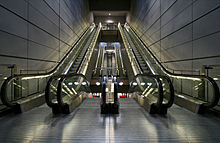

An escalator ( English escalator , compiled in the image of the word elevator , from French escalade - an assault staircase, which in turn is from Lat. Scala - a staircase) - a lifting and transporting machine in the form of a staircase inclined 30–35 ° to the horizon with moving steps to move people from one level to another. The steps of the stairs are usually attached to a closed circuit , which is driven by an electric motor through a gearbox or by a linear drive. It is one of the types of conveyor .
Escalators are common at subway stations, train stations , in large shopping facilities, in underground passages; sometimes used on slopes in cities with difficult terrain as an alternative to the funicular .
Moving stepless paths are called travelators .
Content
History
The first such mechanism was patented by the American inventor on March 9, 1859 , however, this patent No. 25,076 for the "revolving stairs" ( English revolving stairs ) has never been used by anyone. Decades later, on March 15, 1892 , the American patented his invention of the “inclined elevator”. His world's first escalator appeared in 1894 in New York's Coney Island Park as an attraction for tourists.
The underground station was first equipped with an escalator in 1911 - it happened at the station of the London Underground .
The first escalators were smooth moving walkways without steps. A little later they were equipped with handrails, and the escalator acquired a modern look by 1921.
Almost from the very beginning, those who didn’t walk along the escalator, but simply stood, stood on the right to let the passengers go on the left, which created a queue in front of the escalator, since only its right side was fully involved. And some of those who go up the left do it so as not to wait in line, but they don’t go while standing, fearing condemnation from behind. This "underground etiquette" is observed in many countries of the world to this day. When people just stand on both the left and right sides - the capacity of the escalator is much higher than when they go up on the left side.
Escalators in Russia
The first escalators in the USSR appeared in Moscow : they were installed during the construction of the first stage of the Moscow Metro at four deep-seated stations (modern Red Gate , Chistye Prudy , Lubyanka and Okhotny Ryad ). The first public building in the USSR where escalators were installed was the Detsky Mir store (1953-1957, architect A. N. Dushkin , engineer L. M. Glier, co-authors I. M. Potrubach and G. G. Akvilev), built in the center of Moscow, on Dzerzhinsky Square (since 1991 - Lubyanka Square ) [1] [2] .
In the Soviet Union, escalators were used primarily in the subway , occasionally used at train stations , airports, theaters , concert halls and other public buildings. According to the norms for the construction of the metro, escalators are installed on the rise when the height difference on the march is more than 4 m [3] , on the descent - more than 5 m (a number of stations were built before the adoption of these norms, and they do not work there).
Since 1935, the only imported escalators in the USSR were the escalators of the Finnish company KONE , which were installed only in such significant places as the Moscow Kremlin , the Palace of Congresses , etc., other foreign manufacturers appeared on the market only after the collapse of the USSR in 1991.
In modern Russia, escalators are often installed in shopping and business centers , and other public buildings.
Types of Escalators
Escalators are divided into two main classes - tunnel and floor.
Tunnel escalators are installed in long inclined tunnels - exits of deep underground metro stations. The large length of such escalators imposes special requirements on the strength of their design and the reliability of the brakes. Serving such escalators requires a fairly wide balustrade between the tapes.
Floor escalators are used in buildings. Since such escalators are usually freely accessible, they do not need wide balustrades .
Tunnel and floor escalators differ in angle of inclination. So, with the required lifting height of up to 6 meters, the angle of inclination of the escalator is 30 ° or 35 °, with a lifting height above 6 meters - only 30 °.
Characteristics
The theoretical capacity of one escalator line at a speed of 0.75 m / s (45 meters per minute) is 10,000 people / hour, but the actual capacity is usually not more than 5,000-6,000 for ascent and up to 7500 for descent [4] .
As a rule, the speed of the escalator handrails exceeds the speed of the canvas. To increase friction on the disks that drive the handrails, put on rubber pads that wear out over time, as a result of which the speed of the handrails decreases during operation of the escalator [5] . For example, the speed of the handrails and escalator canvases in Baden-Württemberg (Germany) were regulated in 1977: their speeds should be the same, but it is allowed to exceed the speed of the handrail up to 3%. Since 2009, the document is not binding, but recommended as a guideline [6] .
Benefits
- Escalators have greater bandwidth than elevators and funiculars .
- Escalators are continuous transport vehicles: the passenger does not have to wait for the arrival of the vehicle (cab).
- In case of breakdown, the escalator can be used as an ordinary staircase and climb up or go down - while in case of breakdown of the elevator equipment, you must wait until it is repaired.
Weaknesses
- As a rule, escalators are more expensive than elevators and cable cars.
- In comparison with the elevator, the escalator requires more space for installation.
- Unlike the elevator, the escalator cannot be used by passengers in a wheelchair without outside help, it is difficult to move passengers with carts, bicycles and other dimensional cargo.
- Unlike the elevator, when moving in the building several floors at once, the passenger has to make a transfer on each intermediate floor.
- Unlike an elevator, an escalator cannot reach the high speed needed for vertical movements in multi-story buildings.
Records
By age
- The oldest operating escalators in the world are likely to be floor escalators at New York Department in Herald Square , operating since 1927.
- The oldest tunnel escalators have been operating since February 1944 at the Baumanskaya station of the Moscow Metro . In 2015, they were dismantled and replaced with new ones.
- The oldest escalators in the London Underground have been operating at Station since 1947. These were the last surviving escalators with wooden steps in the London Underground. In 2015, they were replaced by the “inclined elevator” [7] .
Length
- The longest escalators in the world are installed at the Admiralteyskaya metro station in St. Petersburg . The station has a depth of 86 m. Escalators are installed in series with a lifting height of 68.7 m and 15.2 m. [8]
- The longest escalators in the European Union are installed at the Namesti Miru station on line A of the Prague Metro . Their length is 87 m, the lifting height is 43.5 m.
- The longest escalators in the Western Hemisphere and the United States are installed at the Wheaton station in the Washington Underground . Their length is 70 m, the height of the lift is 35 m.
- The longest escalators in the Southern Hemisphere are installed at the Station of the Melbourne City Railroad. Lifting height more than 30 m.
See also
- Travelator
- Paternoster
Notes
- ↑ Mamaev, O. “Inside the old“ Children's World “nothing was left at all” (inaccessible link) . Big city (December 1, 2014). - Conversation with the granddaughter of the building architect, professor of the Moscow Institute of Architecture N. Dushkina. Date of treatment April 1, 2015. Archived March 16, 2015.
- ↑ Archived copy (inaccessible link) . Date of treatment December 15, 2012. Archived on February 7, 2013.
- ↑ According to SNiP 32-02-2003, it is necessary to provide for the equipment of stations and metro crossings with escalators when the height difference is from 4 meters.
- ↑ Library / Analytics / Creating a new generation of escalators - a rational way to increase the throughput of metro stations
- ↑ Escalator rescues Muscovites from a crush - Metro (inaccessible link) . Date of treatment March 15, 2012. Archived July 14, 2014.
- ↑ Arbeitsstättenrichtlinie Fahrtreppen und Fahrsteige
- ↑ UK's First Incline Lift Coming To Improve Disabled Access
- ↑ Escalator with linear motor . “Science and Life” (No. 1, 2014). Date of treatment January 26, 2015.
Links
- KONE escalators use a planetary gear instead of chains to drive
- Khristich V.K., Kireev Yu.V. Creation of a new generation of escalators - a rational way to increase the throughput of metro stations
- Overview of the design and design of the Kiev metro escalators
- The largest and smallest escalators in the world