Ristar [a] is a video game in the genre of platformer , developed by Sonic Team under the pseudonym Project Ristar and published by Sega in 1995 for the Mega Drive / Genesis game console . A game was also released for the Sega Game Gear with the same name and genre - Ristar , which has a similar theme, but differs in level design and digital mechanics.
| Ristar | |
|---|---|
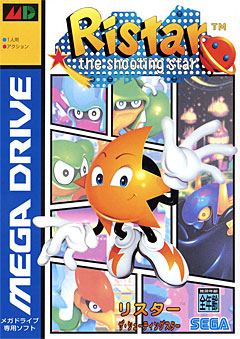 Cover of the Japanese edition of the game for the Sega Mega Drive console | |
| Developer | Project ristar |
| Publisher | Sega |
| Release dates | February 16, 1995 Mega Drive / Genesis:
 September 13, 2010 September 13, 2010 |
| Genre | platformer |
| Age ratings | CERO : A -All ages ELSPA: 3+ ESRB : E - Everyone OFLC (A) : G - General PEGI : 3 USK : SEGA : All Ages |
| Creators | |
| Executives |
|
| Producers |
|
| Game designers |
|
| Screenwriter | Chieko Nakamura |
| Programmers |
|
| Artists |
|
| Composer | Tomoko Sasaki |
| Technical details | |
| Platforms | Mega Drive / Genesis Wii ( Virtual Console ), Windows ( Steam ) As part of collections: Windows , Xbox , Xbox 360 , PlayStation 2 , PlayStation Portable , PlayStation 3 , GameCube , Switch , PlayStation 4 , Xbox One |
| Game mode | single user |
| Interface language | English |
| Carrier | cartridge , digital distribution |
| System requirements | PC (minimum): Windows XP , 32 MB graphics card , DirectX 9.0 , 50 MB HDD |
| Control | gamepad keyboard |


The main role in the game belongs to the anthropomorphic cartoon meteor , using its long stretching arms to move and battle enemies. The game was generally well received, but the initial release of the game overshadowed the imminent end of the Mega Drive era and the advent of the Sega Saturn era and other fifth-generation game consoles. Having not received any sequels, the game was repeatedly reprinted by Sega in digital form and in collections on the Sega theme, including a series of releases for Sega Forever mobile devices. The protagonist also has various cameos in other Sega games.
Subsequently, the game was repeatedly reprinted as part of collections for different platforms, including re-release in the Virtual Console service for Wii . Since 2010, the game has been available as part of the SEGA Mega Drive and Genesis Classics compilation for Linux , macOS , Windows platforms , since 2018 - PlayStation 4 , Xbox One [1] and Nintendo Switch [2] .
Content
Gameplay
Ristar is a two-dimensional side-scrolling platformer reminiscent of games from the Super Mario or Sonic the Hedgehog series , but less tied to jumping and speed and more using Ristar's stretching arms that can stretch in eight main directions. [3] The player must maneuver Ristar through the level to the end, while avoiding damage from obstacles and enemies. Outstretched arms are Ristar's main weapon against enemies: stretching out his arms, he grabs the enemies and, pulling himself to them in a “ head bang ” movement, destroys. [4] The same movement also allows you to open treasure chests containing various objects, or strike at different parts of the environment, for example, to knock down a tree. [4] In addition, with his elastic hands you can simply take or throw objects. [five]
Besides the attack, Ristar’s hands are also used to go through the levels. [4] Many pole-shaped structures are present for rolling Ristar from one side to the other at intervals or for vertical ascent or descent to platforms. [6] Ristar can also capture enemies and objects in the air and swing on them. In addition, Star Hadle is present on the levels, for which Ristar must grasp and use the impulse to rotate in a circle. Releasing the handle launches it in a given direction, depending on the release time. [7] If sufficient momentum is gained, sparks appear behind Ristar and he performs a movement called the Meteor Strike , making him invulnerable and able to defeat any enemy in a collision with him. When a sufficient momentum is lost (usually after a few seconds), the flight stops and the hero falls to the ground, returning to its normal state, although this can be extended by bouncing in flight from walls or ceilings. [8]
Each level ends with a special “star grip” used to launch Ristar to the end of the level. Bonus points are awarded depending on the height of Ristar’s flight beyond the screen, similar to how levels end in Super Mario Bros. In addition, each level contains one hidden handle, sending Ristar to the bonus level, which includes overcoming an obstacle course within a given time limit. After completing the level in a particularly short time, you will receive a continuation , and at the end of the game, depending on how many bonus levels have been completed, special codes will open. Ristar's health is displayed through an icon in the form of four stars in the upper right corner of the screen. Taking damage removes one star, and the loss of all stars causes Ristar to lose his life . The discovery and capture of the Ristar figurine gives the character an extra life, and traditional star figurines replenish his health: a gold star replenishes one star, and a silver one - all four.
Story
As in other games of the same era, like Gunstar Heroes , the plot of the game in the Japanese and American versions is slightly different. In all versions of the game, events take place in the Valdi system, where the evil space pirate Kaiser Gridi subjugated the rulers of the planets to his power, mastering their minds. [four]
In the Japanese version, the inhabitants of the planet Nir pray for the sending of the hero before the minion Gridi, who controls consciousness, cries out into the leader of the planet. Desperate supplications reach the nebula-cloister of the star goddess Oruto. She awakens one of her sons, Ristar, for the sole purpose of fulfilling the pleas of the innocent. He must stop Gridi and the bewitched leaders of each of the seven worlds and return the world to the galaxy.
There is no Oruto in the American version. Instead, Ristar has a father, a legendary hero, a meteor defending the Valdi system. Instead of waking Ristar as a mother, the kidnapping of the legendary hero by Kaiser Gridy takes place, and Ristar must also rescue his father. [9]
The Japanese version of the game ends with a scene with Gridi and two of his subordinates, Inonis and Uranim, who appeared on a desert planet. Gridy observes the appearance in outer space of the image of Ristar. In the final scene in the American version, Ristar reunites with his father.
Development
The game was developed on the basis of an idea that arose when discussing character design, which later became Sonic the Hedgehog . [4] [10] [11] Yuji Naka , head of the Sonic Team , in an interview for Sega Visions , published in October 1992, recalled:
First we used a character that looked like a rabbit with ears that could stretch out and pick up items. As the game became faster and faster, we had to come up with a special skill for the character that he could use against his opponents. I remember a character that I thought of several years ago, who could curl up and throw himself at opponents. Hedgehogs can curl into a ball, so we decided to replace the rabbit with a hedgehog [12] .
A few years later, the development of a separate game with a character resembling a rabbit began. The prototype created was called Feel . [13] [14] His hero no longer resembled a rabbit, since instead of ears he used his hands. [15] After a number of other changes, including a name change (one of them was Volt ), the game took on the form in which it became known as Ristar . In the process of working on versions for release outside of Japan, the name of the game also changed several times, from Ristar the Shooting Star to Dexstar , and as a result, the game was called Ristar . [16]
Back in late 1994, Sega put Ristar in the place of the successor of Hedgehog Sonic. [17] [18] However, the game did not gain massive influence or sales, mainly due to the release of the Sega Saturn console , the successor to Sega Mega Drive, eclipsing it just three months before it. [19] [15] In a 1994 interview with Electronic Gaming Monthly , Sega marketing staff Lisa Best and Terry Tang claimed that Ristar and Sonic were not developed by the same programming team [18] , although most of the game’s development team would later create Nights into Dreams ... for Saturn, which will be officially attributed to the Sonic Team . This, along with the inclusion of Ristar next year in a series of thematic compilations and reprints of Sonic the Hedgehog games , made journalists retroactively designate the game as developed by Sonic Team. [15] [20] [4] [3]
Localization
When localizing the version for Europe and North America, a number of small changes were made. The plot was slightly changed: in the Japanese version of Ristar, the star goddess Oruto calls, while in the American version of Oruto there is no, and instead, Ristar’s father, “the legendary hero”, is mentioned. [fifteen]
The ice-level boss, Itamor, has been transformed from a huge robot cat into a robot-ice monster. In the game, Ristar must capture dishes with hot stew and throw them into Itamoru's mouth. In Japan, it is considered witty to use the "hot" to defeat the cat because of Japanese cultural references to the "cat language" ( 猫 舌 nekojita ), which does not tolerate hot. In the North American and European regions, this mention is absent, so it was replaced by an “ice monster”, defeated by melting from the hot. [fifteen]
The remaining changes are very minor and represent an attempt to appeal to a Western audience. For example, minor graphic changes made to make faces of Ristar and other characters look more serious, changing the names of the levels to more describe their appearance, and adding several non-interactive scenes to show more continuity in the game, such as sequential skiing before a snow theme level or putting on anti-gravity shoes to explain why Ristar swims in a certain level place. [fifteen]
Reviews and criticism
| Reviews | |
|---|---|
| Summary rating | |
| Aggregator | Rating |
| Gameranks | 89.93% ( SMD ) [21] |
| Mobyrank | 87/100 ( SMD ) [22] 82/100 ( Wii ) [22] |
| Foreign language editions | |
| Edition | Rating |
| Allgame | ( SMD ) [23] ( Wii ) [24] [25] ( PC ) [26] |
| Egm | 7.6 / 10 ( SMD ) [22] |
| Gamepro | ( SMD ) [22] |
| Gamespot | 7.6 / 10 ( Wii ) [27] |
| IGN | 8/10 ( Wii ) [28] |
The reviews of the game after its release were generally benevolent. [21] Sega Official Magazine rated it 87%, praising gameplay, graphics, and music, but complained that the game lacked originality, and much was borrowed from other platformers like Sonic the Hedgehog , Dynamite Headdy , and Earthworm Jim . [29] SegaPro praised her for the similarities and differences with the Sonic the Hedgehog series , saying: “If you judge games solely by their visual appearance, you will be forgiven for thinking that it was Sonic the Hedgehog . But when you actually lean back and start playing it, you will find it to be a much slower, strategic game. There’s a big puzzle element here that needs to stand out among hundreds of other platformers on the market. ” [17] Sega Power expressed a number of similar points, comparing the gameplay with the mix “between Sonic and Dynamite Headdy ”, but criticized its short duration and lack of originality and gave the game only 74 points: “... if you like Sonic games, you will like this "However," ... she's not as good as Sonic . " [30] GamePro also noted that Ristar feels “sluggish” compared to Sonic , and criticized that Ristar has few animations compared to other famous platform games, and the low complexity of the game makes it suitable only for beginner gamers. However, they gave the game a general recommendation based on colorful visuals and thoughtful gameplay. [31] A team of five Electronic Gaming Monthly reviewers rated it 7.6 out of 10, and Michael Weigand summed it up: “A great new Ristar character requires more technique than regular action games with jogging and jumping.” [b] [32] The Next Generation columnist, noting that Ristar had borrowed a lot from Dynamite Headdy , claimed that the game character had more than enough originality and versatility to be more than just a clone. Referring to the excellent level design, “smooth transitions, original bosses and great music”, he called the game “one of the best ptatformers for today.” Despite this, he gave the game only three stars out of five. [33] Famitsu rated the game 29 points out of 40. [34]
Ristar received significantly more positive reviews a decade later, after a re-release in digital form and as part of compilations on the theme of Sonic and Sega . IGN rated the Virtual Console version 8 out of ten, praising the graphics, music and gameplay, and in the end wrote: “Fans of platformers should see this” [28] . GameSpot also praised the release on the Virtual Console, especially its graphics, saying: “As you can see, the developers made the most of the limited color palette of the system and used all possible graphic techniques to make the game look spectacular. "Ristar and his enemies have a wide variety of animations, but you will most likely notice the colorful layered backgrounds, constantly flaunting animated details in the form of moving clouds, falling debris and violent creatures that have the habit of throwing objects at you from afar." [27] NintendoLife rated the game at 9/10 points, calling it one of the best systems in terms of graphics, animation and gameplay, saying “ Ristar proves that a radical approach to managing the game in the platform game can sometimes really pay off in the end. Sonic Team not only created a game that easily differs from their Sonic the Hedgehog series , but also offered some unique ideas for the game process that appeared in the 16-bit era, and a game that is as interesting to play today as it was almost 15 years ago when she was first released. " [3] 1UP.com called the game “excellent” and called it “the most interesting” of the four non- Sonic games in the Sonic Mega Collection . [35] AllGame expressed a similar view, calling the game “good, if not better than any” of the Sonic games included in the Sonic Mega Collection [36] and the “lost gem” in the Sega Genesis Collection . [37] Entertainment Weekly was less supportive in its review, giving the game a B– rating due to the alleged redundancy and reuse of Sonic ideas. [38]
IGN Levy Buchanan praised the graphics and gameplay as excellent for the aging Sega Mega Drive in its retrospective, but also claimed that the platform damaged the game’s ability to succeed in sales and visibility, stating that “ Ristar had no chance. The game was released in early 1995, when the world of video games switched to the next generation of hardware. Sega focused on the upcoming Saturn release, and Sonic was still a huge success. And so Ristar was written off. " [four]
Impact
Ristar appeared twice as a cameo. The first time he appeared as a ghasyapon in the game Shenmue [39] . For a short time appeared in the game Segagaga [39] . Ristar can be seen on the Death Egg track in one of the downloadable content for Sonic & Sega All-Stars Racing [40] , and in her sequel Sonic & All-Stars Racing Transformed, he plays the role of a character waving a flag before the start of the race [41] .
Notes
- Comments
- ↑ In Japan, known as the Ristar the Shooting Star ( リ ス タ ー ザ ・ シ ュ ー テ ィ ン グ ス タ ー Risuta: dza Shu: tingu Suta:, "Meteor Ristar") .
- ↑ In the review of the game, the game platform Game Gear was erroneously indicated. The next issue of the magazine published a review of the version of Ristar for Game Gear.
- Sources
- ↑ Sega Mega Drive Classics collection coming to Xbox, PS4, and PC this May . Metro (03/18/2018). Date of treatment February 10, 2019.
- ↑ Genesis Classics On Switch Is The Perfect Way To Play Old Games . Kotaku (11/28/2018). Date of treatment February 10, 2019.
- ↑ 1 2 3 Ristar (Wii Virtual Console / Mega Drive) Review // Nintendo Life. - 2006. - 5 December. (Retrieved May 10, 2019)
- ↑ 1 2 3 4 5 6 7 Buchanan, L. Fond Memories: Ristar : Never as big as Sonic, but he sparkled nonetheless // IGN. - 2008 .-- October 7. (Retrieved May 10, 2019)
- ↑ 'Ristar' Review - This Shooting Star Has Come Quite Far // TouchArcade. - 2017 .-- 15 August. (Retrieved May 10, 2019)
- ↑ Ristar ™: Genesis ™ instruction manual, 1995 , pp. 6-7.
- ↑ Ristar ™: Genesis ™ instruction manual, 1995 , p. ten.
- ↑ Ristar ™: Genesis ™ instruction manual, 1995 , pp. 8-11.
- ↑ Ristar ™: Genesis ™ instruction manual, 1995 , p. 2.
- ↑ Elston, B. Game music of the (holi) day: Ristar // GamesRadar + . - 2010 .-- December 23. (Retrieved May 11, 2019)
- ↑ Mai, P. 10 Things You Didn't Know About Sonic the Hedgehog : [ arch. July 3, 2011 ] // OCWeekly. - 2011 .-- June 29. (Retrieved May 12, 2019)
- ↑ Interview with Yuji Naka: the creator of Sonic the Hedgehog // Sega Visions. - 1992. - No. 9 (September). - P. 20-21. (Retrieved May 12, 2019)
- ↑ Ristar // Sega Magazine. - 1995. - January. - P. 88.
- ↑ Sega Magazine. - 1994.
- ↑ 1 2 3 4 5 6 Kearns, A. Ristar : [ arch. January 15, 2011 ] // Hardcore Gaming 101. - 2011. - 1 July. (Retrieved May 11, 2019)
- ↑ Boardumb. Universal - Ristar (By SEGA) // TouchArcade. - 2017 .-- 9 August. (Retrieved May 12, 2019)
- ↑ 1 2 [Ristar] // Sega Pro. - 1995. - No. 4 (January). - P. 16.
- ↑ 1 2 Sega's Newest Hero Takes on Solar System Scum! // Electronic Gaming Monthly. - 1994. - No. 65 (December). - P. 192-193.
- ↑ Thomas, L. M. Ristar Virtual Console Review : When you wish upon a star: [ arch. December 8, 2006 ] // IGN. - 2006. - 5 December. (Retrieved May 12, 2019)
- ↑ Provo, F. Ristar Review // GameSpot. - 1995 .-- February 16. (Retrieved May 12, 2019)
- ↑ 1 2 (Genesis) Ristar (English) . GameRankings Date of treatment June 15, 2017.
- ↑ 1 2 3 4 Ristar MobyGames Date of treatment June 15, 2017.
- ↑ Marriott, Scott Alan. Ristar AllGame . Date of treatment June 15, 2017. Archived November 14, 2014.
- ↑ Marriott, Scott Alan. Ristar AllGame . Date of treatment June 15, 2017. Archived November 14, 2014.
- ↑ Marriott, Scott Alan. Ristar AllGame . Date of treatment June 15, 2017. Archived November 14, 2014.
- ↑ Marriott, Scott Alan. Ristar AllGame . Date of treatment June 15, 2017. Archived November 14, 2014.
- ↑ 1 2 Provo, F. Ristar Review // GameSpot . 03/09/2007. (Retrieved February 19, 2011)
- ↑ 1 2 Thomas, L. M. Ristar Virtual Console Review : [ arch. June 9, 2012 ] // IGN . 12/05/2006. (Retrieved February 19, 2011)
- ↑ Ristar // Sega Magazine. - 1995. - No. 13 (January). - P. 89. (Retrieved May 13, 2019)
- ↑ Ristar // Sega Power. - 1995. - No. 64 (March).
- ↑ ProReview: Ristar // GamePro. - 1995. - No. 67 (February). - P. 36.
- ↑ Davis, Z. Review Crew: Ristar // Electronic Gaming Monthly. - 1995 .-- February. - P. 36.
- ↑ Startling // Next Generation. - 1995. - No. 3 (March). - P. 101.
- ↑ 新 作 ゲ ー ム ク ロ ス レ ビ ュ ー : リ ス タ ー ・ ザ ・ シ ュ ー テ ィ ン グ ス タ ー // 週刊 フ ァ ミ 通 . - 1995. - 第 323 号 ( 2 月 24 日 ). - 39 頁 .
- ↑ Parish, J. Sonic Mega Collection Plus Review for PS2 : [ arch. December 12, 2013 ] // 1UP.com. - 2004 .-- November 29. (Retrieved April 5, 2013)
- ↑ Marriott, S. A. Sonic Mega Collection : Review: [ arch. November 15, 2014 ] // AllGame. 10/03/2010. (Retrieved May 14, 2019)
- ↑ Marriott, S. A. Sega Genesis Collection : Review: [ arch. November 15, 2014 ] // AllGame. 10/03/2010. (Retrieved May 14, 2019)
- ↑ Strauss, B. Ristar // Entertainment Weekly . - 1995 .-- February 24. (Retrieved May 14, 2019)
- ↑ 1 2 Ristar on the Sega Retro website
- ↑ Сremator. Sonic Secrets and Facts (December 22, 2010). Date of treatment April 3, 2011. (unavailable link)
- ↑ Miguel, Diogo. Sonic & All-Stars Racing Transformed Preview . V3tro (October 9, 2012). - "You know the development team tried their best when the race starts and Ristar is cheerfully waving the flag." Date of treatment October 11, 2012. Archived October 24, 2012.
Literature
- Ristar ™ : Genesis ™ instruction manual. - Sega, 1995 .-- 16 p.