
Icelandic plateau ( Isl. Miðhálendið ) is a plateau in the central part of Iceland .
The Icelandic plateau covers most of Iceland’s inland territory. According to the terminology adopted in this country, it is customary to classify all territories lying at an altitude of 200 or more meters above sea level (such territories occupy 75% of the total area of Iceland).
On the Icelandic Plateau, a wide variety of natural landscapes are found - moraines , stone and sand deserts , lava fields , volcanoes , glaciers , river valleys and freshwater lakes. In places of water spill swampy oases are formed. In such areas, moss and alpine vegetation grow, for example, broad-leaved Ivan tea ( Epilobium latifolium ), called the Arctic meadow rose , and stemless plows ( Silene acaulis ) . Often the landscape of the plateau takes on a specific gray-black color, indicating the volcanic origin of the soil.
Traveling and moving by motor vehicles (off-road vehicles) on the plateau territory is allowed only during the Icelandic summer, that is, from June to August. During the rest of the year, the interior of Iceland is closed to visitors. It is strictly forbidden to exit from paved roads due to the special vulnerability of Arctic soils. River crossings are usually wade, as bridges within the country are extremely rare.
The territory of the Icelandic plateau is divided between various Icelandic communities and is mainly used for grazing sheep, in the tourism business, as well as for generating electricity in areas where there are geothermal waters.
 Glacier and track | 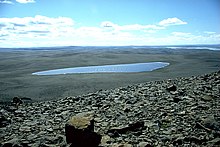 Landscapes of Iceland |  Center. Iceland. Aerial photography |