Caucasian Ular [2] [3] , or Caucasian Mountain Turkey [2] ( Tetraogallus caucasicus ) is a bird of the genus Ulara , a detachment of chickens that lives in the Caucasus .
| Caucasian Ular | |||||||||||||||||||||||||||||||||||
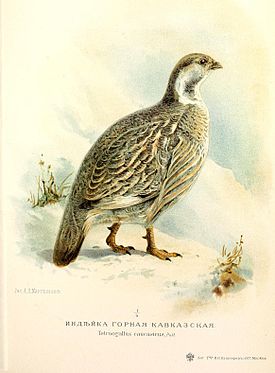 Caucasian Ular, Fig. A.N. Martynova [1] | |||||||||||||||||||||||||||||||||||
| Scientific classification | |||||||||||||||||||||||||||||||||||
|---|---|---|---|---|---|---|---|---|---|---|---|---|---|---|---|---|---|---|---|---|---|---|---|---|---|---|---|---|---|---|---|---|---|---|---|
| |||||||||||||||||||||||||||||||||||
| International scientific name | |||||||||||||||||||||||||||||||||||
Tetraogallus caucasicus ( Pallas , 1811 ) | |||||||||||||||||||||||||||||||||||
| Security status | |||||||||||||||||||||||||||||||||||


Content
Description
The Caucasian ular in behavior and appearance resembles domestic chicken , but it is larger in size. The weight of the oolar varies from 1.6 to 2.4 kg depending on the season .
The trunk of the Caucasian ular is dense, the neck is short, the head is small, the beak is small, but dense and wide, legs are short and thick, the wings are also short, somewhat pointed, the tail is relatively long and slightly rounded. The plumage is plentiful and dense; to protect poultry from low temperatures inherent in alpine habitats of Ular.
The Caucasian Ular is a terrestrial mountain bird, therefore it runs easily and quickly even on steep slopes , using wings to maintain balance . When in danger, runs to the cliffs to plan in the nearest gorge . When flying, the Caucasian ular usually whistles loudly. In winter, the bird is quite silent and relatively rarely gives a voice .
The total approximate number of Caucasian Ular during the year ranges from 410 thousand birds in spring (in April) to 700 thousand in autumn (in October).
Coloring
The Caucasian Ular is painted in gray-steel color with a streaky pattern on each feather. The throat , the upper part of the goiter , the bottom and sides of the neck are pure white, on the sides of the body are wide brown longitudinal stripes with black borders. The front parts of the back , chest and part of the goiter are decorated with clear transverse stripes of black and light ocher color. The tail feathers are brownish-brown, chestnut at the ends. Feather feathers are white with dark brown ends, the underwings are snow-white. By color, males and females are indistinguishable. The difference is observed only in size and spurs .
Habitat
Caucasian Ular is distributed in the alpine zone of the Main Caucasian Range . Here the bird is found from the upper border of alpine meadows to the limits of constant snow (1,800 to 4,000 m above sea level).
For living, it prefers steep rocky placers and rocky gorges with sparse alpine vegetation, alternating with glades overgrown with low alpine grassy vegetation; avoids clean, even slopes of mountains without rocks and screes.
The average density of distribution of Caucasian cows in spring is over 20, in autumn - about 35 individuals per 1 km².
The Caucasian Ular makes seasonal vertical migrations: in the second half of summer, the bird rises to the tops and ridges of the mountains after the retreating border of eternal snows; in the fall, with snow falling in the highlands, the Caucasian Ular descends to the lower zones of the mountains; in winter, the Ular is located in the lower half of the alpine zone, looking for sections of slopes free of snow, where the bird can find food for itself; in early spring, the Ular descends all the way to the subalpine zone.
Reproduction
The mating season in the Caucasian Ular begins in mid-March, during this period flocks of birds that survived the winter together scatter.
The mating
Males often chase females, invite them to sing and fight among themselves. Having achieved the female, the male takes a mating position - lifts the tail to the top, and stretches his head forward.
In the mating season, males eat little and lose much weight.
Nesting at the Ular occurs in April. Clutch usually consists of five to eight eggs. Only the female incubates eggs.
By 3 months, the size of the chicks reaches an adult. Maturity is achieved by the spring of next year.
Shedding
Plumage shedding in Caucasian ular occurs once a year . Males begin to molt 15-20 days before the appearance of the brood, ending the process after about 5.5 months. Females usually molt three weeks after hatching. Due to the increased speed of the plumage, females are controlled in 4 months and finish simultaneously with males.
Nutrition
Caucasian Ular is a herbivorous bird . Animal feeds do not play any role in the nutrition of ular. The ground parts of alpine plants are used as food - leaves , stems , young shoots , buds , flowers , buds and seeds . In total, about 70 plant species are in the diet of ular. These are mainly cereals and sedges , legumes and cloves .
Caucasian Ulars do not need constant sources of water. They get it along with plant foods.
Notes
- ↑ Drawing from the book: Menzbir M.A. Hunting and fishing birds of European Russia and the Caucasus. 2 volumes and atlas. M., typographic lithography of T-va I. N. Kushnerev and Co., 1900-1902.
- ↑ 1 2 Boehme R. L. , Flint V. E. The Bilingual Dictionary of Animal Names. Birds. Latin, Russian, English, German, French / Ed. ed. Acad. V. E. Sokolova . - M .: Rus. lang., "RUSSO", 1994. - S. 65. - 2030 copies. - ISBN 5-200-00643-0 .
- ↑ Arlotte N., Brave V. Birds of Russia: A Guide-Guide. - SPb. : Amphora, 2009 .-- S. 112. - 446 p. - ISBN 978-5-367-01026-8 .
Literature
- Animal Life: in 6 volumes. - M .: Education. Edited by professors N. A. Gladkov, A. V. Mikheev. 1970.