The 2010 presidential election in Ukraine is the fifth (regular) presidential election in Ukraine . Passed in two rounds: January 17 and February 7, 2010; Victor Yanukovych won. He received the largest number of votes already according to the results of the first round of voting (35.32%), but this did not allow him to become president, because under Ukrainian law, the candidate who received more than 50% of the vote becomes the elected president according to the results of the first round. Since none of the candidates managed to achieve this result, a second round was held, in which, in addition to Yanukovych, Y. V. Tymoshenko , who took second place, reached 25.05%. In the second round of voting, the majority of votes (48.95%) was won by the leader of the opposition Party of Regions Viktor Yanukovych (Tymoshenko received 45.47% of the vote) [1] .
← 2004  2014 → 2014 → | |||
| Presidential Election in Ukraine (2010) | |||
|---|---|---|---|
| January 17, 2010 (first round) February 7, 2010 (second round) | |||
 |  |  | |
| Candidate | Victor Yanukovich | Yulia Timoshenko | Sergey Tigipko |
| The consignment | Party of Regions | “Yulia Tymoshenko Bloc” | "Strong Ukraine" |
| Votes in the first round | 8 686 642 ( 35.32% ) | 6 159 810 (25.05%) | 3 211 257 (13.06%) |
| Votes in the second round | 12 481 266 ( 48.95% ) | 11 593 357 (45.47%) | |
 |  |  | |
| Candidate | Arseniy Yatsenyuk | Victor Yushchenko | Pyotr Simonenko |
| The consignment | “Front of changes” | Block "Our Ukraine - People’s Self-Defense" | "Communist Party of Ukraine" |
| Votes in the first round | 1,711,749 (6.96%) | 1,341,539 (5.75%) | 872 908 (3.88%) |
| Other candidates | Vladimir Litvin , Oleg Tyagnibok , Anatoly Gritsenko , Inna Bogoslovskaya , Alexander Moroz , Yuri Kostenko , Lyudmila Suprun , Vasily Protyvsykh , Alexander Pabat , Sergey Ratushnyak , Mikhail Brodsky , Oleg Ryabokon | ||
 | |||
| Election result | Viktor Yanukovych elected President of Ukraine | ||
| Portal: Politics |
| Ukraine |
 Series Article |
Political system Constitution The president Vladimir Zelensky Cabinet of Ministers Prime Minister Vladimir Groisman The Verkhovna Rada Chairman of the Verkhovna Rada Andrey Parubiy Deputies Judicial system Supreme Court constitutional Court Administrative division Cities Regions Political system Political parties Election blocks All-Ukrainian referenda 1991 • 2000 Parliamentary elections 1994 • 1998 • 2002 • 2006 • 2007 • 2012 • 2014 • 2019 Presidential elections 1991 • 1994 • 1999 • 2004 • 2010 • 2014 • 2019
|
On February 14, 2010, the Central Election Commission of Ukraine officially announced the victory of Viktor Yanukovych in the presidential election [2] . The inauguration of President of Ukraine Viktor Yanukovych took place on February 25, 2010 [3] .
Election Date
According to the Constitution of Ukraine :
Article 103. The President of Ukraine is elected by the citizens of Ukraine on the basis of universal, equal and direct suffrage by secret ballot for a term of five years.
A citizen of Ukraine who has reached thirty-five years of age, has the right to vote, has been living in Ukraine for the last ten years before election day and speaks the state language may be elected President of Ukraine.
One and the same person cannot be the President of Ukraine for more than two consecutive terms.
The President of Ukraine cannot have a different representative mandate, hold a position in government bodies or in associations of citizens, or engage in other paid or entrepreneurial activities or be a member of the governing body or the supervisory board of an enterprise, which aims to make a profit.
Regular elections of the President of Ukraine are held on the last Sunday of the last month of the fifth year of the powers of the President of Ukraine. In the event of early termination of the powers of the President of Ukraine, elections of the President of Ukraine shall be held within a period of ninety days from the date of termination of powers.
The procedure for the election of the President of Ukraine is established by law.
On June 23, 2009, the Verkhovna Rada scheduled elections for January 17, 2010 . [4] [5]
Prior to this, due to different interpretations of the Constitution of Ukraine on the date of the next presidential election, as well as different opinions regarding the date of entry of the President of Ukraine into power, there were several possible dates for the next presidential election in Ukraine. The most discussed dates were: October 25, December 17, January 9, January 16, January 23. After the Constitutional Court of Ukraine declared unconstitutional the date adopted on April 1 by the Verkhovna Rada on October 25, 2009 , the most probable date for the next presidential election, supported by the current president, speaker of parliament and other influential politicians, was considered January 9, 2010.
The election campaign began 3 months before the election, October 17, 2009. [6] Unofficially, it began long before that, but it began directly on October 17th. Under the new law on presidential elections, the campaign period was reduced from 120 days to 90.
Registered Candidates
Below is an alphabetical list of candidates registered by the Central Election Commission of Ukraine :
- Theological, Inna Germanovna , self-nominated; leader of the Veche party
- Brodsky, Mikhail Yurievich , member of the Party of Free Democrats ;
- Gritsenko, Anatoly Stepanovich , member of the NUNS faction;
- Kostenko, Yuri Ivanovich , leader of the Ukrainian People's Party ;
- Litvin, Vladimir Mikhailovich , leader of the People's Party ;
- Moroz, Alexander Alexandrovich , leader of the Socialist Party ;
- Pabat, Alexander Viktorovich , self-nominated, president of the Union of Civil Associations " Civil Asset of Kiev " [7] ;
- Protyvsikh, Vasily Vasilievich , self-nominated;
- Ryabokon, Oleg Vasilievich , a lawyer, was previously the managing partner (general director) of the law firm Magisters [8] .;
- Ratushnyak, Sergey Nikolaevich , mayor of Uzhgorod , self-nominated [9] ;
- Simonenko, Pyotr Nikolaevich , leader of the Communist Party of Ukraine ;
- Suprun, Lyudmila Pavlovna , leader of the People's Democratic Party ;
- Tigipko, Sergey Leonidovich , leader of the Labor Ukraine party;
- Tymoshenko, Yulia Vladimirovna , Prime Minister of Ukraine , head of the All-Ukrainian Association "Fatherland" ;
- Tyagnybok, Oleg Yaroslavovich , leader of the political association "Freedom"
- Yushchenko, Viktor Andreevich , the current president of Ukraine , self-nominated, leader of the Our Ukraine party;
- Yanukovych, Viktor Fedorovich , leader of the Party of Regions ;
- Yatsenyuk, Arseniy Petrovich , leader of the Front of Changes party, self-nominated.
Registration of candidates ended on November 12 . The official list of candidates was published on November 18 .
Non-Applicant Candidates
For more than 40 people, for various reasons, registration was refused [10] . One of such persons is Natalya Vitrenko . The CEC found that the documents on its candidacy were submitted in violation of the requirements of the "Law on the Election of the President of Ukraine" and improperly executed. When the Central Election Commission refused Vitrenko to register her candidacy, Natalya Vitrenko stated [11] that the only reason for the refusal was an inappropriate pledge in the amount of UAH 1964 instead of UAH 2.5 million.
Opinion polls
According to the results of surveys of sociological services of Ukraine, the head of the Party of Regions Viktor Yanukovych is leading in the ranking of sympathies of potential presidential candidates. In second place is the current Prime Minister of Ukraine Yulia Tymoshenko , in third place is the former speaker of the Verkhovna Rada Arseniy Yatsenyuk . The observers consider the first two candidates to be the most likely candidates for the post of president of Ukraine.
So, according to a public opinion poll conducted by the SOCIS Center for Social and Marketing Research [12] from September 20 to October 1, 28.7% of respondents are ready to vote for Yanukovich, Yu. Timoshenko - 19%, A. Yatsenyuk - 8 , 2%, P. Simonenko - 3.6%, V. Litvin - 2.9%, V. Yushchenko - 2.8%, S. Tigipko - 2.6%.
A survey conducted by FOM Ukraine LLC [13] from September 26 to October 4 showed that 26.8% of respondents are ready to vote for V. Yanukovych, and 15.6% are ready for Y. Tymoshenko. The leader of the “Front for Change” A. Yatsenyuk is supported by 9.3% of Ukrainians. Also, the survey “FOM - Ukraine” showed that the presidential rating of A. Yatsenyuk and Y. Tymoshenko fell slightly compared to May of this year. The leader of the “Front for Change”, he fell by 3.5%, and the prime minister by 0.6%. At the same time, V. Yanukovych’s rating for the same period increased slightly - from 26.6% to 26.8% of electoral support.
If V. Yanukovych and Y. Tymoshenko had entered the second round of the presidential election, 33.3% of respondents would have voted for the leader of the Party of Regions, and 28.7% of those polled for the current prime minister. If V. Yanukovych and V. Yushchenko enter the second round of elections, the votes would be distributed as follows - 42.8% and 17.6%, respectively. In the situation of entering the second round of elections, Y. Tymoshenko and V. Yushchenko, voters ’sympathies would be shared - 22.2% and 21.7% of respondents, respectively.
According to a survey by the R&B Group [14] , conducted on October 2-12, 30.2% of respondents are ready to vote for the leader of the Party of Regions, 18.5% - for the leader of the BYuT.
At the same time, 8.9% would support the leader of the “Front for Change” A. Yatsenyuk, 4.1% would support the leader of the Left-wing Bloc P. Simonenko, 3.1% would support the current president V. Yushchenko, 2.7% would support S. Tigipko, 2.4% - the chairman of the Verkhovna Rada, the leader of the People’s Party V. Litvin.
At the same time, 45.7% of respondents said that if the second round of the presidential election were held and Y. Tymoshenko and V. Yanukovych participated in it, they would be ready to vote for V. Yanukovych, and 31.9% of the respondents said they were ready in the second round to support Y. Tymoshenko.
According to a poll from TNS [15] conducted from December 7 to 14, 2009, 26.3% of voters are ready to vote for V. Yanukovych, 18.6% for Y. Tymoshenko and 5.6% for S. Tigipko. This is followed by V. Yushchenko with a 4.2% rating, A. Yatsenyuk with 4.1%, V. Litvin with 3.1% and P. Simonenko with 2.3%. And if the second round of the presidential race takes place, then Yanukovych and Tymoshenko will enter it, who are ready to support 34.5% and 29.9% of respondents respectively.
According to a survey by the Center for Information and Marketing Research [16] , conducted on December 21-25, 2009, 27.4% of voters are ready to vote for V. Yanukovych, 23.5% are ready for Y. Tymoshenko, 12.5 would vote against all % Viktor Yushchenko would have collected - 5.8%, Sergey Tigipko - 5.1%, Pyotr Simonenko - 4.1%, Arseniy Yatsenyuk - 3.9%, Vladimir Litvin - 3%. The survey involved 2150 respondents and the sampling error is 2.8%.
For all this, the attitude of the voter both to the quality of candidates and to the relevance of the electoral process is very skeptical, as can be seen from the plot of the Kharkov media about a survey of activists led by Coliva Mark as part of a civil initiative
First Round
Exit Polls
According to exit polls , Viktor Yanukovych and Yulia Tymoshenko entered the second round. [17]
Exit poll of the Inter TV channel (research companies SOCIS, Ukrainian Social Services and FOM-Ukraine - the declared error for the first five candidates is no more than 0.7%): Yanukovych - 35.6%, Tymoshenko - 25 , 8%, Sergey Tigipko - 13.5%, Arseniy Yatsenyuk - 6.6%, Viktor Yushchenko - 5.4%, Petro Symonenko - 3.2%, Vladimir Litvin - 2%, Oleg Tyagnibok −1.6%, Anatoly Gritsenko - 1.3%, Alexander Moroz - 0.3%, Inna Bogoslovskaya –0.3%, Lyudmila Suprun - 0.1%, Alexander Pabat - 0.2%, Yuri Kostenko - 0.2%, Vasily Protyvsykh −0.1%, Sergey Ratushnyak - 0.1%, Oleg Ryabokon - 0.0%, Mih yl Brodsky - 0.0%.
Exit poll of the ICTV channel (GFK NOP research company): Party of Regions leader Viktor Yanukovych scored 34.50%, Prime Minister Yulia Tymoshenko scored 25.63%, and Strong Ukraine party leader Sergei Tigipko scored 13.79% . In addition, according to the exit poll of ICTV , leader of the Front for Change party Arseniy Yatsenyuk gains 7.01%, incumbent president Viktor Yushchenko - 5.65%, and Communist Party leader Petro Symonenko - 3.55%. At the same time, speaker of the Verkhovna Rada Vladimir Litvin won 2.29% of the vote, VO Liberty chairman Oleg Tyagnibok - 2.12%, Civil Position leader Anatoly Gritsenko - 1.31%, other candidates won less than 1% of the vote. In particular, the deputy Inna Bogoslovskaya gains 0.39% of the vote, the leader of the Socialist Party Alexander Moroz - 0.36%, the chairman of the Ukrainian People’s Party Yuriy Kostenko - 0.24%, the leader of the People’s Democratic Party Lyudmila Suprun - 0.25%. According to ICTV, Vasily Protyvsikh gains 0.16% of the vote, city council deputy Alexander Pabat - 0.15%, Mikhail Brodsky - 0.06%, the mayor of Uzhgorod, Sergey Ratushnyak - 0.07%, lawyer Oleg Ryabokon - 0.03 % of votes. 2.97% of Ukrainians did not support any of the candidates.
Exit-poll of the newspaper Argumenty i Fakty (Yaremenko Institute for Social Research in conjunction with the Social Monitoring Center): Viktor Yanukovych - 32.5%, Yulia Tymoshenko - 26.8%, Sergey Tigipko - 12.6%, Arseniy Yatsenyuk - 8.9%, Viktor Yushchenko - 4.9%, Petro Symonenko - 3.1%, Vladimir Litvin - 2.1%, Anatoly Gritsenko - 1.7%, Oleg Tyagnibok - 1.5%, other candidates - 1 , 9%, did not support any of the candidates, 3.5% of voters.
National exit poll (Democratic Initiatives Foundation, Kiev International Institute of Sociology (KIIS) and the Razumkov Center): Viktor Yanukovych won 31.1% of the vote, while the main competitor to the leader of the Party of Regions, the head of the Cabinet, Yulia Tymoshenko received 27.5% of the vote. The third place was taken by Sergey Tigipko with 13.1% of the vote. Arseniy Yatsenyuk gained 7.8%, and Viktor Yushchenko - 6.3%. Reportedly, 2.5% voted for Petro Symonenko, 2.4% voted for Vladimir Litvin, 2.3% voted for Oleg Tyagnibok, 1.6% voted for Anatoly Gritsenko. At the same time, according to exit poll data, Alexander Moroz was supported by 0.7% of citizens, Inna Bogoslovskaya - 0.3%, Sergey Ratushnyak - 0.2%, Yuri Kostenko - 0.2%, Alexander Pabat - 0.1% , Vasily Protyvsykh - 0.1%, Oleg Ryabokonya - 0.1%, Lyudmila Suprun - 0.2%, Mikhail Brodsky - about 0%. 2.8% did not support any of the candidates. [18]
The organizers of the “national exit sex” emphasize [19] [20] that it was conducted according to a more correct methodology, which differs from other exit polls. After publishing six exit polls, Yulia Tymoshenko accused the sociologists who conducted all the exit polls, except for the “national” one, of corruption. [21]
First Round Results
- activity - 24 588 261 (66.76%);
- Viktor Yanukovych - 8 686 751 (35.32%) [22] ;
- Yulia Tymoshenko - 6,159,829 (25.05%) ;
- Sergey Tigipko - 3,211,257 (13.06%);
- Arseniy Yatsenyuk - 1,711,749 (6.96%);
- Victor Yushchenko - 1 341 539 (5.45%);
- Pyotr Simonenko - 914 908 (3.88%);
- Vladimir Litvin - 578 886 (2.35%);
- Oleg Tyagnibok - 352,282 (1.43%);
- Anatoly Gritsenko - 296,413 (1.20%);
- Inna Bogoslovskaya - 102 435 (0.41%);
- Alexander Moroz - 95 169 (0.38%);
- Yuri Kostenko - 54,376 (0.22%);
- Suprun - 47,349 (0.19%);
- Protsyvsikh - 40 352 (0.16%);
- Pabat - 35,475 (0.14%);
- Town Hall - 29,796 (0.12%);
- Brodsky - 14,991 (0.06%);
- Ryabokon - 8 334 (0.03%);
- did not support a single candidate - (2.20%);
- ballots recognized invalid - (1.64%) [23] .
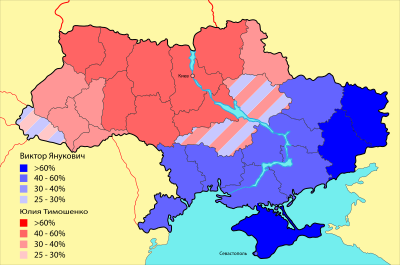
V.F. Yanukovych leads in the regions of Eastern and Southern Ukraine, as well as in Transcarpathia; the best result in the Donetsk region (76.04%), Yu. V. Timoshenko in the regions of Western and Central Ukraine, the best result in the Vinnitsa region (54.78%) [24] Voter turnout - 57.76%, from 49, 74% in the Transcarpathian region to 79.09% in the Donetsk region [25] . The incumbent President Yushchenko suffered a serious defeat: his result was a record low among current heads of state in the entire history of democratic elections [26] . In the second round of elections should meet V.F. Yanukovych and Yu. V. Timoshenko.
Voter Support Cards by District
Candidate and General Voting Cards
Voting in custody
According to the State Department of Ukraine for the Execution of Sentences, according to the vote in places of imprisonment in the first round of the 2010 presidential election in Ukraine, Yulia Tymoshenko won by a wide margin. Just over 60% of prisoners voted for it, about 15% of prisoners supported Viktor Yanukovych , about 3% - Sergey Tigipko , and more than 10% voted against all presidential candidates. [27]
First Round Observers
According to the President of the OSCE Parliamentary Assembly, special coordinator of the OSCE short-term observer mission Joao Soares “These elections were very good. It was a high-quality election. ” According to him, the current election process is "a step forward compared to previous elections." At the same time, Suaresh noted that the election campaign was calm and organized, and the fears of mass fraud did not materialize. At the same time, the OSCE statement said that certain amendments must be made to the legislation in the field of electoral procedures. Representatives of the organization also drew attention to the "unfounded" accusations of some politicians of large-scale falsifications that shook public confidence [28] .
CIS observers recognized the elections in Ukraine as democratic, Polish observers stated that the elections were in line with European standards. Experts of the European Parliament adhere to a similar opinion [28] .
Georgian Observers
Georgia sent to the first round of the presidential election in Ukraine more than two thousand of its citizens as international observers. The Georgian Embassy in Ukraine requested the Ukrainian Foreign Ministry to provide diplomatic permission for the use of the airspace of Ukraine by Georgian observers on arrival flights [29] .
According to an official decision of the Central Election Commission of Ukraine of January 11, 2010, 2011 official Georgia’s international observers were denied registration. (2042 Georgian citizens were included in the draft resolution of the CEC, prepared at the initiative of the BYuT representative).
- This decision was appealed by Yulia Tymoshenko in the Kiev Administrative Court of Appeal, which ordered the Central Election Commission of Ukraine to register Georgian citizens as observers in the elections on January 13 .
- On January 8, 2010, the Central Election Commission of Ukraine finally refused to register Georgian observer data.
According to the representative from the PR, E. Lukash, after processing the documents of Georgian observers, 119 people were found whose profiles were duplicated; among all the candidates there was not one who had experience in observing the elections; 1,466 people are unemployed; many put a dash in the column “profession” of the questionnaire of the international observer [30] . Among Georgian observers - a large number of employees of the power structures of Georgia [29] . About a hundred people are employees of special units of the Ministry of Internal Affairs , the police and the armed forces of Georgia [31] . The deputy secretary of the National Security and Defense Council of Ukraine D. Vydrin called these Georgian citizens “false observers” [32] , saying: “The reputation of international observers began to be deliberately destroyed. This is understandable based on the situation when almost as many false observers from Georgia appear on three thousand official observers. It was an attempt to destroy the authority and reputation of international observers as such ” [32] .
On January 19, 2010, the Verkhovna Rada held a press conference on this subject of the deputy V. Sivkovich , who presented in the Rada a record and a printout of the conversation between, according to him, the President of Georgia M. Saakashvili and Y. Tymoshenko [33] . Then, MP Kolesnichenko at a parliament meeting made public a recording of a telephone conversation between Tymoshenko M. Saakashvili on joint actions to use Georgian citizens during the Ukrainian elections [32] .
Second Round
The Central Election Commission of Ukraine approved the holding of the second round of presidential elections on Sunday, February 7, 2010.
Attempted capture of the Ukraine Polygraph
On January 17, 2010 , a meeting was held in the Cabinet of Ministers of Ukraine (the current prime minister is the presidential candidate of Ukraine, Yulia Tymoshenko ) on the government gaining control and a complete change of leadership over the state-owned enterprise Polygraphkombinat Ukraina, which prints out forms for voting in these presidential elections. 17 January Ministry of Finance issued an order to amend the charter of the printing plant with its transfer under the control of the Cabinet. [34]
At 5.30 a.m. on January 21, 2010, after breaking doors, a shop window and attacking the company using special means (tear gas, batons), the security personnel of the Shield under the leadership of the Cabinet of Ministers Vladimir Rudik got into the printing plant. The plant was protected by the plant’s security, people's deputies from the Party of Regions, including N. Azarov , and their protection (the latter - the director’s office). In this situation, an emergency meeting of the National Security and Defense Council of Ukraine was convened by President V. Yushchenko. According to the president, a few days ago the government changed the charter of the plant and appointed a new director to the enterprise. The new leader has no right to manage the plant during the period when election ballots are printed. “In protest, five deputies of the Party of Regions seized the director’s office,” Yushchenko said. At the same time, the president criticized both the decision of the government and the "method of protest that the deputies chose." [35] The printing plant was taken under guard by internal troops and the SBU , reporting to the president. [36]
The Prosecutor General's Office of Ukraine opened a criminal case on the fact of the seizure of the building of the printing plant under Articles 341 of the Criminal Code (seizure of administrative buildings) and 365 (abuse of office).
An extraordinary session of the Verkhovna Rada was convened on January 26 on the issue of the resignation of the Minister of Internal Affairs of Ukraine Yuriy Lutsenko , since, according to the deputies, the security services of the raider seizure of the plant were carried out by police officers of the Shevchenkovsky District Department of Internal Affairs and the special unit “ Tiger ” of the Ministry of Internal Affairs of Ukraine. As a result, on January 28, Verkhovna Rada was dismissed from the post of Minister of Internal Affairs with the wording “for systematic violation of the current legislation on elections, repeated attempts to interfere in the election process”. [37] An hour later [37] Yulia Tymoshenko reinstated him as “acting minister”.
Telephone Agitation
Any campaign during the day before the election violates Ukrainian law on the presidential election and is prohibited. February 6 , a few hours before the day of the second round of elections, provocatively, automatically on 6,702 city telephone numbers in Kharkov (67.14% of whose voters voted for Yanukovych), as well as a large number of numbers in Lugansk (more than 70% - for Yanukovych) and in other cities phone calls were allegedly made from polling stations. Voters were advised by telephone to “vote correctly for Viktor Yanukovych”: “a cross” should be put in front of his name on the ballot, and “Yulia Tymoshenko should be struck out,” because it was this form of voting that was adopted by the “latest decree of the CEC”.
In fact, ballots filled in this way would be invalidated by the election commissions. [38]
Observers
Before the second vote, on February 3, the Georgian Embassy in Ukraine issued a statement according to which Georgia does not send a single observer to the second round of the presidential election.
Exit Polls
Exit poll “National exit poll 2010”: Viktor Yanukovych - 49.9% Yulia Tymoshenko - 45.8% Against all 4.6% [39]
Exit-pol “Savik Schuster Studio”: Viktor Yanukovych - 48.7% Yulia Tymoshenko - 45.6% Against all 5.7% [40]
Exit-pol GFK NOP commissioned by ICTV: Viktor Yanukovych - 47.3% Yulia Tymoshenko - 46.9% Against all 5.0% [41]
Exit SOCIS commissioned by Inter: Viktor Yanukovych - 52.6% Yulia Tymoshenko - 41.5% Against all 5.9%
Exit pol FOM-Ukraine and Ukrainian sociology service commissioned by Inter: Viktor Yanukovych - 49.8% Yulia Tymoshenko - 44.6% Against all 5.6%
Exit-poll Research & Branding Group: Viktor Yanukovych - 47.26% Yulia Tymoshenko - 44.2% Against all 5.53%
Counting Results
As of February 10, 2010, 100% of the protocols were processed.
According to the calculation results [1] :
- Yanukovych, Viktor Fedorovich - 48.95% (12,481,266 voters)
- Tymoshenko, Yulia Vladimirovna - 45.47% (11 593 357 voters)
- Against all - 4.36% (1,113,055 [42] )
- The number of invalid ballots is 1.22%
A total of 25,493,529 votes were counted.
Congratulations
February 9, 2010, Viktor Yanukovych congratulated over the telephone with “success achieved in the presidential election” by Russian President Dmitry Medvedev [43] , and on the same day he was congratulated by telegram and Patriarch of Moscow and All Russia Kirill [44] .
On February 10, Estonian President Toomas Hendrik Ilves and Latvian President Valdis Zatlers congratulated [45] [46] .
February 11, 2010 - the Presidents of France and Germany Nicolas Sarkozy and Horst Köhler [47] , the President of Poland Lech Kaczynski [48] , the President of the United States Barack Obama [49] , the President of the European Commission Jose Manuel Barroso , the President of Georgia Mikhail Saakashvili [50] congratulated Yanukovych with the election of the president.
Over the next few days, Yanukovych was congratulated by the heads of NATO and dozens of countries.
Second Round Official Results
As a result of the second vote, the elected president of Ukraine was Viktor Yanukovych, the candidate for the post of president of Ukraine, who received more than the number of candidates for the post of president of Ukraine, Yulia Vladimirovna Tymoshenko, who participated in the vote [51] .
On February 16, candidate Tymoshenko filed a lawsuit with the Supreme Administrative Court of Ukraine to appeal the results of the presidential election [52] . Tymoshenko believed that in order to prove her allegations, the court should compare the lists of voters during the voting with the lists of the state register of voters, which ultimately would drag out the process for several months.
On February 20, the Higher Administrative Court of Ukraine, at the request of Yulia Tymoshenko herself, dismissed her lawsuit to annul the results of the presidential election. The decision of the Supreme Administrative Court is final and not subject to appeal on appeal and cassation [53] . Tymoshenko herself linked her decision to withdraw the lawsuit with the court’s refusal to consider evidence of fraud in the elections and question witnesses, expressing the opinion that “it became clear that this was not a court, and that this was not justice” and “Yanukovych was not elected a legitimate president” [54] .
Notes
- ↑ 1 2 Central vibrocha of the Ukrainian COMMISSION → Results of voting in Ukraine (in Ukrainian)
- ↑ Yanukovych officially declared the winner in Ukraine . Russian service of the BBC (February 14, 2010). Date of treatment February 22, 2010. Archived April 1, 2012.
- ↑ The Verkhovna Rada approved the date of the inauguration of Yanukovych . Lenta.ru (February 16, 2010). Date of treatment February 22, 2010. Archived April 1, 2012.
- ↑ The presidential election in Ukraine will be held in January 2010 . Vesti.ru (June 23, 2009). Date of treatment February 22, 2010. Archived April 1, 2012.
- ↑ The Parliament of Ukraine scheduled the presidential election on January 17, 2010 . Interfax-Ukraine (June 23, 2009). Date of treatment February 22, 2010. Archived April 1, 2012.
- ↑ Ukraine drags into election fever
- ↑ Brief information about candidates on the website of the CEC of Ukraine (in Ukrainian)
- ↑ Dossier: Oleg Ryabokon , Liga.net
- ↑ New items 11.11.2009 p
- ↑ Выборы Президента Украины 2010 года . Центральная избирательная комиссия Украины. Дата обращения 12 ноября 2009. Архивировано 1 апреля 2012 года. (Ukrainian)
- ↑ Украина обречена либо на распад, либо на революцию
- ↑ Партия регионов сплотила 'посторанжевые силы'. Невольно… — Украина — Правда. Ру
- ↑ Большинство украинцев придут на выборы и проголосуют за Януковича / Власть / Украина и мир / Украинский бизнес ресурс
- ↑ Список исследований :: R&B Group: маркетинговые, социологические и политические исследования
- ↑ РБК-Украина : TNS обнародовала предвыборные рейтинги кандидатов в Президенты Украины за ноябрь-декабрь 2009 г.
- ↑ УНИАН : Социологи констатируют сокращение разрыва до 4 % между основными кандидатами в президенты Януковичем и Тимошенко
- ↑ Национальный экзит-полл: Янукович набирает 31,5 %, Тимошенко — 27,2 % Новости политики Украины — Корреспондент
- ↑ Согласно данным на 23.00 17.01.2010
- ↑ Национальный экзит-пол обещает не допустить ошибок первого тура
- ↑ Национальный экзит-пол объяснил, почему их результаты расходятся с ЦИКом
- ↑ Организаторы Национального экзит-пола пожаловались на погоду : Новости УНИАН
- ↑ {title} (недоступная ссылка) . Дата обращения 17 января 2010. Архивировано 10 февраля 2010 года.
- ↑ Результати голосування по Україні Архивная копия от 10 февраля 2010 на Wayback Machine (укр.)
- ↑ Підсумки голосування. Підтримка лідерів по регіонах (укр.)
- ↑ Хід голосування по регіонах України (укр.)
- ↑ [Главред] Азартная география
- ↑ Зэки решили добить Тимошенко
- ↑ 1 2 utro.ua ОБСЕ: «Это были высококачественные выборы», 18 января 2010 года
- ↑ 1 2 В. Скачко. «Власть на сохранении». « Киевский телеграф », 29 января-4 февраля 2010, № 4(506), стр.2 (Проверено 3 февраля 2010)
- ↑ 2000 (газета) , Киев, № 2(493), 15-21 января 2010 г. (Проверено 3 февраля 2010)
- ↑ Александр Чачия: «Десант» наблюдателей от Грузии — беспрецедентный случай в мировой практике". Интервью . « Киевский телеграф », 29 января 2010, № 4(506) (Проверено 3 февраля 2010)
- ↑ 1 2 3 «БЮТ готовит хаос для Украины — СНБО». 04.02.2010, 16:06, MinProm.ua
- ↑ Политика: «Тимошенко и Саакашвили: Ещё один скандал вокруг леди Ю набирает обороты», 20.01.2010, 14:43 UBR.ua (Проверено 3 февраля 2010)
- ↑ «Тимошенко пошла на захват полиграфкомбината Украина » Укр.нет, 22 января 2010, 16:08 (Проверено 3 февраля 2010)
- ↑ Гудок.ру: Политика (Проверено 3 февраля 2010)
- ↑ «Депутаты переживают за „Украину“. Полиграфкомбинат подвергся атаке» «Коммерсантъ», 28.01.2010 (Проверено 3 февраля 2010)
- ↑ 1 2 «Юрий Луценко: холодная зима 2010-го» . « Киевский телеграф », 29 января-4 февраля 2010 № 4(506) (Проверено 3 февраля 2010)
- ↑ «Хроника голосующего города». «Харьковские известия» № 17(2143), 3 февраля 2010, стр.2
- ↑ Янукович — 49,9 %, Тимошенко — 45,8 %, — «Национальный экзит-полл-2010»
- ↑ Янукович — 48,7 %, Тимошенко — 45,6 %, — «Савик Шустер Студия»
- ↑ GFK NOP
- ↑ Підсумки голосування. Підтримка лідерів по регіонах (укр.)
- ↑ Д. Медведев поздравил В. Януковича с успехом // РБК , 9 февраля 2010.
- ↑ https://ru.tsn.ua/ukrayina/moskovskii-patriarh-pozdravil-yanukovicha-s-pobedoi-na-vyborah.html
- ↑ Эстонский президент уже поздравил Януковича с победой // Украинская правда , 10 февраля 2010.
- ↑ Президент Латвии поздравил Януковича с победой на выборах
- ↑ Лидеры Франции и Германии поздравили Януковича с победой на выборах
- ↑ Качиньский пожелал Януковичу успехов
- ↑ Президент США Барак Обама поздравил по телефону лидера Партии регионов Виктора Януковича с победой на выборах президента Украины
- ↑ Януковича вслед за Медведевым спешат поздравить мировые лидеры , Newsru, 11.02.2010.
- ↑ Протокол Центральної виборчої комісії про результати повторного голосування з виборів Президента України (укр.) (14 февраля 2009). Дата обращения 15 февраля 2010.
- ↑ Тимошенко оспорила результаты выборов в суде (16 февраля 2009). Дата обращения 18 февраля 2010. Архивировано 1 апреля 2012 года.
- ↑ Суд прекратил рассмотрение иска Тимошенко . РИА Новости - Украина (20/02/2010). Дата обращения 20 февраля 2010. Архивировано 1 апреля 2012 года.
- ↑ Тимошенко объяснила, почему отзывает иск . РИА Новости - Украина (20/02/2010). Дата обращения 20 февраля 2010. Архивировано 1 апреля 2012 года.
Links
- Раздел сайта Центральной избирательной комиссии Украины посвященный выборам (укр.)
- Карты выборов 2010 по участкам (укр.)
- Краткая информация о кандидатах на сайте ЦИК Украины (укр.)
- Президентские выборы на Украине, Регнум.ru
- На Украине определились с датой президентских выборов. Голосование должно состояться 17 января 2010 года , АиФ, 28.01.2009.
- Выборы Президента Украины, Центр Разумкова. (Ukrainian)
- График: Якби вибори Президента України відбувалися наступної неділі, то за кого Ви проголосували б? (динаміка, 2008—2009) (укр.)
- Mace hunters. "LOOK.RU"
- Elections 2010. Analysis of statistics on Google searches
- Election ratings of candidates for the presidency of Ukraine , Elections.in.ua
- Yushchenko and Tymoshenko are leaders in rating downgrade in Lviv