Plastinous ( lat. Scarabaeidae , or Scarabaeidae sensu lato ) is a numerous diverse family of beetles . One of the most distinctive and characteristic features of the representatives of which is the special form of the structure of the antennae with a 3-7-segmented lamellar mace, capable of opening in the form of a fan (in the genus Lethrus, the mace is enveloping, not capable of opening in the form of a fan); the front tibiae are digging, no more than one apical spur is developed on their tops [1] .
| Plastinous | |||||||||||||||||||||||||||||||||||||||||
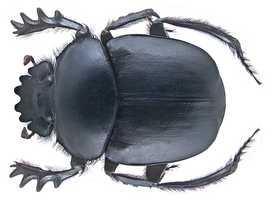 Sacred Scarab ( Scarabaeus sacer ) - a type species of the type genus of the family - Scarabaeus | |||||||||||||||||||||||||||||||||||||||||
| Scientific classification | |||||||||||||||||||||||||||||||||||||||||
|---|---|---|---|---|---|---|---|---|---|---|---|---|---|---|---|---|---|---|---|---|---|---|---|---|---|---|---|---|---|---|---|---|---|---|---|---|---|---|---|---|---|
| |||||||||||||||||||||||||||||||||||||||||
| International Scientific Name | |||||||||||||||||||||||||||||||||||||||||
Scarabaeidae | |||||||||||||||||||||||||||||||||||||||||
| Type genus | |||||||||||||||||||||||||||||||||||||||||
Scarabaeus | |||||||||||||||||||||||||||||||||||||||||
| Subfamilies: | |||||||||||||||||||||||||||||||||||||||||
| |||||||||||||||||||||||||||||||||||||||||
Content
General characteristics
The total population of the family is approximately 30,000 species, and up to 200 new ones are described annually [2] [3] . In the territory of the countries of the former USSR about 1000 species are known [4] , directly in Russia - 435 species [5] .
Plastinous are widespread throughout the globe, in all six zoogeographical regions .
Most of the members of the family are medium-sized beetles, 2–60 mm long, but among the species there are real giants belonging to the largest beetles in the world. The largest species of the family is the Hercules beetle ( Dynastes hercules ), found in Central and South America , individual males of which reach a length of 165–172 mm [6] [7] , and according to not documented data, up to 178 mm. The second largest is the closely related species Dynastes neptunus , with a maximum recorded length of the male 158 mm [8] , the average length 120-140 mm. They are followed by representatives of the South American genus Megasoma - Megasoma elephas , Megasoma actaeon , Megasoma mars , with a body length of up to 125 mm, and the Asian genus Chalcosoma - reaching lengths of 110–120 mm [7] . The most severe beetles in the world belong to the platycine - individual males of a number of goliath species reaching a length of up to 95-100 mm [7] , according to one data, up to 47 grams [9] can weigh in life, and others - up to 80-100 grams [ 2] .
Representatives of the family are very diverse in shape and body length; coloration; the presence of thorns, horns, outgrowths, mounds on the pronotum and head - all this makes them one of the favorite families among beetles for collecting by entomologists .
Male Chalcosoma caucasus , island Java
Male Megasoma elephas , Mexico
Male Megasoma actaeon , South America
Male Goliathus goliatus , Cameroon
Hercules beetle male ( Dynastes hercules lichyi ) South America
Male Dynastes neptunus from Colombia
Imago morphology
The body is compact, short-oval. The shape of the body is varied: oval, sub-square, cylindrical. Coloring is also varied; adults have or do not have a metallic tint. Representatives of the genus Chrysina are colored in various greens and are often carried on the elytra of the grooves, but there are also several species of the genus with completely smooth skin and a solid metallic color of gold or silver. Some of the species may be stubby or scaly cover. [2]
Head
Head slightly bent or forward. Antennae consist of 10 segments (occasionally they are 9- or 11-segmented) with a 3-7-segmented lamellar mace [1] capable of opening in the form of a fan (in the genus Lethrus, the mace is enveloping and unable to open as a fan) [1] . The apical segments of the mace are bare (in a large part of the whorls ) or completely or partially covered with gray hairs. In representatives of Troginae , or Trogidae, such protrusions are reduced, while in the tribes of Geotrupini and Lethrini the eye is completely divided into two parts. Clypeus often hillocky and horned. Usually the upper lip is well developed and often extends from the clypeus. The varied structure of the mandibles : usually strongly chitinized with the teeth, but in coprophages they are soft and leaf-shaped. Mandibles are usually well visible from above, but in some groups they are hidden under the upper lip or clypeus. Maxillae have a 4-segmented palp and a lower lip with a 3-segmented palp. [2]
Chest
Pronotum of various forms, often bumpy and with various projections. The flap is visible from above or hidden under the elytra. The flap is usually triangular or parabolic. [2]
Limbs
Paws with transverse or conical coxae. The coxae of the front legs are valvate, transverse, close together, rather protruding. Median coxae longitudinal or oblique, more or less widely spaced, slightly protruding subthorax. Hind coxae very long, transverse, contiguous. Fore tibia with three or two large teeth, or several small ones on the outer edge. Top of a shin with one spur. Powerful hips, especially the front. Middle and hind tibia thickened or thin, their tops with 1st or 2nd spurs that touch each other and are separated by the first segment of the foot. Formula paws 5-5-5. The forelegs of some scarab ( Scarabaeinae ) are absent. Claws of different structure, the same or different in size, simple or jagged. Developed empody . [2]
Elytra and wings
In most species, the wings are well developed. Rarely, in some species, in connection with the way of life, there is a reduction of wings, complete in both sexes and ootrophic only in females. The inability to fly, associated with the reduction of the hind wings, is clearly an apomorphic feature. [2]
In some species, males and females fly equally often, in others females fly little, and sit more and crawl, in the third females do not fly at all. In forms with wingless females, males with normally developed wings, the first ones creep along the ground, while males fly low at this time.
Venation refers to the keantharoid type. The costal and subcostal veins are completely radial, partially merged in the basal half of the anterior margin of the wing, forming a single supporting structure. The costal vein before the lower bend of the wing has a rather long row of transverse notches.
Most species fly well. The flight of larger species from genera, etc. is slow and heavy. Small species, especially have a quick takeoff and high speed of flight.
Elytra convex or thickened, grooves well expressed or absent altogether. In several tribes of the subfamily Cetoniinae and in the genus Gymnopleurus ( Scarabaeinae ), a recess appeared on the lateral margins of the elytra. In this case, the flight takes place with folded elytra, and the wings are extended to the sides of the body, through these notches.
Abdomen
The belly consists of 6 sternites [10] and has 7 spiracles. Pigidium, among the representatives of the subfamily Scarabaeinae , Aphodiinae , Geotrupinae , is hidden under the eurfins , and in most species it is open. The aedeagus consists of a basal sclerite and two parameres (symmetric or asymmetrical).
Sexual dimorphism
In the whole detachment of beetles, the representatives of the platylae are distinguished by the most diverse and pronounced manifestations of sexual dimorphism . Only some species and less often - the genera are characterized by a weak development of secondary sexual characteristics; such are Canthon and a number of other Canthonini , Sysiphini . In other groups, the head of the males is supplied with various horns or lamellar outgrowths, which are absent or poorly developed in females. Secondary sexual characteristics may also be expressed as a modification of the pronotum, prothorax, legs, and pygidium.
The number or shape of spurs in both sexes may vary. Sometimes the male differs from the female in the degree of pubis pubescence. Among other signs of sexual dimorphism, the structure of the limbs in males should be noted, for example, the front legs of the males of some Onthophagini are strongly elongated and twisted, often with additional teeth and processes. In a number of species, the posterior trochanters in the males of some Sisyphus from tropical Africa are elongated. Male hind tibia of a number of Scarabaeus species have fringes of particularly dense setae along the inner margin. The subfamily of the Scarabins is characterized by a different size and shape of the pygidia and the 8th sternite of the abdomen of males and females, and only in Gymnopleurini , Sisyphini and many Cantiionini these signs are weakly expressed.
Geographical distribution
Plastinaceae are widespread throughout the globe, in all zoogeographical regions , with the exception of the polar regions. Most species are very thermophilic. Therefore, they are most richly represented in tropical countries, and in the temperate zones of the globe, the number of species decreases as they approach the polar polar latitudes.
Ecology Features
A number of species feed on compost from rotting leaves and other plant debris. Others are found in anthills or termitaries , at the stage of imago or larvae. Species from the American genus Deltochilum (for example, Deltochilum valgum [11] ) lead a predatory lifestyle and pursue other manure inhabitants.
Almost all members of the subfamily Scarabaeinae , except for a few tropical species, are biologically related to the soil, and adults are , as a rule, excellent diggers. The main feature of the biology of Scarabaeinae , which determined their formation as a subfamily of plate, is coprophagy , that is, the feeding of animal excrement. Numerous adaptations of adults to coprophagy are reflected in the structure of the oral apparatus, intestines, head, legs, integuments, etc. Morphology of the larvae is also associated with coprophagy and development in a limited supply of nutrients harvested by parents. Most species of the subfamily eat the excrement of mammals , especially ungulates, cattle, horses, donkeys, camels and pigs. Wild animals prefer the droppings of deer, wild boars, bears and various rodents. In countries with insufficiently developed excreta disposal, human excrement often serves as food for dung beetles. Necrophagy in its pure form is characteristic of a number of representatives of the subtrib Phanaeina and Dichotomiina , as well as for most species of Parascatonomus from South and Southeast Asia. Many species of Onthophagus , less commonly Scarabaeus, are optional necrophages and are sometimes found on carrion [12] .
A number of species of the genus Gluphyrocanthon are mammalian ectocomments and live in South America in the fur of some monkeys. Species of the genera Uroxis and Thihillum are found in the wool of the sloths or in the anus of the American tapir . Representatives of the genus Macropocopris live in Australia under similar conditions on kangaroos [12] . Many species, representatives of the Bronzovka tribes, are often found feeding on flowers or flowing tree sap. Representatives of the tribe Khrushchi actively feed on leaves of tree species. Afagia is widespread in the species inhabiting sea coasts, river sands, steppes and deserts, where they constitute the predominant group. Afagia is an adaptation to life in conditions of weak development of the aerial parts of plants [13] .
Activity and flight time
Imago of some species are active during the day, while others are predominantly at night, flying to the light. Beetles usually occur throughout the warm period, but the activity of most species is confined to a particular season, the duration of the flight may be different even in closely related species [14] .
The morphology of the preimaginal stages
Egg
The length of eggs in various species ranges from 1 to 15 mm. The shape of the eggs is cylindrical-oval, usually slightly curved. The surface of the eggs is smooth, leathery. Coloring - yellowish-white. Eggs are laid in the soil, the substrate that feeds the larvae, or in specially dug minks, where the imago store the food for the larvae (most often animal droppings) [14] .
Larva
Larvae of scarab beetles have a C-shaped (scarabeoid) cylindrical shape, thick, curved, six-legged [15] . Color is almost white to slightly yellow. The head is of hypognathic type, yellow-brown or yellow-red, with developed strong jaws. The head capsule is strongly sclerotized. On the head, there is an epicranial suture separating two pleural sclerites, and frontal sutures separating the frontal triangle. [2]
Most of the eyes are absent, but only some Dynastinae , Cetoniinae , and Trichiinae are present.
Antennae most 4-segmented ( Geotrupinae 3-segmented). [2]
The upper lip has a diverse structure, with the apex usually round or three-lobed. Maxills are symmetrical. The mandibles are chitinized and asymmetrical, their edge with one or several teeth. [2] Breast tergites with transverse grooves dividing them into pro-, meso- and metergit. Prothorax with a pair of spiracles. Abdomen with 9 visible segments. Tergites 1–7 divided into 3 folds like breast segments. Segments 1–8 carry a pair of spiracles on the sides. Anal sternite with bristles or spines. Anal opening 3- or 6-beam, often in the form of a transverse slit. Legs are 4-segmented, often the boundaries between the segments are not very distinct. The legs are rather long and approximately equal in length, but sometimes the 1st or 3rd pairs are noticeably shorter than the rest, and in the Kravchik larvae ( Lethrus ) the legs of all pairs are very short [15] .
The larval stages are three [14] . The habitat and food of the larvae are diverse. Plate larvae form two groups: [15]
- the group, Scarabaeidae-Pleurosticti, is made up of forms living in soil or rotten wood, and they are also quite actively engaged in the search for food, they themselves build protective cradles , etc. [15] The group mainly consists of phytophages, these are Melolonthini , Rhizotrogini and others , and from saprophages - Cetoniini , Valgini , genus Oryctes , etc., or forms with mixed nutrition - Rutelini . [15]
- the group, Scarabaeidae-Laparosticti, is represented mainly by animals that are scotophagous . In the simplest cases, such as the Laparosticti, the larvae feed on manure in the place where the eggs were laid or in places with decaying vegetation, riddled with the mycelium of deciduous litter of forests, and there is the species Geotrupes stercorosus . [15]
The larvae of various members of the family feed on plant roots, plant and animal residues, and soil humus [14] .
Pupa
Pupation occurs in the soil or substrate, which the larva ate. Pupa open, free, soft, mostly yellowish-white. Usually it lies on its back and is placed in a false cocoon (the so-called cradle), which consists of the remains of larva food, its excrement and soil. False cocoons are made by the larvae, sometimes with the help of parents (usually females).
The shape of the pupae is peculiar and is characterized primarily by the presence of numerous protrusions on different parts of the body, which ensure minimal contact of the pupa’s body with the walls of the crib.
In the majority of dung beetles in the year 1, generation (in a number of species of the Aphodiinae subfamily, several generations), in herbivorous species, as a rule, larvae develop 2–3 years, in some species, up to 5-6 years [14] .
Phylogeny
Paleontological finds are rather scarce [12] . Of a significant number of described fossil species of beetles, only a very small number is accounted for by the members of the family. Taking into account the extremely insufficient paleontological data, as well as data on the current distribution of species, it must be assumed that the subfamily was formed already in the Cretaceous period , and partly already in the Jurassic .
The most ancient discovery of a morphologically typical representative of the subfamily Scarabaeinae should be considered the Prionocephale deplanate , described from the upper Cretaceous of Zhejiang Province in China. According to the structure of the body, this beetle is a dauber, which indicates the considerable antiquity of this feature of biology, which may have arisen while feeding on excrement. From the Paleogene sediments of Europe ( Eocene , Early and Late Oligocene ), two species of Onthophagus are described, one is Onitis , one is Sisyphus , one is Scarabaeus from the tribe Scarabaeini . The evolution of this subfamily of platelets was inseparably linked with the evolution of large vertebrate animals: primarily mammals, and in the early stages, perhaps, of herbivorous dinosaurs [12] . The fossil deposits of Khrushchev are known from the Lower and Upper Oligocene , Miocene, and Quaternary deposits of Western Europe and North America.
Classification and Systematics
Initially, most of the lamellas were described as part of a huge Linnaean genus Scarabaeus . But soon, as information on the diversity of species was accumulated, a large number of independent genera were separated from Scarabaeus , which, in turn, were also repeatedly “split up” and “gave rise” to subfamilies and even families [1] .
Until now, there is no generally accepted classification, a number of subfamilies are considered by different authors, both in the rank of independent families and tribes. Lamellar classification recently actively discussed and there are many points of view on their systematics. Eastern European and North American taxonomists include the stag beetle family ( Lucanidae ) and the passalidae ( Passalidae ) in the Scarabaeoidea superfamily. Western European authors divide Scarabaeidae into several families. Often considered as independent families of Aphodiinae , Geotupinae and Troginae . In addition, each subsequent more thorough study of any taxon almost always led to an increase in its rank.
Role in ecosystems
Many large members of the subfamily Scarabaeinae may be intermediate owners of a number of helminth species, including pathogens for domestic animals and less commonly, humans. The most common nematodes from the order Spirurata are : Ascarops strongylina , Gongylonema ingluvicola , Gongylonema pulchrum , Spirura rutipleurites , Spirocerca lupi , Spirocerca sanguinolenta and Physocephalus sexalatus . These species are parasitic in mammals: pigs, camels , cattle, deer and various predators, less frequently in poultry [12] .
Practical value
Most of the species, especially in the northern areas, are relatively inconspicuous in biocenoses and do not have any influence on human activities. Beetles from the subfamily Scarabins are the main natural orderlies clearing the surface of the soil from a variety of excrement . Disposal of manure by beetles contributes to their movement into the lower layers of soil, which are loosened and fertilized [12] . Negative value is also noticeable. The larvae and beetles of a number of plate species are pests of forest, fruit and agricultural crops. For example, some species of May Khrushchev are one of the main pests of fruit and berry and forest plantations in Central Europe, in the forest-steppe zone, in the North-East of Ukraine. In the years of mass breeding, these beetles can completely devour the leaves of trees [16] . Some tropical species from the genus Oryctes and others harm coconut palms , taro , sugarcane , etc.
Many members of the subfamily Scarabaeinae are intermediate hosts of a number of helminths that cause epizootics of domestic and wild animals, and sometimes dangerous to humans [12] . In South India and Sri Lanka, there is another parasitological problem associated with members of the subfamily Scarabaeinae . Among the local population, occasionally a periodic bowel disease occurs, accompanied by bloody diarrhea, called scarabiase . It is caused by some small species of Onthaphagus . These beetles during sleep penetrate the human intestine through the anus, especially children living in unsanitary conditions and cause damage to the intestinal mucosa [12] .
In Laos and Burma, the large larvae and pupae of a number of species of the family are a delicacy in the local cuisine [12] .
In culture
The sacred scarab , was a sacred insect in ancient Egypt . It was believed that the beetle, rolling the ball of dung, personified the path of the Sun's movement across the sky. The Egyptians identified the scarab with the mystery of the creation of the luminary and portrayed the Egyptian God Khepri , depicted with the head of a scarab - the creator of the world and man [17] . Images of the sacred scarab are found in the painting of tombs, on papyrus. Preserved jewelry and sculptures depicting scarabs. In the temple complex of Karnak, not far from Luxor , a column, crowned by a stone scarab, has been preserved.
See also
- Systematics of beetles
Notes
- ↑ 1 2 3 4 G.V. Nikolaev Plate beetles (Scarabaeoidea) of Kazakhstan and Central Asia. - Alma-Ata: Science, 1987. - 232 p. - 1000 copies
- ↑ 1 2 3 4 5 6 7 8 9 10 Plateaceous (Scarabaeidae)
- ↑ Brett C. Ratcliffe. A checklist of the Scarabaeoidea (Coleoptera) of Panama (Eng.) // Zootaxa: journal. - 2002. - No. 32 . - P. 1-48 .
- ↑ Medvedev S. I., Plastinous. The fauna of the USSR. Insects beetles, t. 10, c. 1-5, M. — L., 1949-64.
- ↑ ZIN.ru Atlas of beetles Russia superfamily SCARABAEOIDEA
- ↑ Insect-Sale.com - Insect Price List - Special
- ↑ 1 2 3 Yukio Yaznda & Shuji Okejima “Kafer der Welt”, 1990, 126 pages, 700 col illus
- ↑ The Breeding of Dynastes hercules hercules Archived May 20, 2012.
- ↑ Coleop-Terra Giant Beetles Goliathus goliatus Archived April 29, 2011.
- ↑ Mamaev BM, Medvedev L.N. and Pravdin F.N. Identifier of insects of the European part of the USSR. - Moscow: "Enlightenment", 1976. - p. 103-187. - 304 s.
- ↑ James Morgan . Little dung beetle is big chopper , BBC News ( 2009-01-21 ).
- ↑ 1 2 3 4 5 6 7 8 9 O. N. Kabakov Plaster beetles of the subfamily Scarabaeinae of the fauna of Russia and adjacent countries M.;, KMK Scientific Press Association, 2006. 374 p.
- С. Medvedev S. I. The Scarabaeidae family (Subfam. Melolonthinae, part 1). The fauna of the USSR. Insects beetles. Volume 10, issue. 1. 1951. 514 p.
- ↑ 1 2 3 4 5 P. Ler - Determinant of insects of the Far East of the USSR. V.3. Coleoptera, or beetles. Part 1 - 1989
- ↑ 1 2 3 4 5 6 Medvedev S.I. Larvae of scarab beetles of the fauna of the USSR. - 1952. - 342 s.
- ↑ Savkovsky P.P. Atlas of pests of fruit and berry crops. - 5th edition, supplemented and revised. - Kiev: Harvest, 1990. - 96 p., Col. tab., ill. with.
- ↑ Symbols of discipleship in ancient Egypt Scarab
Literature
- Gilyarov MS The determinant of insect larvae living in the soil. - M .: Nauka Publishing House, 1964. - 293 p.
- Dzhambazishvili Ya. S. Plastinous beetles of Georgia. - Tbilisi: Metsniereba, 1979. - 275 p.
- Knipovich N. M. Plastinous // Encyclopedic Dictionary of Brockhaus and Efron : 86 t. (82 t. And 4 extra.). - SPb. , 1890-1907.
- Medvedev S.I. Larvae of scarab beetles. - M .; L .: USSR Academy of Sciences, 1952. - 342 p.
- Medvedev S.I. Family Scarabaeidae (Subfam. Melolonthinae, part 1). The fauna of the USSR. Insects beetles. Volume 10, issue. 1. 1951. 514 p.
- S. Medvedev. The family of Scarabaeidae (Subfam. Melolonthinae, part 2). The fauna of the USSR. Insects beetles. Volume 10, issue. 2. 1952. 276 p.
- Medvedev S. I. Family Scarabaeidae (Subfam. Rutelinae). The fauna of the USSR. Insects beetles. Volume 10, issue. 3. 1949. 372 p.
- Medvedev S. I. Family Scarabaeidae (Subfam. Euchirinae, Dynastinae, Glaphyrinae, Trichiinae). The fauna of the USSR. Insects beetles. Volume 10, issue. 4. 1960. 398 p.
- Medvedev S. I. Family Scarabaeidae (Subfam. Cetoniinae, Valginae). The fauna of the USSR. Insects beetles. Volume 10, issue. 5. 1964. 375 p.
- Nikolaev, GV. Plate beetles (Coleoptera, Scarabaeoidea) of Kazakhstan and Central Asia. - Alma-Ata, "Science", 1987. - p. 232.
- Medvedev S.I. Scarabaeidae // Key to the insects of the European part of the USSR (ed. G. Bey-Bienko.) - Moscow-Leningrad, 1965. - Vol. 2. - S. 1-668.
- Dalla Torre, KW Von. 1912-1913. Scarabaeidae: Melolonthinae. Coleopterorum Catalog, pars 45, 47, 49, 50: 1-450. W. Junk, Berlin.
- Endroedi, S. 1985. The Dynastinae of the World. Dr. W. Junk Publisher, London. 800 pp.
- Howden, HF 1964. A Catalog of the North American of Coleoptera. Family Scarabaeidae. Subfamily: Geotrupinae. United States Department of Agriculture, Agriculture Handbook 529-34a. 17 pp.
- Machatschke, JW 1972. Scarabaeoidea: Melolonthidae, Rutelinae. Coleopterorum Catalog Supplementa 66: 1-361.
- Scholtz, CH 1982. Catalog of the World Trogidae (Coleoptera: Scarabaeoidea). Republic of South Africa, Department of Agriculture and Fisheries, Entomology Memoire 54: 1-27.