Project 1205 landing craft (code “Scat” , according to the classification of the USA and NATO GUS-Class , from the English - “goose”) - hovercraft , designed for landing on an unequipped coast. The first of its kind serial hovercraft in the Soviet Navy . Project boats are designed to carry 40 people landing.
| Project 1205 hovercraft | |
|---|---|
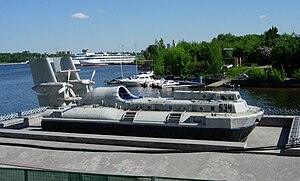 Scat at the Navy Museum in Moscow | |
| Project | |
| A country |
|
| Manufacturers |
|
| Operators |
|
| Subsequent type | project 1206 |
| Years in the ranks | 1969—? |
| Scheduled | 29th |
| Built | 29th |
| Main characteristics | |
| Displacement | 22 tons (standard) 27 tons (full) |
| Length | 21.4 m (largest) |
| Width | 7.3 m (largest) |
| Draft | 0.5 m |
| Engines | 2 × GTU TVD-10M, 1 × GTU TVD-10 |
| Power | 2340 l. from. |
| Speed | 49 knots (maximum) |
| Sailing range | 200 nautical miles |
| Autonomy of swimming | 1 day |
| Crew | 4 people |
| Armament | |
| Radar weapons | Radar "Kivach-1" |
| Artillery | 4 × 1 - 30-mm grenade launcher BP-30 "Flame", 2 × 1 - 7.62 mm FCT |

Content
Project Development History
The Soviet navy was well aware of the advantage of hovercraft , because these ships could move on water and land, and doing so with great speed. Since the 30s, there have been projects to create such ships, but they all did not go into series. In the late 60s, the Ministry of the Navy gave the task of creating the hovercraft to the design bureau of PKB Almaz . After brief research, the first ships went into series and went on combat duty in 1969. The chief designer was L.V. Ozimov. From the side of the Navy, the progress of the development and construction of the project boats was observed by the captain of the 2nd rank V.A. Litvinenko.
Series
Seaside Shipyard
- 4 units
Sea Shipyard
- 19 units
D-345
- Play media file
Marine landing with D-462
Zelenodolsk Plant named after A.M. Gorky
- 6 units
Skat hovercraft, Amur Military Flotilla , 1982