For namesakes, see Francisco de Borja and Borja y Aragon, Francisco de
| Francisco de Borja | |
|---|---|
| Fransisco de borja | |
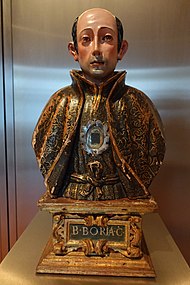 | |
| Name in the world | Francisco de Borja, Duke of Gandia |
| Birth | October 28, 1510 Gandia |
| Death | September 30, 1572 ( 61) Rome |
| Beatified | November 23 , 1624 in Madrid |
| Canonized | June 20 , 1670 in Rome |
| In the face | |
| Day of Remembrance | October 3rd |
Francisco de Borja or Francesco Borgia , 4th Duke of Gandia ( Spanish: San Francisco de Borja ; October 28, 1510 , Gandia - September 30, 1572 , Rome ) - Catholic saint , third general of the Society of Jesus (Jesuits). The representative of the noble Catalan clan Borgia (Borja), the great-grandson of the pope from this clan - Alexander VI . It was canonized on June 20, 1670 [1] [2] .
Content
Biography
Before tonsure
Francisco Borgia was born in Gandia in the Valencia region in 1510. He was the first-born of 16-year-old Juan de Borch , 3rd Duke of Gandia . On the paternal side, Francisco is the great-grandson of Pope Alexander VI , and on the maternal side, King of Aragon Ferdinand Catholic [3] [2]
He spent his childhood at the court of his uncle, Juan of Aragon, Archbishop of Zaragoza , where he was raised as a court gentleman. The request of the archbishop was enough for Francis to be appointed in 1522 the page of his cousin - the Infanta Catherine . At the court of her brother Charles V, Francisco received an excellent education and in 1529 married Leonora de Castro, maid of honor Queen Isabella of Portugal . Eight children were born in the marriage: Carlos in 1530, Isabelle in 1532, Juan in 1533, Alvaro and Juan 1535, Ferdinando in 1537, Dorothea in 1538, and Alfonso in 1539. Isabelle was the mother of the Duke of Lerma , Carlos - the father of the head of the Spanish Church . The grandson of Juan - Francisco de Borja y Aragon - in 1615-21. governed in South America.
When Karl left Italy in 1530, it was Francis who became the de facto leader of the court and chief adviser to his wife Isabella . In addition to his other duties, Francis was the mentor and companion of Prince Philip [4] . Gossip attributed to him a love affair with Isabella, but there is no evidence of this [5] .
In 1536, Francis accompanied Charles V in his military campaign in Provence . This was his first experience on the battlefield, and Francis was very disappointed. According to legend, one of the most significant experiences affecting the life of Francis was the death of Empress Isabella in 1539. Francis and his wife Eleanor were responsible for all stages of the funeral and he was forced to personally open her coffin before the funeral [5] . It is said that after her death he said that he would never again serve the mortal master.
After the death of Isabella, Francis was appointed viceroy to Catalonia . In 1542, he inherited the duchy of his father, but after the death of his wife he refused it and decided to become a monk [6] .
Monastic life
After completing a theological education, in 1551 he accepted ordination and openly declared his belonging to the Society of Jesus . He refused the ranks that the world could offer him, but throughout most of his monastic life he was assigned administrative duties. He undoubtedly possessed all the necessary qualities for this, which manifested themselves in the world when he was vice-king of Catalonia (1539-1542) [5] .
In 1565, he was elected the third general of the order [2] . He often called the day of his election to the position of the Jesuits dies meae crucis (the day of his crucifixion) and in his prayers said: "Take me away or take away my position from me, or lead and direct me according to Your will." As a model of his activity, he called his two predecessors - St. Ignatius and about. Laines and asked the Lord to grant him "the kindness of Fr. Lines and the prudence and clarity of our father Ignatius . " He adopted the decree of the Second General Congregation, which elected him with 31 votes out of 39, for the rate of his activity [2] . He devoted considerable attention to organizing the proper training of novices. Francisco Borgia zealously adhered to the spirit of the Society and in a memorial letter listed the means to preserve it. By the authority of the General Congregation, he regulated the amount of time allotted for prayer, but in such a way that it could be adapted to the needs of each individual province. He studied the “Constitution” and commented on them, drafted the rules for various posts and published them in 1567. He prepared the preliminary publication of Ratio Studiorum . Outside Europe, it was he who became the founder of the mission in Latin America, and during his tenure as General, the first Jesuits were sent to Florida . When, after many painful trials, this mission had to be suspended, he turned his attention to Mexico , and the first Jesuit expedition headed for the country in 1571 [2] . More than three missions were sent to Peru during his tenure as general rector.
Francisco Borgia died in Rome on September 30, 1572 and was canonized by Pope Clement X in 1671. [2] His memory in the liturgical calendar falls on October 3. Historians write about him as one of the most successful generals of the Jesuit order after St. Ignatius of Loyola . His relics were transferred in 1901 to the Jesuit Church of Madrid.
Notes
- ↑ Patron Saint | St. Francis Borgia Catholic Church (English) (Neopr.) ? . www.saintfrancisborgia.org. Date of treatment February 18, 2017.
- ↑ 1 2 3 4 5 6 CATHOLIC ENCYCLOPEDIA: Francis Borgia . www.newadvent.org. Date of treatment February 18, 2017.
- ↑ Miroslav MAREK. Borgia 1 . genealogy.euweb.cz. Date of treatment February 18, 2017.
- ↑ Read online "Borgia" by Klulas Ivan - RuLit - Page 159 . www.rulit.me. Date of treatment February 18, 2017.
- ↑ 1 2 3 Read online Borgia by Ivan Klulas - RuLit - Page 162 . www.rulit.me. Date of treatment February 18, 2017.
- ↑ Michael Mallet. Per. Yu.S. Kiryukova: Borgia - the rise and fall of the Renaissance dynasty . samlib.ru. Date of treatment February 18, 2017.
| Predecessor: Laines, Diego | Society of Jesus General July 2, 1565 - October 1, 1572 | Successor: Everardo Mercuriano |