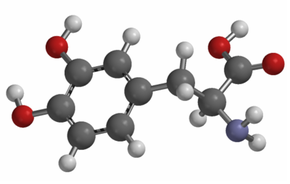
Levodopa is a medicinal , antiparkinsonian drug.
| Levodopa | |
|---|---|
| Levodopa | |
 | |
 | |
| Chemical compound | |
| IUPAC | 3-hydroxy-L-tyrosine |
| Gross formula | C 9 H 11 NO 4 |
| Molar mass | 197.19 g / mol |
| Cas | |
| PubChem | |
| Drugbank | |
| Classification | |
| Pharmacokinetics | |
| Bioavailable | thirty% |
| Metabolism | DOPA decarboxylase |
| The half-life. | 0.75-1.5 hours |
| Excretion | Kidneys 70-80% |
| Dosage Forms | |
| Capsules and pills | |
| Other names | |
| Levodopa | |
Content
General Information
Dihydroxyphenylalanine (DOPA, dopa, dopa) is a biogenic substance that is formed in the body from tyrosine and is a precursor of dopamine , which in turn is a precursor of norepinephrine .
Due to the fact that with parkinsonism, the dopamine content in the basal ganglia of the brain is lowered, it is advisable to use substances that increase the content of this amine in the central nervous system to treat this disease. Dopamine itself cannot be used for this purpose, since it penetrates poorly through the blood-brain barrier . It turned out that instead of dopamine, its predecessor, dioxiphenylalanine (dopa), which is absorbed by oral administration, penetrates the central nervous system, undergoes decarboxylation , turns into dopamine and, replenishing its reserves in the basal ganglia, stimulates dopamine receptors and provides a therapeutic effect in case of parkinsonism .
As a medicine, a synthetic levorotatory isomer of dioxiphenylalanine - L-dopa, which is much more active than the dextrorotatory isomer, is used.
Pharmacological action
Eliminates hypokinesia , stiffness , tremors , dysphagia , salivation. Most are converted to dopamine in peripheral tissues; dopamine formed here does not participate in the implementation of the antiparkinsonian effect of levodopa (does not penetrate the central nervous system) and is responsible for most of its side effects. In this regard, it is advisable to combine levodopa with peripheral dopa-decarboxylase inhibitors ( carbidopa , benserazide ), which can significantly reduce the dose of levodopa and the severity of side effects. To reduce decarboxylation, levodopa is used with dopa-decarboxylase inhibitors (see Nakom , Madopar ). The therapeutic effect is observed after 6-8 days, and the maximum - after 25-30 days. It is established that the therapeutic effect is achieved in 50-60% of patients. In others, the effect is not very pronounced, the dose of the drug cannot be increased due to side effects.
Pharmacokinetics
When taken orally, it is rapidly absorbed from the gastrointestinal tract , absorption - 20-30% of the dose (depends on the speed of evacuation of the contents of the stomach and on the pH in it). The presence of food in the stomach slows down absorption. Some food amino acids may compete with levodopa for absorption from the intestines and transport through the BBB . With oral administration, TCmax is 1-2 hours. It is detected in large quantities in the small intestine , liver and kidneys , only about 1-3% penetrates the brain . It is metabolized in all tissues, mainly by decarboxylation with the formation of dopamine , which does not penetrate the BBB. The elimination half-life is 3 hours. It is excreted by the kidneys in the form of metabolites (dopamine, norepinephrine , epinephrine ) - about 75% for 8 hours, through the intestines - 35% for 7 hours.
Indications
Parkinson's disease, Parkinson's syndrome (except caused by antipsychotic drugs). There are indications of the effectiveness of the drug in hereditary extrapyramidal diseases characterized by akinetorigid syndrome . The effectiveness of levodopa in the treatment of deforming muscular dystonia was also found . There is evidence of levodopa treatment of reactive stuporous conditions (especially in patients with reduced dopamine excretion ).
Contraindications
Contraindicated in severe atherosclerosis , hypertension with a significant increase in blood pressure , in uncompensated endocrine, renal, hepatic, cardiovascular, pulmonary diseases, narrow-angle glaucoma (with wide-angle glaucoma, treatment is carried out under close monitoring of intraocular pressure and with ongoing anti-glaucoma therapy) blood , melanoma , as well as with individually hypersensitivity to the drug. Levodopa and levodopa-containing preparations are not recommended for pregnant women , nursing mothers and children under 12 years of age.
Caution
Levodopa should be prescribed to patients with bronchial asthma , emphysema , patients with an active stomach ulcer , with psychoses and psychoneuroses , patients who have had myocardial infarction in the past.
Dosage
Inside. Treatment begins with small doses, gradually increasing them to the optimum for each patient. The initial dose is 0.25-1 g in 2-3 doses. The dose is gradually increased by 0.125-0.75 g every 2-3 days, depending on tolerance and until the optimal therapeutic effect is achieved. The maximum daily dose is 8 g. Cancellation is carried out gradually. The drug is taken with meals or with a small amount of liquid, the capsules are swallowed whole. To obtain the best therapeutic effect with the least side effects, the dose of the drug should be selected individually, starting with a relatively small dose with a gradual increase. It is necessary to carefully monitor the patient's condition, especially at the beginning of treatment.
Levodopa can be prescribed simultaneously with anticholinergic drugs. The combined use of anticholinergics with levodopa is effective in the case of rigidobradikineticheskoy and tremulous forms of vascular parkinsonism. You can also combine the use of levodopa and midantan .
Special instructions
When levodopa is discontinued, the phenomena of parkinsonism usually resume, and with the rapid withdrawal of the drug after prolonged therapy, the symptoms of the disease may sharply increase.
It was previously indicated that the use of levodopa is contraindicated in the simultaneous administration of mono-aminoxidase inhibitors ( MAOs ). This provision is currently being specified. The drug should not be used together with irreversible MAO inhibitors of type A (see Nialamide ). In the case of the previous administration of irreversible MAO inhibitors, their intake should be stopped at least 14 days before the start of levodopa. At the same time, MAO inhibitors of type B have recently been proposed to enhance the effect of levodopa (see Deprenyl ).
If general anesthesia is necessary, levodopa should be stopped within 24 hours.
In the process of treatment, it is necessary to periodically conduct blood tests, check the function of the liver and kidneys.
With severe side effects, it is necessary to stop taking the drug.
Side Effects
From the digestive system
Decreased appetite , nausea , vomiting , constipation , dysphagia , ulceration of the mucous membrane of the gastrointestinal tract , gastralgia , gastrointestinal bleeding (in patients with a history of peptic ulcer ).
From the nervous system
Drowsiness or insomnia , anxiety, dizziness , paranoid conditions, hypomania (with increased sexual desire and antisocial behavior), euphoria , depression , dementia , ataxia , convulsions , spasmodic torticollis , dyskinesia , choreiform, dystonic and other uncontrolled thoughts, suicidal movements.
From the cardiovascular system
Decreased blood pressure , orthostatic collapse , arrhythmias , tachycardia .
From the hemopoietic organs
Leukopenia , thrombocytopenia .
Others
Polyuria rarely - diplopia .
Interaction
With the simultaneous use of levodopa with beta-adrenostimulants, ditilin and drugs for inhalation anesthesia, an increased risk of developing heart rhythm disturbances is possible; with tricyclic antidepressants - a decrease in the bioavailability of levodopa. With diazepam , closepine , phenytoin , clonidine , m-anticholinergics , antipsychotic drugs ( antipsychotics ) - derivatives of butyrophenone , diphenylbutylpiperidine , thioxanthene , phenothiazine ; pyridoxine , papaverine and reserpine may decrease antiparkinsonian action. With Li + drugs, the risk of developing dyskinesias and hallucinations increases; with methyldopa - aggravation of side effects. With the simultaneous use of levodopa with MAO inhibitors (with the exception of MAO-B inhibitors), circulatory disorders are possible (taking MAO inhibitors should be stopped after 2 weeks). This is due to the accumulation of dopamine and norepinephrine under the influence of levodopa, inactivation of which is inhibited by MAO inhibitors, and a high probability of the development of arousal, increased blood pressure, tachycardia , facial redness and dizziness. In patients receiving levodopa, the use of tubocurarine increases the risk of a pronounced decrease in blood pressure.
Physical Properties
White crystalline powder, slightly soluble in water, insoluble in alcohol .
Release form
Capsules and tablets of 0.25 and 0.5 g in packs of 100 and 1000 pieces.
Storage
Storage: List B.
Literature
- V.N. Vasiliev. Diagnosis and therapy of incurable nervous and mental diseases of dopamine etiology. Biocorrection of Vasiliev. - M .: Mediaakit, 2009 .-- 247 p. - ISBN 978-5-9901746-1-0 .
Links
- Biochemistry of Parkinson's Disease (link not available)