Cholecystokinin ( CCK ; previously also called pancreosimine ) is a neuropeptide hormone produced by I-cells of the duodenal mucosa and the proximal jejunum [1] .
| Cholecystokinin | |||||||||||||
|---|---|---|---|---|---|---|---|---|---|---|---|---|---|
| Identifiers | |||||||||||||
| Symbol | ; MGC117187 | ||||||||||||
| External IDs | ChEMBL : GeneCards : | ||||||||||||
| |||||||||||||
| RNA expression profile | |||||||||||||
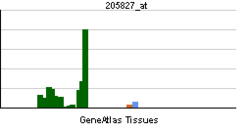 | |||||||||||||
| Orthologists | |||||||||||||
| View | Person | Mouse | |||||||||||
| Entrez | |||||||||||||
| Ensembl | |||||||||||||
| Uniprot | |||||||||||||
| RefSeq (mRNA) | |||||||||||||
| RefSeq (protein) | |||||||||||||
| Locus (UCSC) | |||||||||||||
| Search PubMed | |||||||||||||
Content
Molecular forms of cholecystokinin
Three molecular forms of cholecystokinin were revealed in the mucous membrane of the small intestine, which differ in the number of amino acid residues (cholecystokinin-8, cholecystokinin-12 and cholecystokinin-ZZ). Cholecystokinin-8 accounts for 60-70%. [2]
There are a number of other forms of cholecystokinin: cholecystokinin-58 (abbreviated name CCK58), cholecystokinin-58-disonopeptide ((1-49) -CCK58), cholecystokinin-Z9 (CCK39), cholecystokinin-25 (CCK25), cholecystokinin-18 (CCK18) ), cholecystokinin-7 (CCK7), cholecystokinin-5 (CCK5), [3] CCK-4 .
The amino acid sequence of cholecystokinin-33: H-Lys-Ala-Pro-Ser-Gly-Arg-Val-Ser-Met-lle-Lys-Asn-Leu-GIn-Ser-Leu-Asp-Pro-Ser-His-Arg- lle-Ser-Asp-Arg-Asp-Tyr-Met-Gly-Trp-Met-Asp-Phe-OH. [four]
Functions
Cholecystokinin acts as a mediator in a variety of processes occurring in the body, including digestion. In addition, cholecystokinin acts as a regulator of behavioral physiological acts. It has antidepressant properties. It is related to the emotions of fear and the pathogenesis of schizophrenia . [4] Influences a person’s nutritional behavior, causing a feeling of satiety and controlling appetite .
Low molecular forms of cholecystokinin are inactivated during the first passage through the liver , while large molecular cholecystokinin enters the systemic circulation from the liver. The concentration of cholecystokinin in the blood of a healthy person is 5-800 ng / l. [5] Through the bloodstream, cholecystokinin can pass through the kidneys into the urine , while maintaining biological activity (urocholecystokinin). [2]
The role of cholecystokinin in digestion
In the organs of the gastrointestinal tract, cholecystokinin is produced by I-cells of the duodenum and jejunum. In addition, cholecystokinin is found in pancreatic islets and various intestinal neurons. Cholecystokinin secretion stimulants are proteins , fats , especially those with a long chain of fatty acids (fried foods), components of choleretic herbs ( alkaloids , protopin , sanguinarine , essential oils , etc.), and acids ( but not carbohydrates ). A gastrin-releasing peptide is also a stimulant for cholecystokinin release.
Cholecystokinin stimulates the relaxation of the sphincter of Oddi ; increases the flow of hepatic bile; increases pancreatic secretion; reduces the pressure in the biliary system: it causes a reduction in the pylorus , which inhibits the movement of digested food into the duodenum. [6] [5] Cholecystokinin is a blocker of hydrochloric acid secretion by the parietal cells of the stomach. [7]
An inhibitor of cholecystokinin is somatostatin .
Use as a stimulant in medical diagnostics
Cholecystokinin is used as a stimulant in a manometric study of the Oddi sphincter . In healthy patients, the consequence of its administration should be a decrease in the frequency and amplitude of the phase pressure waves, as well as the basal pressure of the sphincter of Oddi. A different reaction to the cholecystokinin test is a sign of sphincter of Oddi dysfunction . [eight]
History
E.K. Ivy and E. Oldberg (E. Oldberg) in 1928 discovered a regulatory peptide in the mucosal extract that causes contraction of the gallbladder and the release of bile into the duodenum, [9] which was named “ cholecystokinin "(from Greek choly - bile, kýstis - bubble and kieō - to move). A. A. Harper and A. S. Harper in 1943 isolated a peptide capable of stimulating pancreatic secretion from the mucous membrane of the small intestine and called it “pancreosimine” for this ability. [10] In the 1960s, the identity of cholecystokinin and pancreosimine was established. [eleven]
Notes
- ↑ Murray R., Grenner D., Mays P., Rodwell V. Human biochemistry Archived January 23, 2015. . Volume 2, p. 272.
- ↑ 1 2 XuMuK.ru. Cholecystokinin .
- ↑ UniProtKB. Swiss-Prot P06307 (CCKN_HUMAN) . (eng.)
- ↑ 1 2 Human biology. Cholecystokinin (pancreosimine): general information .
- ↑ 1 2 Mayev I.V., Samsonov A.A. Diseases of the duodenum. M., MEDpress-inform, 2005, - 512 s, ISBN 5-98322-092-6 .
- ↑ Yakovenko E.P., Grigoryev P.Ya., Agafonova N.A., Yakovenko A.V. Place of choleretic drugs in clinical practice . Attending doctor. 2005, No. 6.
- ↑ Butov M.A., Kuznetsov P.S. Examination of patients with diseases of the digestive system. Part 1. Examination of patients with diseases of the stomach . A manual on the propaedeutics of internal diseases for 3rd year students of the Faculty of Medicine. Ryazan. 2007 (2.42 MB).
- ↑ Kalinin A.V. Dysfunctions of the sphincter of Oddi and their treatment Archival copy of October 17, 2009 on the Wayback Machine . Breast cancer, August 30, 2004.
- ↑ Ivy AC, Oldberg E. A hormone mechanism for gallbladder contraction and evacuation // Amer. Journal of Physiology. - 1928. No. 86. P. 599-613. (eng.)
- ↑ Harper AA, Raper HS J. Physiol. 1943, 102 , 115. (English)
- ↑ Kravets A.V., Kravets V.P. Historical views on the pancreas . Bulletin of SumDMU. Series "Medicine", 2008, No. 1, p. 26-31.