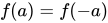
The Borsuk – Ulam theorem is a classical algebraic topology theorem that states that every continuous function that maps -dimensional sphere in -dimensional Euclidean space for a pair of diametrically opposite points has a common meaning.
Informally, the statement is known as the “temperature and pressure theorem”: at any time on the surface of the Earth ( ) there are antipodal points with equal temperature and equal pressure [1] ; the one-dimensional case is usually illustrated by two diametrically opposite points of the equator ( ) with equal temperature.


Wording
For continuous function 


History
The statement was first encountered by Lazar Aronovich Lyusternik and Lev Genrikhovich Shnirelman in 1930 [2] [3] . The first evidence was published in 1933 by Karol Borsuk , in this article he claims that the wording belongs to Stanislav Ulam .
Variations and generalizations
- An equivalent statement is a general zero theorem : every odd (with respect to the diametric opposite) continuous function
of
-dimensional sphere in
vanishes:
. Equivalence is established by introducing a continuous function
. In the one-dimensional case, the general zero theorem follows directly from the intermediate value theorem ; the general proof uses the (algebraic-topological version), or is deduced from ( combinatorial version; in this case, Tucker's lemma is considered to be a combinatorial analogue of the Borsuk – Ulam theorem).
- Abram Ilyich Fet proved this statement not only for the ratio of antipodes, but also for arbitrary involution
spheres
.
Notes
- ↑ O. Ya. Viro, O.A. Ivanov, N. Yu. Netsvetaev, V.M. Kharlamov. Elementary topology
- ↑ L.A. Lyusternik, L.G. Shnirelman. Topological methods in variational problems // Proceedings of the Institute of Mathematics and Mechanics at Moscow State University (special issue). - 1930.
- ↑ Jiří Matoušek. Using the Borsuk – Ulam theorem. - Berlin: Springer Verlag, 2003 .-- ISBN 3-540-00362-2 . - DOI : 10.1007 / 978-3-540-76649-0 .
Literature
- K. Borsuk Drei Sätze über die n -dimensionale euklidische Sphäre - Fund. Math., 20 (1933), p. 177-190.
- Borsuk-Ulam theorem implies the Brouwer fixed point theorem
- M. Crane , A. Nudelman . The Borsuk – Ulam theorem, or something about the weather, about a trained horse, and about two-dimensional fields // Quantum . - 1983. - No. 8 . - S. 20-25 .