Paris Congress - multilateral international negotiations aimed at ending the Crimean War , culminating in the signing of the Paris Treaty ; opened on February 13 (25), 1856 in the capital of France. Plenipotentiary representatives of Russia , France , England , Austria , Sardinia , the Ottoman Empire , as well as Prussia participated in it.
| Paris Congress | |
|---|---|
| English Congress of Paris | |
 Participants of the Paris Conference | |
| the date of the | February 13 (25), 1856 - April 16 (28), 1856 |
| A place carrying out |  Paris , Second French Empire Paris , Second French Empire |
| Members | French empire British empire British empire Russian empire Russian empire Austrian Empire Austrian Empire Ottoman Empire Ottoman Empire |
| Issues Considered | Drafting a peace treaty that concluded the Crimean War The fate of the Danube principalities Black Sea Status The fate of river trade on the Danube Revision of borders between the Russian Empire and the Ottoman Empire |
| results | Paris Treatise March 18 (30), 1856 |
The meetings were chaired by the French Minister of Foreign Affairs, the son of Napoleon Bonaparte, Count A. Walewski . Russia was represented by the first authorized Count A.F. Orlov and the second by F.I. Brunnov , who had long served as the Russian ambassador in London . England was represented by Lord Clarendon ( George Villiers, 4th Earl of Clarendon ) and Cowley ( Henry Wellesley, 1st Earl Cowley ). Austria - Buolem , the Sardinian kingdom - Cavour .
The decision of the Russian emperor Alexander II to negotiate peace was made at a meeting in the Winter Palace on January 3 (15), 1856 , at which the ultimatum presented to Russia by the Austrian emperor Franz Joseph was discussed for the second time (only Count D.N. opposed the adoption of the Austrian ultimatum Fornication ); by then Napoleon III, behind the back of his allied England, was already in secret negotiations with St. Petersburg about the possibility of concluding a peace to which he himself was inclined, not seeing for himself any interest in continuing the war.

England and Austria took the most implacable stance on Russia in Paris; their line subsequently softened under the influence of Napoleon III. England, which initially did not want such a speedy peace at all, now openly sought to weaken Russia in the Black Sea basin , to undermine its positions in the Caucasus , and insisted on the demilitarization of the Aland Islands. With the support of the Austrians, the British even demanded the complete disruption of Russian fortifications along the Black Sea coast, however, thanks to the support of Napoleon III, Orlov won in this matter. Austria demanded the exclusion of all Bessarabia from Russia and counted on the annexation of the Danube principalities to its possessions. The former allies, however, did not support the Danube principalities in any way, and the Austrians left Congress, having received no payment for their ultimatum of December 2, 1855. At the congress, Turkey was forced to agree with the Allies even when their opinions clearly diverged from its interests. Especially (but without any serious consequences) at the congress the question of the need for a future political unification of the Danube principalities was considered.
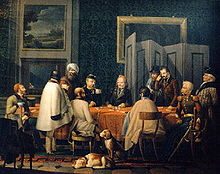
As a result, on March 18 (30), 1856 , a peace treaty was signed, which until 1871 determined the political system in Europe.
Congress was closed on April 16 (28), 1856 .
See also
- Paris Peace / Paris Peace Treaty (1856)
- Warsaw agreement
Literature
- Petrov A.N. Russian diplomats at the Paris Congress of 1856 // Historical Bulletin, 1891. - V. 43. - No. 1. - S. 98-119 , No. 2. - S. 386-413 , No. 3. - S. 672-705.
- Petrov A.N. Russian diplomats at the Vienna conferences of 1855 // Historical Bulletin, 1890. - T. 40. - No. 4. - P. 22-50 , No. 5. - P. 265-289. , No. 6. - S. 514-534.
- Tarle E.V. Crimean War