Cobalt (II) chloride ( cobalt dichloride ) is a cobalt salt of hydrochloric (hydrochloric) acid with the formula CoCl 2 . Belongs to the class of cobalt halides .
| Cobalt chloride | |
|---|---|
 | |
 | |
| Are common | |
| Systematic name | Cobalt Chloride (II) |
| Traditional names | cobalt chloride; cobalt dichloride |
| Chem. formula | CoCl 2 |
| Rat formula | CoCl 2 |
| Physical properties | |
| condition | solid |
| Molar mass | 129.84 g / mol |
| Density | 3.356 g / cm 3 hexahydrate: 1.92 g / cm³ |
| Thermal properties | |
| T. melt. | 735 ° C |
| T. bale. | 1049 ° C |
| Enthalpy of Education | −310 kJ / mol |
| Classification | |
| Reg. CAS number | 7646-79-9 |
| PubChem | |
| Reg. EINECS number | |
| Smiles | |
| Inchi | |
| RTECS | |
| Chebi | |
| UN number | |
| ChemSpider | |
| Security | |
| LD 50 | 80 mg / kg |
| Toxicity | very toxic |
| GHS icons |    |
| NFPA 704 |  0 3 0 |

Cobalt (II) chloride hexahydrate
Cobalt (II) chloride is hygroscopic. Known crystalline hydrates of CoCl 2 · n H 2 O ( n = 1, 2, 4, 5, 6):
- blue-violet monohydrate (stable in air up to 110 ° C, mp 335 ° C, with decomposition);
- violet dihydrate (stable up to 90 ° C, mp 206 ° C, with decomposition);
- dark red tetrahydrate;
- red pentahydrate;
- pink hexahydrate (mp 51.2 ° C, decomposed) - cobalt chloride hexahydrate: CoCl 2 · 6H 2 O;
Content
Physical Properties
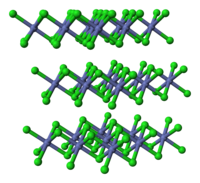
Anhydrous cobalt dichloride under normal conditions is a paramagnetic hygroscopic shiny blue hexagonal crystals; when heated to 680 ° C, it passes into another polymorphic modification.
- Molecular mass of anhydrous substance: 129.84.
- Boiling point: 1049 ° C.
- Melting point: 735 ° C (other sources 724 ° C).
- Heat of fusion 38 kJ / mol.
- The heat of vaporization is 14.5 kJ / mol.
- Heat capacity 78.49 J / (mol · K).
- The molar conductivity at infinite dilution at 25 ° C is 260.7 cm · cm² / mol.
- Density: 3.356 g / cm 3 .
- Vapor pressure at 770 ° C: 5.33 kPa.
- It is soluble in water, methyl and ethyl alcohols, acetone.
- Not soluble in pyridine and methyl acetate .
Solubility in water:
- at 7 ° C 45.0 g / 100 ml;
- at 20 ° C 52.9 g / 100 ml.
Getting
- the action of chlorine on powdered cobalt heated to 850–900 ° C;
- dissolution of cobalt metal, its oxide CoO , hydroxide Co (OH) 2 or carbonate CoCO 3 in Hcl, followed by dehydration in vacuum at 150 ° C or treatment with thionyl chloride SOCl 2 .
- anhydrous - by dehydration of crystalline hydrates of CoCl 2 · n Н 2 О;
Application
- Used in meteorology for the manufacture of indicator paper, with which atmospheric humidity is determined.
- stains for dyeing fabrics,
- livestock feed additives
- components of solutions for applying cobalt coatings on metals
- moisture indicator in the composition of silica gel , the property of changing the color of crystalline hydrate with an increase in the number of trapped water molecules is used.
- for catalysts
- Cobalt chloride gives the glass mass a blue color, so it is used to produce blue and blue decorative glass .
- Cobalt chloride forms strong bonds with the cyan ion. This led to the idea of using cobalt chloride as an antidote for cyanide poisoning. Although a positive effect was obtained, the cobalt salts themselves are highly toxic and are carcinogens .
Toxicity
Like all cobalt compounds, its chloride is toxic.
See also
- Cobalt (III) chloride CoCl 3
Sources
- Rakov E.G. Cobalt halides // Chemical Encyclopedia: 5 t / Knunyants I.L. - M .: Soviet Encyclopedia , 1990. - T. 2: Duffa-Copper. - S. 416. - 671 p. - 100,000 copies. - ISBN 5-85270-035-5 .
- Lurie Yu. Yu. Handbook of analytical chemistry. - M .: Chemistry, 1989
- Fremantle M. Chemistry in action. T. 2. M.: Mir, 1991