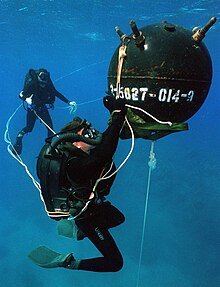
Sea mines - ammunition , covertly installed in the water and designed to destroy submarines, ships and ships of the enemy, as well as to complicate their navigation.
History

The predecessor of sea mines was first described by a Chinese artillery officer of the initial period of the empire, Ming Jiao Yu, in a 14th-century military treatise called Holongjing ( en: Huolongjing ). [1] Chinese chronicles also talk about the use of explosives in the 16th century to fight Japanese pirates ( wokou ). Sea mines were placed in a wooden box, sealed with putty. General Qi Juguang made several such drifting mines with a delayed detonation to harass Japanese pirate ships. [2] In the treatise Sut Insina Tiangong Kaiu ('Use of natural phenomena') in 1637, sea mines are described with a long cord stretched to a hidden ambush located on the shore. Pulling the cord, an ambush man actuated a steel wheel lock with flint to produce a spark and ignite a sea mine fuse. [one]

The first project on the use of sea mines in the West was made by Ralph Rabbards, he presented his designs to the English Queen Elizabeth in 1574. [1] The Dutch inventor Cornelius Drebbel , who worked in the artillery department of the English king Charles I , was engaged in the development of weapons, including “floating crackers” that have shown their unsuitability. [3] The British apparently tried to use weapons of this type during the siege of La Rochelle in 1627 . [four]
American David Bushnel invented the first practical sea mine to be used against Great Britain during the American Revolutionary War . It was a sealed barrel of gunpowder that floated in the direction of the enemy, and its shock castle exploded in a collision with a ship [5] .
In 1812, a Russian engineer, Pavel Schilling, developed an electric underwater mine fuse. [6] In 1854, during an unsuccessful attempt by the Anglo-French fleet to seize the fortress of Kronstadt , several British ships were damaged by an underwater explosion of Russian sea mines. More than 1,500 naval mines or “infernal vehicles” designed by Boris Jacobi were installed by Russian naval experts in the Gulf of Finland during the Crimean War . Jacobi created a sea anchor mine, which had its own buoyancy (due to the air chamber in its hull), a galvanic shock mine, and introduced the training of special galvanic units for the fleet and sapper battalions [7] The Russian Imperial Fleet became the first fleet in world military history to use sea mines without sporadically, but as an element of a planned naval strategy (later, the USSR Navy attached great importance to the use of sea mines in military operations at sea) [8] .
According to official data of the Russian Navy , the first successful use of naval mines took place in June 1855 in the Baltic during the Crimean War . On the mines fired by Russian miners in the Gulf of Finland , the ships of the Anglo-French squadron were blown up. [9] Western sources cite earlier cases - 1803 and even 1776. Their success, however, is not confirmed. [ten]
Sea mines were widely used during the Crimean and Russian-Japanese wars. In World War I , 310 thousand sea mines were installed, from which about 400 ships sank, including 9 battleships .
Russia was not only the first to create naval mines and, applied them, but also achieved concrete military results. The British officially recognized the high-precision use of minefields in the Russian Navy. And the famous German submariner Ernst Hashagen wrote that during the First World War only mines of one country - Russia - represented a real danger.
Many scientific developments of Russian inventors in the field of sea mines have remained unrealized, primarily because they are far ahead of the technical capabilities of their era. Nevertheless, as military historians write, in any situation Russia had highly skilled mine weapon specialists. And sea mines were actively used both for defensive and offensive purposes [11]
Carriers of sea mines
Sea mines can be installed both by surface ships (ships) ( mine barriers ) and from submarines (through torpedo tubes , from special internal compartments / containers, from external trailed containers), or dumped by aircraft. Anti- airborne mines can also be installed from the shore at a shallow depth.
Destruction of sea mines
To combat sea mines, all cash is used, both special and improvised.
The classic means are minesweepers . They can use contact and non-contact trawls, search mine action vehicles or other means. A contact-type trawl cuts a minrep , and mines that surface to the surface are shot from firearms. A mine guard is used to protect minefields from being damaged by contact trawls.
Non-contact trawls create physical fields that trigger fuses.
In addition to minesweepers of special construction, converted ships and vessels are used.
Since the 40s, aviation can be used as minesweepers, including helicopters from the 70s.
Subversive charges destroy a mine at the location of the production. They can be installed by search engines, combat swimmers, improvised means, less often by aviation.
Mine barriers , a kind of kamikaze ship, cause mines to fire by their presence.
Classification
Sea mines are divided into:
- By type of installation:
- Anchor - the body, which has positive buoyancy, is held at a given depth under water at anchor with the help of a minrep ;
- Bottom - are installed at the bottom of the sea;
- Floating - drifting with the stream, staying under water at a given depth
- Pop-up - anchored, and when triggered, giving it up and pop-up vertically: freely or using the engine
- Homing - electric torpedoes held under water by an anchor or lying at the bottom.
- According to the principle of the fuse:
- Contact - exploding in direct contact with the ship's hull;
- Galvanic shock - are triggered when the ship hits the cap protruding from the mine’s shell, in which there is a glass ampoule with an electrolyte of a galvanic cell
- Antennas - work when the ship’s hull contacts a metal cable antenna (they are used, as a rule, to destroy submarines)
- Non-contact - triggered by the passage of the ship at a certain distance from the effects of its magnetic field, or acoustic effects, etc .; including non-contact are divided into:
- Magnetic - respond to the target’s magnetic fields
- Acoustic - react to acoustic fields
- Hydrodynamic - respond to a dynamic change in hydraulic pressure from the target’s course
- Induction - respond to changes in the magnetic field of the ship (the fuse works only under the ship, with the course)
- Combined - combining fuses of different types
- Contact - exploding in direct contact with the ship's hull;
- By multiplicity:
- Non-multiple - trigger when a target is first detected
- Multiples - trigger after a given number of detections
- Manageability:
- Unmanaged
- Driven from shore by wire; or from a passing ship (usually acoustically)
- By selectivity:
- Normal - hit any detected targets.
- Selective - able to recognize and hit targets of specified characteristics
- By type of charge:
- Common - TNT or similar explosives
- Special - nuclear charge
Sea mines are being improved in the direction of increasing the power of charges, creating new types of non-contact fuses and increasing resistance to minesweeping .
See also
- Towed mine - the first armament of the first mine boats (sea mine towed into the attack with a cable)
- Shestovaya mine - a mine fixed on a 5 meter pole in front of a mine boat, exploding when ramming
- Throwing mine
- Self-propelled mine (torpedo)
- Mine can
- Stepan Osipovich Makarov
- Boris Tovyevich Lishnevsky
- Captor (mine)
- Airborne mine (against amphibious tanks and other amphibious amphibious assault vehicles or forces crossing the river; mounted on the bottom of a reservoir near its shore to a depth of two meters)
Notes
- ↑ 1 2 3 Needham, Volume 5, Part 7, 203–205.
- ↑ 追根 寻 源 话 水雷 (in Chinese) (unavailable link) . Date of treatment April 7, 2009. Archived September 27, 2007.
- ↑ Historical Persons: Cornelius Drebbel (1572 - 1633) . Date of treatment April 7, 2009. Archived February 11, 2012.
- ↑ Robert Routledge. Discoveries and inventions of the 19 th Century. - Bracken Books, 1989 .-- P. 161. - ISBN 1-85170-2679 .
- ↑ Bushnel, David // Military Encyclopedia : [in 18 vol.] / Ed. V.F. Novitsky [et al.]. - SPb. ; [ M. ]: Type. t-va I. D. Sytin , 1911-1915.
- ↑ Shilling Pavel Lvovich // Great Soviet Encyclopedia : [in 30 vol.] / Ch. ed. A.M. Prokhorov . - 3rd ed. - M .: Soviet Encyclopedia, 1969-1978.
- ↑ Jacobi Boris Semenovich // "Tashkent" - Rifle cell / [under the general. ed. A. A. Grechko ]. - M .: Military Publishing House of the Ministry of Defense of the USSR , 1976. - S. 656. - ( Soviet Military Encyclopedia : [in 8 vols.]; 1976-1980, vol. 8).
- ↑ Statement of Rear Adm. William L. Read, United States Navy . / Hearings on S. 920. - March 21, 1975 .-- Pt. 6 - P. 3449 - 3605 p.
- ↑ Navy Mining and Torpedo Service Specialists Day
- ↑ The Trafalgar Campaign: 1803-1805. Robert Gardiner, ed. Chatham Publishing, 1997, pp. 82-84.
- ↑ Sea mines - Russia's priority // korvet2.ru.
Literature
- Great Soviet Encyclopedia : [in 30 vol.] / Ch. ed. A.M. Prokhorov . - 3rd ed. - M .: Soviet Encyclopedia, 1969-1978.
- Needham, Joseph (1986). Science and Civilization in China: Volume 5, Part 7 . Taipei: Caves Books, Ltd.