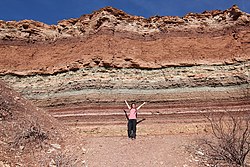
Stratigraphy (from Lat. Stratum - flooring, layer + other Greek. Γράφω - I write, draw, draw) - science , section of geology , on determining the relative geological age of layered sedimentary and volcanogenic rocks [1] , disintegration of rock strata and correlation various geological formations. One of the main sources of data for stratigraphy is paleontological definitions.
In archeology, stratigraphy refers to the relative position of cultural layers relative to each other and the overlying natural rocks. Establishing this location is critical for dating finds ( stratigraphic dating method , planigraphy ).
Content
From History
The theoretical basis of stratigraphy is composed of two principles: the law of bedding the Wall and the law of conformity of the flora and fauna of Huxley . According to the law of bedding, introduced into science by Nicholas Steno in the 17th century , higher-lying strata of rocks are usually younger than deeper. According to the Huxley principle, the layers in which the fossil remains of the same species of living organisms are contained have the same age.
The founder of scientific stratigraphy is considered to be an English self-taught geologist William Smith . He compiled the first geological map of England and used fossil remains as markers for matching layers of different sections.
A serious study of stratigraphy began in the second half of the 19th century . Then at the II-VIII sessions of the International Geological Congress (IYC) in 1881-1900 , the hierarchy and nomenclature of most modern stratigraphic units were adopted. Subsequently, the International Geochronological (stratigraphic) scale was constantly updated.
Specific names for systems (periods) were given for various reasons. Most often used geographical names. So, the name of the Cambrian system comes from lat. Cambria (the name of Wales when it was part of the Roman Empire ), Devonian - from the county of Devonshire in England, Perm - from the city of Perm , Jurassic - from the Jura Mountains in Europe. In honor of the ancient tribes, the Vendian (Slavic tribe of Vendas ), the Ordovician and Silurian (tribes of the Celtic Ordovician and Silurians) systems are named. Names associated with the composition of the rocks were less commonly used: the coal system was named because of the large number of coal seams, and the chalk system because of the wide distribution of written chalk .
In Russia, the supreme body organizing and coordinating the stratigraphic service is the Interdepartmental Stratigraphic Committee of Russia .
See also
- Stratigraphic unit
- Planigraphy
- Paleosvod
Links
Notes
- ↑ V.A. Prozorovsky. GENERAL STRATIGRAPHY . TEXTBOOKS ON STRATIGRAPHY .