Khunzakh ( avar. Khunzakh ) is a village in Dagestan , the administrative center of the Khunzakh region and the municipality "Village Council" Khunzakh "(composed of: Khunzakh , Arani, Batlaich, Baitl, Genichutl, Gonokh, Zaib, Gotsatl, Harikolo, Kakh , Nakitl, Heaney, Pee, Chondotl and a few more villages).
| Village | |
| Hunzah | |
|---|---|
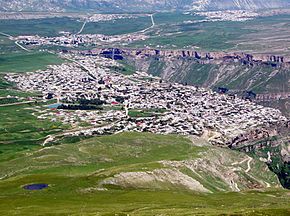 Village view | |
| A country |  Russia Russia |
| Subject of the federation | Dagestan |
| Municipal District | Hunzakh |
| Rural settlement | Village Council of Khunzakh |
| History and Geography | |
| Center height | 1658 m |
| Timezone | UTC + 3 |
| Population | |
| Population | ↗ 4245 [1] people ( 2010 ) |
| Nationalities | Avars |
| Denominations | Muslims are Sunnis |
| Digital identifiers | |
| Postcode | 368260 |
| OKATO Code | 82256890001 |
| OKTMO Code | |
| Other | |
| official languages | Russian , Avar |
| khunzakh.ru | |

The population is 4.2 thousand inhabitants ( 2010 ). Avars live in the village [2] .
Content
Etymology
In the scientific world there is no consensus on the origin of the name of the village; on this account there are different, often conflicting versions:
- The 11th-century Georgian historian Leonti Mroveli writes that a certain descendant of the prophet Nuh named Hunzakh, who moved from the plain “into a mountain gorge under the pressure of nomads, built a city there and gave him his name.
- Khunzakh several times collapsed and rebuilt. Therefore, some believe that the name Khunzakh could come from the phrase “Khun bakh” (translated from the Avar, “died and was reborn”).
- According to others, the name of the village could come from the word Hanzabah, since Khunzakh was the residence of the Avar khans.
- It is possible that Hunzakh could come from the name of the locality in which it arose. There are many similar examples in the accident.
- Also, the version of the Turkic origin of the name that the Avar tribe brought with it, which in turn founded the Sarir kingdom, is not ruled out.
Geography
Geographical position
The Khunzakh Plateau is located in the heart of Dagestan, 140 km from the city of Makhachkala. It rises at 1700-2000 m above sea level and it offers amazing views of the surrounding mountain ranges and peaks. It is composed of solid rocks, partly solid limestones. It has steep, in some places steep edges of several tens and even hundreds of meters. The Hunzakh plateau is the most extensive of all plateau-like uplifts of the republic. It has a length of about 25 km and a width of 8-10 km. In total, the plateau occupies 250 km² of area. According to the relief structure, the Khunzakh Plateau is an inclined plain composed of small hills and ravines. The Hunzakh plateau is referred to the Sulak basin.
Distance from Hunzakh to other settlements by road.
| Name of city / village | Distance, km | |
|---|---|---|
| one | Makhachkala | 140 |
| 2 | Derbent | 195 |
| 3 | Buinaksk | 90 |
| four | Izberbash | 146 |
Internal Description
On the eastern edge of the plateau is dissected by the canyon of the Tobot-Zolotl River. The canyon begins almost at the walls of the Khunzakh fortress, ends within the Sovetsky district, near the village of Golotl on the banks of the Avarsky Koisu. The total length of the canyon increases from 100 to 1000-1200m. Moreover, formed by solid limestones of the Mesozoic era. Barremian limestones are most clearly traced here. They are also pronounced in the southwest of the plateau, where it abruptly breaks off to the Allaor river valley. The largest rivers on the Plateau-Tobot, Hunderil Tlyar, Itlya Tlyar-erupt with beautiful waterfalls in the form of narrow streams in the Hunzakh canyon (Tsolotl). The height of each of these waterfalls is 50-80 m.
Climate
The climatic conditions of the Hunzakh plateau are more severe than the Gunib. The average annual temperature here is +6.6 degrees Celsius, the amount of annual rainfall is 532 mm, and on the upper Gunib, located almost at the same height, the average annual temperature is +8.1 degrees, and the annual rainfall is 507 mm. The Hunzakh Plateau is characterized by frequent strong winds. Sometimes they reach 8 points. The peculiarity of the climate on the Hunzakh Plateau is explained by the fact that it is located in an open area and is accessible for the penetration of air masses from almost all sides.
Geology
The soils of the Hunzakh plateau are mainly leached mountain chernozems; they are fertile. Closer to the hills surrounding the plateau, chernozems are less leached and their humus content reaches 7 percent. The chernozemic areas of the plateau, despite its slope, are terraced and cultivated. They are used for crops of cereals, potatoes, black beans, lentils, flax and other crops.
Flora and Fauna
The flora of the Hunzakh plateau is not rich. Forests are not preserved here. The grass cover is characterized by meadow and mountain steppe vegetation. Astragalus, sage, bindweed, thyme, exparcet, mountain and meadow clover, alfalfa, timothy steppe, etc. prevail. Meadows and mountain slopes of the Hunzakh plateau in spring are distinguished by a variety of shades of flowering plants, their aroma intoxicates.
The fauna of the Hunzakh plateau is relatively poor. Of the mammals, the blackest hamster Radde, which is endemic to Dagestan, is most often found. Occasionally, a hare, a fox is found. Weasel, badger, wolf. Somewhat richer world of birds. Here you can see colonies of alpine jackdaws, wild pigeons, there are broods of quails, partridges, and a number of birds of prey. The wild fauna of the plateau is in danger of total extinction, primarily due to uncontrolled hunting and the destruction of broods of wild animals by dogs.
History
Hunzah was the capital of the Avar Khanate . Taken by Russian troops in 1837 [3] , in 1843 came under the control of Shamil , in 1859 again taken by Russian troops. In 1864-69, a military fortification was built. In the years 1864-1928 - the administrative center of the Avar district .
Hunzah related people
- Abu Muslim - Sheikh, the distributor of Islam among the Avars, is buried in Hunzakh.View of the Tobot waterfall and gorge.
- Ummah Khan Avar - Avar Khan.
- Muhammad Nutsal IV - Avar Khan.
- Maksud Alikhanov-Avarsky - general of the tsarist army, Mervsky district chief and Tiflis governor.
- Kaitmaz Alikhanov - Colonel , associate of Nazhmudin Gotsinsky , counter-revolutionary .
- Hadji Murat of Khunzakh (1816-1852) is the milk brother of the Avar khans, one of the most famous and legendary mountain leaders. Naib of Imam Shamil. Character of the novel of the same name by Leo Tolstoy .
- Magomedbekova, Zagidat Magomedovna (1920-1999) - Dagestanologist.
- Gadzhiev, Zagid Gadzhievich (1898-1971) - Avar poet. People's poet of the Dagestan ASSR.
- Alikhan Huseynov (1814—?) - Murid of Shamil, and later major general of the tsarist troops.
- Omar ibn abd-Assalam ad-Dagestani (1759-1792) - a famous religious figure, poet. Coming from the village of Khunzakh. He lived in Medina.
- Abubakr ibn Abdusalyam of Dagestani is a famous religious figure, the mufti of the Radiant Medina, according to the Hanafi madhhab. Coming from the village of Khunzakh. He lived in Medina.
- Usman ibn Abdusalyam ibn Abubakra ibn Abdusalyam Dagestani - Mufti of the Hanafi madhhab of Medina (1303-1319 in Hijra)
Notes
- ↑ 2010 All-Russian Population Census. Table No. 11. The population of urban districts, municipalities, urban and rural settlements, urban and rural settlements of the Republic of Dagestan . Date of treatment May 13, 2014. Archived on May 13, 2014.
- ↑ http://linguarium.iling-ran.ru/maps/8-dag.jpg (inaccessible link)
- ↑ Ya. I. Kostenetsky Avar expedition of 1837 // Contemporary, 1850, Prince. 10-12 (separate edition: Notes on the Avar expedition of St. Petersburg, 1851)
Links
- Khunzakh.ru - Website of the Khunzakh region
- Khunzakh district site
- Hunzach // Encyclopedic Dictionary of Brockhaus and Efron : in 86 volumes (82 volumes and 4 additional). - SPb. , 1890-1907.
- Topographic map K-38-58. Hunzah
- Unofficial website of the village of Khunzakh
- in medina.