Depreciation is the structure of payments associated with the repayment of financial borrowings through a series of periodic payments. Each payment pays off the interest accrued on the outstanding amount of the debt and part of the principal amount of the debt. Payments are made throughout the entire borrowing period in equal amounts.
Depreciation is calculated by the formula:
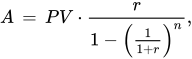
where A is the periodic payment, PV is the loan amount, r is the loan value (interest rate of the borrowing), n is the loan term.
When providing a loan , the bank proceeds from the premise that the discounted value of all depreciation payments (payments to repay the loan) must be not less than the amount of the loan provided. Therefore, in the above formula, based on the equality of the amount of the loan and the discounted value of the sum of all depreciation payments, the first PV multiplier, which is essentially the discounted value of the payment amount, is equal to the loan amount. If the bank intends to calculate depreciation so that as a result the discounted value of the payment amount is greater than the amount of the loan provided, the PV value should be equal to the discounted value of the payment amount (the amount that the bank intends to receive as a result), and not the size of the loan granted.
The formula for financial depreciation is derived from the formula for calculating the present value of a series of payment flows and annuity payments (see present value ).
In table processors , financial functions include a function to calculate the depreciation of payments. For example, OpenOffice.org Calc uses the PMT function to calculate the depreciation of payments.
Links
- Depreciation (finance) // Brockhaus and Efron Encyclopedic Dictionary : 86 t. (82 t. And 4 ext.). - SPb. , 1890-1907.