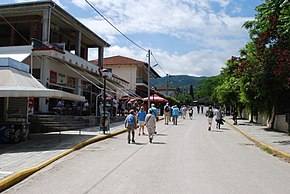
Vergina ( Greek Βεργίνα [2] ) is a city in Greece . Located at an altitude of 120 meters above sea level [1] , 13 kilometers south-east of Veria and 80 kilometers south-west of Thessaloniki . The historical center of the community (dima) of Veria in the peripheral unit of Imatia in the periphery of Central Macedonia [2] . The population is 1242 inhabitants according to the 2011 census [2] . Area - 33.4 square kilometers [1] . The world famous Vergina brought the burial of the Macedonian king Philip II .
| Vergina | |
|---|---|
| Greek Βεργίνα | |
 | |
| A country | |
| Periphery | Central macedonia |
| Peripheral unit | Imatia |
| Community | Veria |
| History and Geography | |
| Square | 33.4 [1] km² |
| Center height | 120 [1] m |
| Timezone | and |
| Population | |
| Population | 1242 [2] people ( 2011 ) |
| Nationalities | Greeks |
| Denominations | Orthodox |
| Other | |
 World Heritage Site World Heritage Site | |
| Archaeological Site of Aigai (Vergina) (Archaeological sites of Vergina) | |
| Link | No. 780 World Heritage Sites |
| Criteria | i, iii |
| Region | Europe and North America |
| Turning on | 1996 ( 20th session ) |
Content
History
Modern Vergina was founded in 1926 ( ΦΕΚ 401Α ) at the merger of the abolished villages of Kutles ( Κούτλες ) and Barbes ( Mπάρμπες ) [3] , which previously belonged to the Turkish Bey. About 25 Greek families lived in these villages.
Archaeological excavations in Vergina were begun in 1861 by the French archaeologist Leon Ezi ( Léon Heuzey ), who concluded that the city of Valla ( Βάλλα ) was once located on the site of Vergina [4] . Excavations were continued by the Greek archaeologist C. Romeos in 1938-1940. In the post-war years, excavations were continued by Manolis Andronicos .
In 1957, the Greek archaeologist researcher F. Papazoglu came to the conclusion that the common identification of the city of Edes with the ancient capital of the Macedonians, the city of Aigu ( dr. Greek Αἰγαί ) [5] , erroneously; Aegi, in her opinion, was located closer to Nausa [6] .
While working on the first volume of The History of Macedonia, the English historian Nicholas Hammond came to the conclusion that Edes and Aigie are two different cities. In 1968, he first suggested that excavations in the Vergina area were conducted on the territory of the Eg [7] [8] .
In 1976, the Greek archaeologist Manolis Andronikos resumed excavation, and in 1977 discovered a rich royal burial, which, in his opinion, belongs to King Philip II [9] . In addition, two more tombs are richly decorated, one of which, with unidentified remains, is conventionally called the “tomb of Persephone” (after the preserved fresco, which depicts the abduction of Persephone ), and the other is usually attributed to Alexander IV , the son of the great Alexander of Macedon . These unique finds that are exhibited at the Vergina Archaeological Museum (located directly inside the funerary hill) brought Vergina world fame.
Since Philip II was killed in the Egah [10] , Andronikos, following Hammond, believed that the current Vergina was the oldest Macedonian capital.
Population
| Year | Population |
|---|---|
| 1991 | 1198 [11] |
| 2001 | 1197 [11] |
| 2011 | ↗ 1242 [2] |
Notes
- ↑ 1 2 3 4 Απογραφή πληθυσμού - κατοικιών της 18ης μαρτίου 2001 (μόνιμος πληθυσμός) (Greek) . - Πειραιάς: Εθνική στατιστική υπηρεσία της Ελλάδας , 2009. - Τ. I. - Σ. 395 . - ISSN 1106-5761 .
- ↑ 1 2 3 4 5 Πίνακας αποτελεσμάτων Μόνιμου Πληθυσμού-Απογραφής 2011 (Greek) . Ελληνική Στατιστική Αρχή (20 Μαρτίου 2014). Date of treatment October 22, 2017.
- ↑ Μπάρμπες-Κούτλες (Θεσσαλονίκης) (Greek) . ΕΕΤΑΑ. Date of treatment July 18, 2018.
- ↑ Pliny the Elder . Natural history. IV. 10.34
- ↑ Aegae // The Real Dictionary of Classical Antiquities / ed. F. Lubker ; Edited by members of the Society of Classical Philology and Pedagogy F. Gelbke , L. Georgievsky , F. Zelinsky , V. Kansky , M. Kutorgi and P. Nikitin . - SPb. , 1885.
- ↑ Ανδρόνικος, 1991 , p. 59.
- ↑ Hammond NGL A History of Macedonia. - Oxford, 1972. - Vol. 1: Historical geography and prehistory. - P. 156-158.
- ↑ Isaev V.I. Verginskaya tomb: the tomb of Philip II of Macedon? // Meetings with history. - Vol. 2. - M., 1988 .-- S. 127.
- ↑ Isaev V.I. Verginskaya tomb. - S. 128.
- ↑ Ανδρόνικος, 1991 , p. 21.
- ↑ 1 2 Μόνιμος και Πραγματικός Πληθυσμός της Ελλάδος. Σύνολο Ελλάδος, νομοί, δήμοι / κοινότητες, δημοτικα / κοινοτικά διαμερίσμα και οικισμοί. Απογραφές πληθυσμού 2001 και 1991 (Greek) (unavailable link) . Ελληνική Στατιστική Αρχή . Date of treatment June 22, 2017. Archived July 16, 2006.
Literature
- Isaev V.I. Verginskaya tomb: the tomb of Philip II of Macedon? // Meetings with history: Scientific. essays. - Vol. 2. - M .: Young Guard, 1988. - S. 125-128.
- Μανόλης Ανδρόνικος . Βεργίνα, οι βασιλικοί τάφοι. - Αθήνα, 1991. - ISBN 960-213-129-2 .