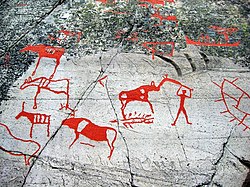
Komsu culture is a term for the archaeological culture of hunters and gatherers of the Late Paleolithic and Early Mesolithic era of Northern Fennoscandia.
The culture was described on the basis of a special type of instrument, common in northern Norway about 10 thousand years BC. er and named after Mount Koms in the community of Alta , Finnmark , where in 1925 the first monuments of tools of this type were discovered.
Since the 1970s, Norwegian archaeologists have considered the classification of guns into the types of “Koms” (north of the Arctic Circle) and “ Fosna ” (in the Swedish version - Hensbask) (Oslo fjord) as obsolete. Since then, they decided to consider these two types of tools as characteristic of the same culture [1] .
Recent archaeological finds in Finnish Lapland were initially seen as a continental version of the Koms culture of about the same age as the earliest finds on the coast of Norway and the Kola Peninsula. Currently, this material is considered to be associated with modern post- Sweeping cultures of northern and central Russia and the eastern Baltic, and therefore reflects their early invasion of northern Scandinavia [2] [3] .
Norwegian archaeologists believe that the earliest settlers arrived on the coast of Northern Norway from the west and southwest coast of Norway, and, in turn, came from the Arensburg culture of the Paleolithic era of northwest Europe [4] . They suggest that Komsa culture bearers followed the retreating glacier along the Norwegian coast at the end of the last glaciation (between 11000 and 8000 BC), opening up new lands for settlement. Some could have moved to the territory of modern Finnmark from the north-east, possibly crossing the coast of the Kola Peninsula , which was freed from glaciation, although the evidence in favor of this point of view, previously widespread back in the 1980s [5] , according to Norwegian archaeologists, still small [1] .
Archaeological finds show that the “Komsomol culture” was oriented almost exclusively to the marine way of life, was engaged in hunting for seals , and was very skilled in the construction of boats and fishing. Compared to manufacturers of Fosna-type guns of the same archaeological culture in southern Norway, Koms-type guns and their other adaptations are quite rude, due to the small amount of flint in the region.
A series (about 30) of radiocarbon determinations (C-14) gave an age in the range of 10,300-8,000 years ago [6] .
Soviet archaeologists proved that this culture comes from the northern part of Eastern Europe, which was brilliantly confirmed by the latest paleogenetic studies of Norwegian geneticists who reconstruct the path of these people from Lake Onega - the Barents Sea, through Finnmark and along the coast of Northern Norway [7] .
Notes
- ↑ 1 2 [1] Brittanica online, Norway
- ↑ PEOPLE, MATERIAL CULTURE AND ENVIRONMENT IN THE NORTH Proceedings of the 22nd Nordic Archaeological Conference, University of Oulu, 18-23 August 2004 Edited by Vesa-Pekka Herva GUMMERUS KIRJAPAINO [2]
- ↑ Tuija Rankama & Jarmo Kankaanpää: The Earliest Postglacial Inland Settlement of Lapland, in: KAMENNYI VEK EVROPEISKOGO SEVERA, Syktyvkar 2007, edited by AV Volokitin, VN Karmnov & P.Yu. Pavlov, ISBN 5-89606-291-5
- ↑ Survey and excavation at Lake Vetsijärvi, Lapland - Tuija Rankama & Jarmo Kankaanpää, in: PEOPLE, MATERIAL CULTURE AND ENVIRONMENT IN THE NORTH, Proceedings of the 22nd Nordic Archaeological Conference, University of Oulu, 18-23 August 2004, Edited by Vesa- Pekka Herva [3]
- ↑ [4] The Paleohistory of Circumpolar Arctic Colonization - JANUSZ KOZLOWSKI and H.-G. BANDI, Actic VOL. 37, NO. 4 (DECEMBER 1984) P. 358372
- ↑ V. Ya. Shumkin . Stages of development of the North-West of the European Arctic, 2015
- ↑ Torsten Günther, Helena Malmström, Emma M. Svensson, Ayça Omrak, Federico Sánchez-Quinto, Gülşah M. Kılınç1, Maja Krzewińska, Gunilla Eriksson, Magdalena Fraser, Hanna Edlund, Arielle G., Alexandra R. Mário Vicente1, Anders Sjölander, Berit Jansen Sellevold, Roger Jørgensen, Peter Claes, Mark D. Shriver, Cristina Valdiosera, Mihai G. Netea, Jan Apel, Kerstin Lidén, Birgitte Skar, Jan Storå, Anders Götherström Genomics of Mesolithic Scandinavia reveal colonization routes and highlatitude adaptation. Jul. 17, 2017; doi: http://dx.doi.org/10.1101/164400 c. 95-96
See also
- Fosn-Hensback Culture
- History of Norway
- Prehistoric Fennoscandia
- Saami
- en: Sami Genetics