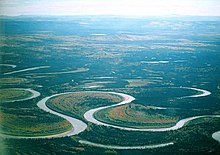

Meandering (from the Greek Greek Μαίανδρος Meandros - the ancient name of the winding Bolshoi Menderes river) is a type of channel processes , a deformation scheme in the form of successive stages of sinuosity of the river channel .
Content
General Information
Distinguished between developed and undeveloped meandering, free and limited meandering.
A large number of rivers with sinuous outlines are characterized by the fact that planned reorganizations occur in them, due to the influence of the stream on the channel.
The meandering is understood not only as the external form of the planned outlines of the channel (see Meander river ), but as a certain process, which reduces to changing the planned outlines of the channel according to a certain regularity, namely, in the form of the development of smoothly curved convolutions. At the same time, the river can move its channel for a long time, while maintaining a sinusoidal tortuosity, or it can form well-defined loops of various shapes, completing their development by breaking through the isthmus.
The founder of the science of channel processes, corresponding member of the USSR Academy of Sciences M. A. Velikanov (1948) singled out only meandering rivers and considered them to be a natural state of rivers.
Ocean currents, like rivers, can also meander, forming eddies in the ocean .
Meandering hypotheses
The reasons for the formation and existence of meander are still not unambiguously clarified. At different times, researchers have proposed various hypotheses that explain the causes of meandering. The most famous of them are:
- transverse water circulation in the river;
- principle of minimum energy dissipation;
- the principle of minimizing the variation of a parameter of a random process of a river wandering;
- structural turbulence ;
- instability of the rectilinear flow motion to harmonic disturbances;
- wandering of the dynamic axis of the flow;
- concept of entropy ;
- neotectonics ;
- geological reasons;
- Earth rotation
- Coriolis acceleration ;
- “Flow property meander”;
- the presence of random obstacles;
- flow carrying capacity;
- sediment consumption;
- general denudation of the earth's surface;
- the relative width of the floodplain and others.
The most recognized hypotheses for meandering reasons are:
- flow circulation in the channel ( Velikanov M.A. , 1948a);
- instability of the direct channel (Kondratiev N.E., 1954; Zamyshlyaev V.I., 1983)
- dynamic stability of a winding channel ( N. Makkaveev , 1955; R. Chalov , 1979). The explanation is widespread that the reason lies in the internal hydrodynamic structure of the flow ( M. Velikanov , 1950).
Analysis of the shortcomings of the main of these theories was given by N. N. Fedorov (1954). Reviews of the hypotheses of the appearance of meandering are contained in the following works of Soviet and foreign researchers: N. I. Makkaveev (1955, 1969), N. N. Fedorov (1954; N. Kondratyev et al., 1959), CT Yang (1971), D. Knighton (1987), V.I. Zamyshlyaev (1978), B.V. Matveev (1985), and others. A. N. Lyapin (1956, p. 103) correctly noted: “Such an abundance of hypotheses says, with on the one hand, about the importance of the problem, and on the other hand, that the physical side of the phenomenon is still not clear. ”
The only acceptable hypothesis may be that which does not proclaim the exclusivity, uniqueness and naturalness of the meander. Meandering, although it is, indeed, the most common type of channel processes, but in no way is the only type. Other types are also natural and widespread in nature: multi-sleeve Amur, Ob, Volga , etc.
There is a hypothesis that the cause of the formation of meandering is the relative transporting ability of the stream. The same reason explains the formation not only of meandering, but also of several other types of channel processes - direct, branched as a channel multi-arm and intermediate between them.
See also
- River science is a science that studies river channels.
- Baire's Law
Literature
- Makkaveev N.I. Riverbed and erosion in its basin. - M .: Academy of Sciences of the USSR, 1955 .-- 346 p.
- Kondratiev N.E., Popov I.V., Snishchenko B.F. Fundamentals of the hydromorphological theory of the channel process. - L .: Gidrometeoizdat, 1982.- 272 p.
- Zamyshlyaev V.I. On the causes of meandering rivers (review of foreign authors) // Issues of land hydrology. - L .: Gidrometeoizdat, 1978. - S. 138-141.
- Lamakin V.V. Why do some rivers meander, while others split into channels // MOIP Bulletin . - 1952. - Issue. 2 . - S. 85 ..
- Lyapin A.N. On the occurrence of tortuosity of channels // Transactions of GGI. - 1956. - Vol. 56 (110) . - S. 103-117 .
Links
- Research Laboratory of Soil Erosion and Channel Processes N. I. Makkaveeva , Faculty of Geography, Moscow State University