 architectural monument (newly discovered object)
| "Airport" | |||
|---|---|---|---|
 Zamoskvoretskaya line | |||
| Moscow subway | |||

| |||
| Area | Airport and Khoroshevsky | ||
| District | Northern | ||
| opening date | September 11, 1938 | ||
| Project name | Air Fleet Academy | ||
| Rename Projects | Air Terminal ( 1991 , 1992 ) Leningradsky Prospect (2012) | ||
| Type of | Single-vaulted shallow | ||
| Depth of laying, m | ten | ||
| Number of platforms | one | ||
| Platform type | insular | ||
| Platform form | straight | ||
| Platform Length, m | 155 | ||
| Platform width, m | eight | ||
| Architects | B. S. Vilensky , V. A. Ershov with the participation of T. Weiner, V. Sdobnov [1] | ||
| Lobby architects | B. S. Vilensky , V. A. Ershov [1] | ||
| Design Engineers | N. A. Kabanov [1] | ||
| Station erected | Distance-17 Mosmetrostroya (Head S. Fradkin) | ||
| Exit to the streets | Leningrad Avenue | ||
| Ground transportation | A : m1 , 105, 904, 905 , T86; TB : 6, 12, 43, 65, 70, 82 | ||
| Operation mode | 5: 30—1: 00 | ||
| Station Code | 037 | ||
| Neighboring stations | and | ||

Aeroport is a station of the Zamoskvoretskaya line of the Moscow Metro . Located under the Leningrad Prospect between the stations " Falcon " and " Dynamo ". The exits are located in the “ Airport ” area of the Northern Administrative District of Moscow and one exit (via an underground passage under Leningradsky Avenue) in the territory of the Khoroshevsky District of the same district.
It was opened on September 11, 1938 as part of the Ploshchad Sverdlova (now Teatralnaya ) - Sokol section (second stage of construction). Named on the former Central Moscow airfield , located on the Khodynka field [2] .
“Airport” is the first one -vaulted station of the Moscow metro, completely built by an open method [3] (including inclined passages and lobbies), as well as the second-built one-vaulted station of the Moscow Metro (after the Lenin Library ).
History
In 1910, on the Khodynka field , not far from the current metro station, the airfield of the Moscow Society of Aeronautics was opened. Later, it was called the “ Central Airfield named after MV Frunze ”. In 1931, the first air terminal in the USSR appeared on it [4] .
The plan for the construction of the metro line passing near the airfield appeared in 1932 . In the general plan for the reconstruction of Moscow in 1935 it appeared that the line of the second metro line will connect the center of Moscow with the airfield. According to the plan, the station "Airport" was supposed to be the ultimate. But due to the transfer of the depot of the second stage to the area of the village of Vsekhsvyatskiy, the subway station Sokol became the final [5] . The initial design of the station was developed in 1935 by the Architectural Workshop NKTP No. 2 (architect - B. S. Vilensky , co-authors - D. B. Savitsky and V. A. Ershov) [6] , later some changes were made to it.
The metro station "Airport" was built in an open way [3] . Vestibules were built into two residential buildings erected simultaneously with the station [7] . The opening of the “Airport” station took place on September 11, 1938 . The station became part of the Sokol section - Ploshchad Sverdlova (now Teatralnaya ) of the second construction phase [1] , after its commissioning in the Moscow Metro there were 22 stations.
During World War II, the station served as a bomb shelter , like other stations of the Moscow metro [8] . There is a version that the first German bomb that fell on Moscow exploded on July 22, 1941 near the Airport station [9] . The design of the Aeroport metro station was copied by architect Julian Ostrovsky for the construction of Stalin's bunker in Samara [10] .
Now the design of the station is slightly different from the original. Round lamps on the ceiling were replaced by fluorescent lamps [3] . In 1979 , an exit was made from the northern avanthall to the underground passage under Leningradsky Avenue [11] . This exit was equipped with an escalator [12] . By the early 1970s, the floor was lined with gray granite [13] (before that it was partially asphalt and partly covered with colored marble ).
In the mid -1990s, in the apartment building closest to the station, the level of noise and vibrations emanating from the metro significantly increased. According to the head of the Moscow metro, Dmitry Gayev , the reason for this was the capital redevelopment carried out by residents of the house [14] .
In the mid -2000s, there was a project for the construction of the Third Metro Interchange Circuit , which included a transfer at the Aeroport station [15] . In subsequent plans, a transplant was decided to be made at Dynamo station [16] .
Name and rename issue
At the time of drawing up the Master Plan for the reconstruction of Moscow in 1935, the Moscow International Airport operated at the Central Aerodrome named after MV Frunze , located on the Khodynka Field. With the opening of the terminal building on November 6, 1931, it became the first airport in Moscow.
However, after the Great Patriotic War , in 1947-1948, most of the flights were transferred from the Central airport to the airports of Bykovo and Vnukovo . Since 1948, the Central Airfield has become the center for testing new aircraft located near aircraft factories [17] . Thus, even then the name “Airport” partly lost its full compliance with the environment.
In 1959, the Sheremetyevo Airport opened further to the north-west, and in 1964 the green metro line was extended to the north-west, which created additional confusion.
In 1960, a helicopter station was opened at the Central Aerodrome, from where passengers were flown by helicopters to Bykovo and Vnukovo airports. In 1966, a complex of the Central City Air Terminal with helicopter and bus stations was opened on Leningradskoye Shosse, 37. It was located at an equal distance from the metro stations " Dynamo " and "Airport". In 1971, the helicopter station was closed, leaving only the air terminal.
The proposal to rename the metro station “Airport” to the “Airport Terminal” was sounded in 1987 [18] . In 1991-1992, when a number of Moscow metro stations were renamed, this proposal was announced again. In 1995, Yuri Druzhnikov in the book “I was born in a queue” wrote: “The name of the metro station“ Airport ”is also now meaningless, because there are four passenger airports in Moscow, and everything is not here now, but to the city air terminal from the subway”.
In 2003, the airfield was closed. Buses to airports were moved to the end stations of the metro [19] , and the airport terminal turned into a bus station, from where intercity buses departed [20] , which was also closed in January 2013, after which it became an ordinary shopping center. Bus routes from the airport terminal to airports with the appearance of Aeroexpress in the 2000s were stopped. Thus, the name “Airport” and “Air Terminal” have lost relevance. In 2012, designer Ilya Birman suggested the name Leningradsky Prospect [21] .
Architecture and layout
In the design of the station, the architects tried to express the theme of Soviet aviation [1] . The desire to transfer the volume to the apron led to the choice of a single-arched station design [7] . The vault was constructed of monolithic reinforced concrete according to a special project [1] . "Airport" was the first one-vaulted station of the Moscow Metro, built in an open way [3] .
Through the arch of the station pass long narrow relief strips resembling parachute lines. They intersect with each other and give an additional feeling of space and lightness [3] .
The lower part of the travel walls is trimmed with black diabase [3] . Above it are embossed fan-shaped inserts lined with marble- like limestone [22] " Biyuk-Yanka " [1] and purple marble [3] . Between these inserts the walls are lined with pink marble. The harmonious combination of materials of different colors and textures gives travel walls a special decorative expression [23] .
Above the travel walls are cast-iron ventilation grilles of a diamond shape. They are inscribed in the intersection of "parachute lines" [3] . On the ceiling is a series of conical chandeliers for fluorescent lamps , giving a uniformly diffused light. Originally, the chandeliers consisted of semicircular lamps mounted around a single spherical ceiling. But they gave too little coverage and therefore were replaced [3] .
The floor of the station is lined with gray granite [1] . Initially, the platform was covered with asphalt , and along its center was a patterned walkway made of marble [7] . In the center of the station there are five bilateral wooden benches. Information boards and signs are fixed above their backs [3] .
The ends of the station hall are connected with two outposts by wide staircases passing through arches decorated with decorative metal gratings. Each avant-hall has a rectangular shape. The central part stands out with a ring marked on the ceiling, which is supported by four multifaceted columns lined with onyx . A complex stucco pattern is applied to the ceiling. The walls of the avant-stone are lined with dark yellow marbled limestone “Biyuk-Yanka”; pilasters - from black marble " Dalalu " [7] .
Avenues are connected by stairs with two ground entrance halls overlooking Leningradsky Avenue . They were built into two residential buildings erected in 1938 by the project of architect S. M. Kravets [7] (in 1954 these houses were connected [24] ).
Outside, the lobby is a loggia with three arches resting on square columns lined with labradorite . Passengers enter and exit through the side arches. From them to the box office are two stairs. In the interior of the lobby, architects also tried to achieve the effect of lightness and airiness. High ceiling with lace molding, supported by two octahedral columns, lined with marble limestone. The upper part of the columns is decorated with stucco capitals and latticed bells . The center of the composition of the lobby is a cash niche. Near it, two flights of stairs join, and then one broad staircase leads to the antechamber [7] .
As it was written in 1938 in the magazine “ Architecture of the USSR ”, the architects of the Aeroport metro station tried to solve the artistic problem in a rather original way. If at other stations of the second stage architects expressed their ideas on the basis of the quality capabilities of the stone and its technological properties, the authors of the “Airport” station intentionally departed from this. They express the theme of Soviet aviation with the use of architectural forms that, with their combination, create the impression of simplicity, airiness and lightness. This impression is created due to the fact that the authors decided to overcome the properties and qualities of the main material of the station - a massive stone. The bends of the marble facing and fan-shaped lines intersecting at the arch create a feeling of not a dense mass, but a thin film. In the decoration of the station one can feel the raid of the Art Nouveau style and, in particular, Art Deco . Nevertheless, according to the critic V. Lavrov, the excessive disregard by the authors of the properties of materials refers to the shortcomings of the station architecture [25] .
There are two ticket offices at the station: one is located in the southern lobby, the second is in the northern avenue (the ticket office, which was originally located in the northern lobby, is not operating now) [26] . The northern avant hall is connected to the underground passage under Leningradsky Avenue. The exit to the underpass is equipped with a ladder and an ET-5 type escalator. This escalator has a height of 3.2 meters and is one of the two shortest escalators in the Moscow Metro (the second is at the Chekhovskaya metro station) [12] . Apart from this escalator, the station is not adapted for people with limitations of the musculoskeletal system (there are no elevators and ramps ).
A large number of fossils of the Cretaceous marine organisms can be found in the marbled limestone, which revets the track walls and the station lobby. Among them are various corals and shells of mollusks [22] (see Fossils in the Moscow Metro ).
The architects of the station are B. S. Vilensky and V. A. Ershov (with the participation of T. Weiner and V. Sdobnov). The architects of the entrance halls are B. S. Vilensky and V. A. Ershov. Design Engineer - N. A. Kabanov [1] . The construction of the station was completed by the Distance No. 17 of Mosmetrostroy (head S. Fradkin) [27] . Metro station "Airport" is an identified object of cultural heritage of the city of Moscow [28] .
| Bench | Lobby columns | Avant hall |
| Cashier and memorable inscription in the lobby | Subway entrance | Escalator |
Station in numbers
- Station code - 037 [1] .
- Depth of laying - 10 meters [7] .
- The length of the platform is 155 meters [6] .
- The width of the platform is 8 meters [29] .
- Picket PK71 + 16 [30] .
- According to 1999 data, the station’s daily passenger traffic was 62,280 people [31] . According to a statistical study of 2002 , the station's passenger traffic was: at the entrance - 59,800 people, at the exit - 7,600 people [32] .
- The opening time of the station for the entrance of passengers is 5 hours and 20 minutes, the closing time is at 1 am [33] .
- Like the entire Zamoskvoretsky line , the Airport station is served by eight-car trains of cars of the type 81-717 / 714 and 81-717.5 / 714.5 [34] .
- Table of the passage of the first train through the station [35] :
| By even numbers | Weekdays days | Weekends days |
|---|---|---|
| By odd numbers | ||
| Towards the station " Falcon " | 06:01:00 | 06:01:00 |
| 06:01:00 | 06:01:00 | |
| Towards the station Dynamo | 05:30:00 | 05:30:00 |
| 05:30:00 | 05:30:00 |
Location
The metro station "Airport" Zamoskvoretskaya line is located between the stations " Dynamo " and " Falcon ". Two ground-based vestibules lead to the even side of Leningradsky Prospekt : one lobby near Ernst Telman Square (at the intersection of Leningradsky Avenue and Chernyakhovsky Street ), the second lobby near 1st Aeroportsovskaya Street . The station has an access to an underground pedestrian crossing under Leningradsky Avenue, which, on the one hand, goes to Ernst Telman Square, and on the other, to the square at the intersection of Viktorenko and Ostryakova streets. Address station halls: Leningradsky Avenue, Building 62 [28] . The distance to the center of Moscow is 7.3 kilometers [36] .
Ground public transport
The “Airport” station has exits to three public transport stops [37] :
- The metro station "Airport" (south) is located near the southern ground station lobby. It stops trolley buses number 6, 12, 43, 70, 82 and buses H1, M1, T86 (follow to the area).
- Stop MADI - Finance Academy is located next to the northern ground station lobby. It stops trolley buses number 6, 12, 43, 70, 82 and buses H1, M1, 904, 904k, 905, T86 (follow to the area).
- Stop Metro "Airport" (northern) - Financial Academy is located near the exit of the underpass to the odd side of Leningradsky Avenue. It stops trolley buses number 6, 12, 43, 65, 70, 82 and buses M1, H1, 105, 904, 904k, 905.
- The metro stop "Airport" (south) is located near the south lobby. It stops trolley buses 6, 12, 43, 65, 70, 82 and buses H1, M1, 105, T86.
- Table: public transport routes (data for 2011) [38] [39]
| Route | Follows to subway stations | End Point 1 | End Point 2 |
|---|---|---|---|
| tr. № 6 | " Falcon ", " Voikovskaya ", " Water Stadium " | Sandy square | Cinema "Neva" |
| auth. M1 | Streshnevo (MCC), Falcon , Dynamo , Belarusian, Mayakovskaya, Tver, Pushkin, Chekhov, Okhotny Ryad , Alexander Garden , Teatralnaya , Ploshchad Revolyutsii , Lenin Library, Alexander Garden, Borovitskaya , October, Leninsky Prospect, Gagarin Square (ISC) | Hospital MPS | Kravchenko street |
| tr. No. 43 | " Polezhaevskaya ", " Falcon ", " Voikovskaya ", " Water Stadium " | Karamyshevskaya embankment | Coastal travel |
| tr. No. 65 | " Dynamo ", " Running ", " Polezhaevskaya " | Art. Metro "Airport" | silver Forest |
| tr. No. 70 | " Shodnenskaya ", Streshnevo (MSC), " Falcon ", " Dynamo ", " Belorusskaya " | Bratsevo | Belorussky Station |
| tr. No. 82 | Streshnevo (MCC), Falcon , Dynamo , Belorusskaya | Hospital MPS | Belorussky Station |
| auth. No. T86 | Sokol, Dynamo , Begovaya , Polezhaevskaya | Art. Sokol metro station | silver Forest |
| auth. No. 105 | “ Schukinskaya ”, “ Falcon ”, “ Dynamo ” | Art. metro station " Schukinskaya " | Art. Metro Dynamo |
Institutions near the station
Near the station are educational and sports facilities [40] :
- The Higher School of Economics is a state university administered by the Government of the Russian Federation . Since 2009 - National Research University . One of the university buildings is located at Kochnovskiy Proezd , Building 3 [41] (about 700 meters north of the Airport Station along Chernyakhovsky Street to the intersection with Planetnaya Street , then 150 meters to the right along the street and 100 meters to the left).
- Moscow Automobile and Road Institute is a state university that trains specialists in the field of the automotive industry, transport, road-bridge and airfield construction [42] . Located at Leningradsky Avenue, Building 64 [43] (exit from the northern vestibule of the Aeroport station, then 200 meters to the right along the avenue).
- Financial University under the Government of the Russian Federation is a state university specializing in the training of financiers. Located at Leningradsky Avenue, Building 49, near the western exit of the underground passage of the Aeroport metro station.
- Sports Complex CSKA consists of a number of sports facilities. There are home arenas of basketball and hockey clubs CSKA [44] . The sports complex is located at the address: Leningradsky Avenue, Building 39 (from the western exit of the underground passage of the Airport station, walk about 500 meters towards the center, or transport to the Konstantin Simonov Street stop) [45] .
Artistic Station
Метро «Аэропорт» упоминается в постапокалиптическом романе Дмитрия Глуховского « Метро 2033 ».
Notes
- ↑ 1 2 3 4 5 6 7 8 9 10 Аэропорт . Официальный сайт Московского метрополитена. Дата обращения 24 октября 2010. Архивировано 25 января 2012 года.
- ↑ Аэропорт, станция метро // Имена московских улиц . Топонимический словарь / Р. А. Агеева, Г. П. Бондарук, Е. М. Поспелов и др.; авт. предисл. Е. М. Поспелов. — М. : ОГИ, 2007. — (Московская библиотека). — ISBN 5-94282-432-0 .
- ↑ 1 2 3 4 5 6 7 8 9 10 М. С. Наумов, И. А. Кусый. Московское метро. Путеводитель. — М. : Вокруг Света , 2006. — С. 160—161.
- ↑ Центральный аэродром имени М.В. Фрунзе // Москва: Энциклопедия / гл. ed. С. О. Шмидт ; сост.: М. И. Андреев, В. М. Карев. — М. : Большая российская энциклопедия , 1997. — 976 с. - 100 000 copies — ISBN 5-85270-277-3 .
- ↑ Проектирование и первые очереди строительства . metro.molot.ru. Дата обращения 25 октября 2010. Архивировано 14 августа 2011 года.
- ↑ 1 2 Вторая очередь Московского метрополитена . Журнал «Строительство Москвы». 1935 год. Дата обращения 25 октября 2010.
- ↑ 1 2 3 4 5 6 7 С. М. Кравец . Архитектура Московского метрополитена имени Л. М. Кагановича. — М. : Издательство Всесоюзной академии архитектуры, 1939. — С. 75—78.
- ↑ Москва цвета солдатской шинели . his.1september.ru. Дата обращения 11 ноября 2010. Архивировано 25 января 2012 года.
- ↑ Элемент чудесного . Русская жизнь . Дата обращения 11 ноября 2010. Архивировано 25 января 2012 года.
- ↑ Объекты глубинного заложения (недоступная ссылка — история ) . Красная звезда . Дата обращения 11 ноября 2010.
- ↑ Газета «Метростроевец» . metro.ru (30 января 2009). Дата обращения 5 ноября 2010. Архивировано 25 января 2012 года.
- ↑ 1 2 Основные характеристики эскалаторов (недоступная ссылка) . Официальный сайт Московского метрополитена. Дата обращения 31 октября 2010. Архивировано 22 августа 2011 года.
- ↑ И. Прокофьев, В. Чехарин. Трассами Московского метрополитена. — М. : Издательство «Реклама», 1973. — С. 151—154.
- ↑ Строгинское метро въехало в квартиры . Известия . Дата обращения 21 ноября 2010. Архивировано 25 января 2012 года.
- ↑ История и тайны московского метро (недоступная ссылка) . gzt.ru (15 мая 2005). Дата обращения 11 ноября 2010. Архивировано 30 сентября 2010 года.
- ↑ Метро: третий контур . Российская газета (15 января 2009). Дата обращения 11 ноября 2010.
- ↑ Москва. Наука и культура в зеркале веков. Все тайны столицы
- ↑ Ю. К. Ефремов. «Имена московских улиц»
- ↑ Аэропорты Москвы. Схема.
- ↑ Москва, АВ «Аэровокзал»
- ↑ Проект перезагрузки московского метро
- ↑ 1 2 Аэропорт . paleometro.ru. Дата обращения 2 ноября 2010. Архивировано 25 января 2012 года.
- ↑ Архитектура московского метро . metro.ru. Дата обращения 26 ноября 2010. Архивировано 25 января 2012 года.
- ↑ Эта дата указана на центральной секции дома
- ↑ В. Лавров. Две очереди метро // Архитектура СССР : Журнал. — 1938. — № 9 . — С. 2—5 .
- ↑ Схема станции . Официальный сайт Московского метрополитена. Дата обращения 6 ноября 2010. Архивировано 25 января 2012 года.
- ↑ Замоскворецкая линия. Станция "Аэропорт". news.metro.ru. Дата обращения 6 ноября 2010. Архивировано 25 января 2012 года.
- ↑ 1 2 Объекты культурного наследия. Станция метро «Аэропорт» (недоступная ссылка) . Комитет по культурному наследию города Москвы. Дата обращения 12 ноября 2010. Архивировано 25 января 2012 года.
- ↑ Тоннели около станции «Аэропорт» и исторический артефакт . russos.livejournal.com. Дата обращения 2 апреля 2013. Архивировано 3 апреля 2013 года.
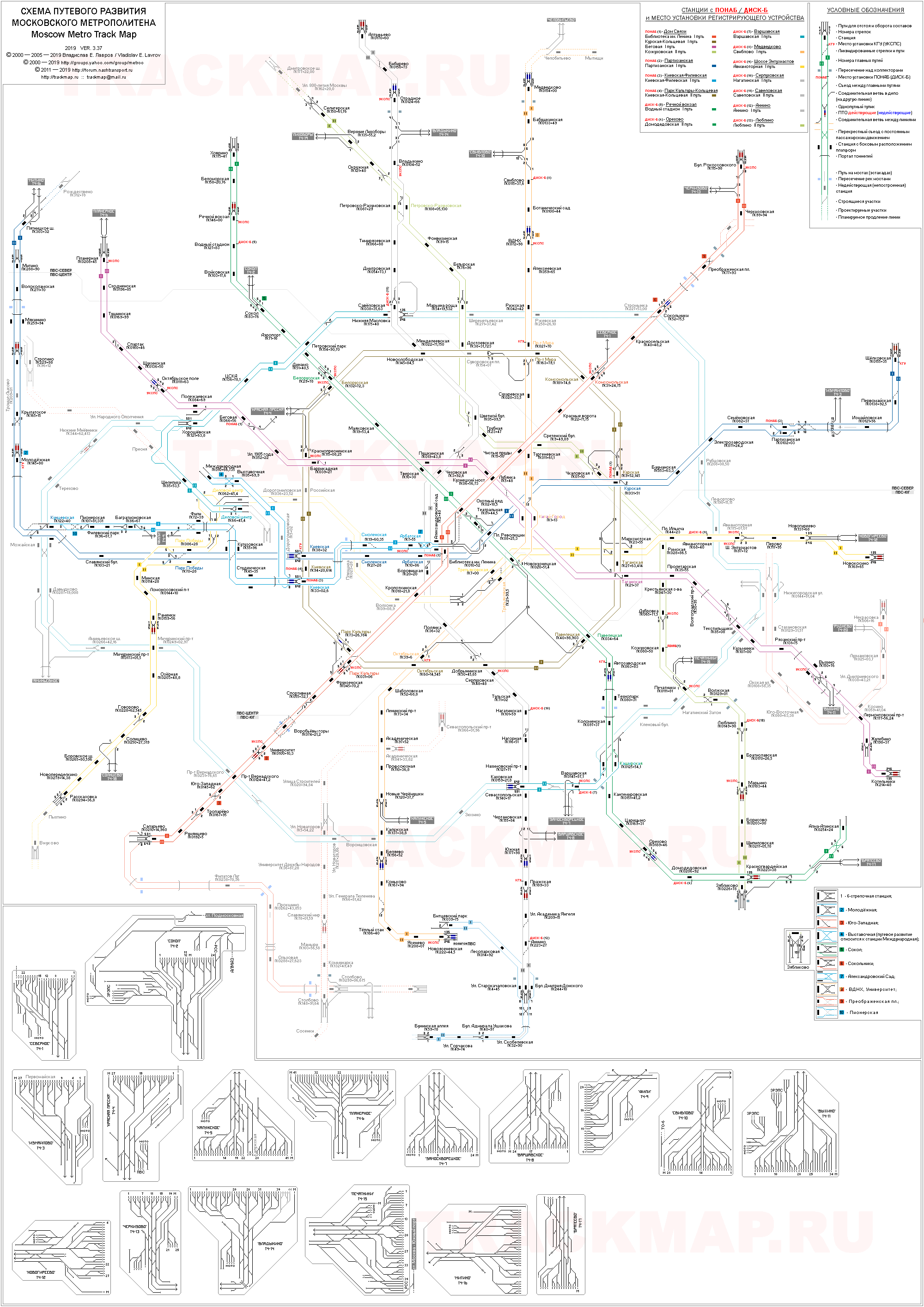
- ↑ Схема путевого развития Московского Метрополитена . trackmap.ru. Дата обращения 25 октября 2010. Архивировано 28 августа 2011 года.
- ↑ Исследования пассажирских потоков. 18 марта 1999 года . metro.ru. Дата обращения 25 октября 2010. Архивировано 25 января 2012 года.
- ↑ Исследования пассажирских потоков. Март 2002 года . metro.ru. Дата обращения 25 октября 2010. Архивировано 25 января 2012 года.
- ↑ Режим работы станций и вестибюлей . Официальный сайт Московского метрополитена. Дата обращения 25 октября 2010. Архивировано 18 августа 2011 года.
- ↑ Замоскворецкая линия . Официальный сайт Московского метрополитена. Дата обращения 25 октября 2010. Архивировано 22 августа 2011 года.
- ↑ Расписание поездов . mosmetro.ru . ГУП « Московский метрополитен ».
- ↑ Измерение расстояния от станции метро «Аэропорт» до «Нулевого километра». Yandex. Дата обращения 7 ноября 2010.
- ↑ Метро «Аэропорт» на Яндекс-картах . Yandex. Дата обращения 7 ноября 2010.
- ↑ Маршруты . Московский троллейбус. Дата обращения 11 февраля 2011. Архивировано 20 августа 2011 года.
- ↑ Список маршрутов . Московский автобус. Дата обращения 7 ноября 2010. Архивировано 20 августа 2011 года.
- ↑ Эти учреждения перечислены на информационных щитах станции метро «Аэропорт»
- ↑ Учебный корпус: Кочновский проезд, д. 3 . hse.ru. Дата обращения 7 ноября 2010. Архивировано 25 января 2012 года.
- ↑ Общая информация . madi.ru. Дата обращения 7 ноября 2010. Архивировано 25 января 2012 года.
- ↑ Контакты (недоступная ссылка) . madi.ru. Дата обращения 7 ноября 2010. Архивировано 25 января 2012 года.
- ↑ Центральный спортивный клуб армии (ЦСКА) // Москва: Энциклопедия / гл. ed. С. О. Шмидт ; сост.: М. И. Андреев, В. М. Карев. — М. : Большая российская энциклопедия , 1997. — 976 с. - 100 000 copies — ISBN 5-85270-277-3 .
- ↑ Ледовый спорткомплекс ЦСКА (недоступная ссылка) . cska.ru. Дата обращения 7 ноября 2010. Архивировано 10 ноября 2010 года.
Literature
- С. М. Кравец . Архитектура Московского метрополитена имени Л. М. Кагановича. — М. : Издательство Всесоюзной академии архитектуры, 1939. — 83 с.
- M. S. Naumov, I. A. Kusy. Moscow Metro. Guide. - M .: Around the World , 2006. - 360 p.
Links
- Official site (old version) . The appeal date is January 4, 2014.
- Site "Moscow Metro" . The appeal date is January 4, 2014.
- Site "METRO . Photo Album" . The appeal date is January 4, 2014.
- Site "Walking on the subway . " The appeal date is January 4, 2014.
- Site "Encyclopedia of our transport" . The appeal date is January 4, 2014.