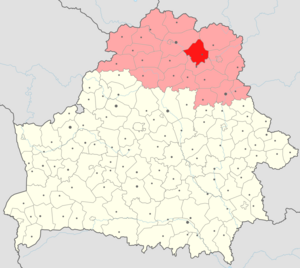
Shumilinsky district ( Belorussian. Shumilinsky rayon ) is an administrative unit in the center of the Vitebsk region of Belarus .
| area | |||||
| Shumilinsky district | |||||
|---|---|---|---|---|---|
| Belor. Shumilinsk Raion | |||||
| |||||
| A country |  Belarus Belarus | ||||
| Included in | Vitebsk region | ||||
| Adm. center | Shumilino | ||||
| Chapter | |||||
| History and Geography | |||||
| Area | 1,695.40 [1] km² (14th place ) | ||||
| Height | |||||
| Timezone | UTC + 3 | ||||
| Population | |||||
| Population | ▼ 17 808 [2] people ( 2018 ) | ||||
| Density | 11.09 people / km² (15th place) | ||||
| Nationalities | Belarusians - 92.24%, Russians - 6.09% others - 1.67% [3] | ||||
| official languages | Native language: Belarusian - 68.02%, Russian - 31.44% They speak at home: Belarusian - 21.16%, Russian - 78.55% [3] | ||||
| Digital identifiers | |||||
| Auto Code numbers | 2 | ||||
| Official site | |||||
 | |||||
![Coat of arms [d]](http://upload.wikimedia.org/wikipedia/commons/thumb/3/36/BIA_Szumilino_COA.jpg/90px-BIA_Szumilino_COA.jpg)
The administrative center is the urban village of Shumilino .
Content
Administrative device
In the region of 8 village councils:
- Dobeysky
- Kovlyakovsky
- Lovzhansky
- Mishnevichsky
- Nikolaevsky
- Obolsky
- Svetloselsky
- Orphan
Abolished village councils in the district:
- Koziansky
- Yazvinsky
Geography
Territory - 1695.4 km² (14th place among the districts of the Vitebsk region) [5] . The main rivers are the Western Dvina and its tributary Obol . The largest lakes: Budovest , Dobeevskoe , Pine , Brine , Moshno , Leskovichi . 5 km south of Shumilino is Lake Kruglik - one of the deepest lakes in Belarus.
The Shumilinsky district borders on the Gorodok district in the northeast, the Vitebsk region in the east, the Beshenkovichi district in the south, the Ushachsky district in the southwest and the Polotsk region in the northwest.
The climate of the region is cooler and wetter than the average for the Republic of Belarus. The growing season in the district begins April 15-17 and lasts until October 13-18 (178-185 days, including the period of active vegetation - 136-140 days) [6] .
Forest vegetation of the region belongs to the northern subzone of deciduous-spruce forests. The most common trees are pine, spruce, birch, ash, aspen [6] . About 380 beavers, 280 moose, 190 roe deer, 240 black grouse and 170 capercaillie live on the territory of the Shumilinsky forest hunting economy, which includes the main forest and wetlands, [6] .
History
It was founded on July 17, 1924 as the Sirotinsky district (the administrative center is the Sirotino station). In 1927, the center of the district was moved to the village of Shumilino (urban-type village since September 27 1938). In 1941, the district included 14 village councils.
Since November 13, 1961, the Sirotinsky district was renamed Shumilinsky.
Demographics
The population of the district is 17,808 people, including 7,525 in Shumilino , 2,340 in the city of Obol (on January 1, 2018) [2] .
| Population [7] [8] [9] [10] : | |||||||
|---|---|---|---|---|---|---|---|
| 1970 | 1979 | 1989 | 1996 | 2001 | 2002 | 2003 | 2004 |
| 29,226 | ▼ 27 009 | ▲ 28 098 | ▲ 28 198 | ▼ 25 838 | ▼ 25 262 | ▼ 24 667 | ▼ 24 041 |
| 2005 | 2006 | 2007 | 2008 | 2009 | 2010 | 2011 | 2012 |
| ▼ 23 374 | ▼ 22 669 | ▼ 22 066 | ▼ 21 550 | ▼ 21 052 | ▼ 20 523 | ▼ 19 964 | ▼ 19 347 |
| 2013 | 2014 | 2015 | 2016 | 2017 | 2018 | 2019 | |
| ▼ 19 108 | ▼ 18 806 | ▼ 18 521 | ▼ 18 263 | ▼ 18 093 | ▼ 17 808 | ▼ 17 513 | |
| National composition by census 2009 [11] [12] | ||
|---|---|---|
| People | Number | % |
| Belarusians | 19 108 | 92.24% |
| Russians | 1262 | 6.09% |
| Ukrainians | 176 | 0.85% |
| Poles | 48 | 0.23% |
| Armenians | eighteen | 0.09% |
| Tajiks | fifteen | 0.07% |
In 2018, 17.7% of the population of the region were younger than able-bodied, 51.6% - in able-bodied, 30.7% - older than able-bodied. The working-age population is the highest in the Vitebsk region, and Shumilino is one of the youngest (20.1%) district centers in the region after Dokshitsy (20.9%) [13] . In 2017, the birth rate was 11.9 per 1000 people (the highest in the region), the mortality rate was 17.7 [14] (the average birth and death rates in the Vitebsk region were 9.6 and 14.4, and in the Republic of Belarus - 10.8 and 12.6 [15] ). In 2017, 213 were born in the district and 318 people died [16] . The balance of internal migration is negative (-180 people in 2017) [17] .
In 2017, 93 marriages (5.2 per 1000 people) and 56 divorces (3.1 per 1000 people) were concluded in the district; the average indicators in the Vitebsk region are 6.4 and 3.4 per 1000 people, in the Republic of Belarus - 7 and 3.4 per 1000 people, respectively [18] [19] .
Economics
The average salary in the district is 80.3% of the average level in the Vitebsk region (2017) [20] . In 2017, 98 microorganizations and 10 small organizations were operating in the district [21] . In 2017, 23.5% of the district's organizations were unprofitable (in 2016 - 22.5%) [22] . In 2015-2017, $ 0.6 million of foreign investment was received in the real sector of the economy of the region [23] . In 2017, the district enterprises exported goods worth $ 3.4 million, imported $ 0.8 million (balance - $ 2.6 million) [24] .
Revenue from sales of products, goods, works, services for 2017 amounted to 84.8 million rubles (about $ 42 million), including 18.8 million rubles from agriculture , forestry and fisheries, 29.4 million from industry , 10.3 million for construction, 25.6 million for trade and repair [25] .
The mineral resources of the area are peat , brick clay , gravel , construction sand .
Industry
The largest industrial enterprises [26] :
- Obolsky Ceramic Plant OJSC in Obol (one of the largest brick factories in the Republic of Belarus);
- JLLC “Vezha” in Shumilino (production of fruit wines);
- PUP “Slavic product” in Shumilino (vodka production);
- Shumilinsky branch of the Vitebsk OJSC "Milk" (production of fatty cheeses and animal oil);
- Production sites of JVC “Vitkonproduct” in the village of Sloboda and Shumilino (poultry processing).
Agriculture
In 2017, 9.2 thousand ha of arable land was sown for grain crops, and 13.9 thousand ha for fodder crops [27] . The gross harvest of grain and leguminous plants in 2017 amounted to 16.5 thousand tons (average yield - 18.6 t / ha). Cereal productivity in the Shumilinsky district is one of the lowest in the whole Republic of Belarus [28] .
As of January 1, 2018, 18.4 thousand cattle (including 7.1 thousand cows), 6.7 thousand pigs, 65.2 were kept in agricultural organizations of the district (excluding farmers and personal households of the population) thousand heads of poultry [29] . In 2017, 9675 tons of meat (in slaughter weight) and 18 550 tons of milk were produced [30] .
In the village of Sloboda there is a poultry farm JLLC "Vitkonproduct" [26] .
Forestry
GLHU “Shumilinsky Forestry” is responsible for 76.6 thousand ha of forest resources, including 66.6 thousand ha of forests directly. 59.3% of forests belong to group I. The timber stock in forests is estimated at 9630 thousand m³, including 3637 thousand m³ of coniferous wood. The total size of the estimated cutting area is estimated at 65.8 thousand m³ per year. Forest hunting is operating on an area of 54.3 thousand ha [6] .
Transport
The district runs the railway " Vitebsk - Polotsk - Daugavpils ."
Republican highways pass through the territory of the district:
- “Vitebsk — Polotsk — border of the Republic of Latvia (Grigorovschina)” ( P20 ),
- Minsk - Ulla- Vitebsk.
By road, the district is connected to such cities as Vitebsk, Polotsk, Gorodok , Beshenkovichi , Ulla .
Health
In 2017, there were 46 medical practitioners in the institutions of the Ministry of Health of the Republic of Belarus (25.8 in terms of 10 thousand people; the average for the Vitebsk region is 37, for the Republic of Belarus - 40.5) and 193 paramedics. In the district’s medical institutions, there were 103 hospital beds (57.8 in terms of 10 thousand people; the average for the Vitebsk region is 80.5, for the Republic of Belarus - 80.2). According to the provision of the population with hospital beds, the district is in one of the last places in the Vitebsk region [31] .
Culture
In the regional center is the Shumilinsky Museum of History and Local Lore with a branch - the museum of the Obolsky Komsomol underground. The museum has collected 11.7 thousand museum items of the main fund. In 2016, 9.8 thousand people visited the museum [32] [33] .
Education
In 2017, 17 pre-school education institutions operated in the district (including kindergarten-school complexes) with 748 children. In the academic year 2017/2018, there were 13 institutions of general secondary education, in which 1856 students studied. The educational process in schools was provided by 318 teachers [34] .
Religion
In the Shumilinsky district, 8 Orthodox communities, 4 Roman Catholic, 2 communities of evangelical Christians-Baptists, one community of Christians of the Evangelical faith (Pentecostals) and Christians of the full Gospel are registered. There are 6 Sunday schools of various faiths, in nine groups of which 96 children are involved [35] .
See also
- Holocaust in Shumilinsky district
Notes
- ↑ “The State Land Cadastre of the Republic of Belarus” (as of January 1, 2011)
- ↑ 1 2 Population as of January 1, 2018 and the average annual population for 2017 in the Republic of Belarus in the context of regions, districts, cities and urban-type settlements. // National Statistical Committee of the Republic of Belarus. - Mn., 2018.
- ↑ 1 2 2009 Census Results
- ↑ GeoNames - 2005.
- ↑ Statistical Yearbook of the Vitebsk region. - Minsk: National Statistical Committee of the Republic of Belarus, 2018 .-- P. 21.
- ↑ 1 2 3 4 Forestry
- ↑ Population by cities and districts of Vitebsk region , Main Statistical Office of Vitebsk region
- ↑ The present population of cities, towns, districts, and district centers of the USSR according to the census as of January 15, 1970 in the republics, territories, and regions (except for the RSFSR)
- ↑ 1979 All-Union Census of the Population of the Union and Autonomous Republics, Autonomous Oblasts and Districts, Territories, Regions, Districts, Urban Settlements, Village District Centers and Rural Settlements with a Population of Over 5,000 (Except the RSFSR)
- ↑ 1989 All-Union Population Census. Population of the Union Republics of the USSR and their Territorial Units by Sex
- ↑ Census of 2009. National composition of the Republic of Belarus. Volume 3 - Mn. , 2011 - S. 106-115.
- ↑ National composition of the Vitebsk region
- ↑ Statistical Yearbook of the Vitebsk region . - Minsk: National Statistical Committee of the Republic of Belarus, 2018. - P. 49-52.
- ↑ Statistical Yearbook of the Vitebsk region . - Minsk: National Statistical Committee of the Republic of Belarus, 2018 .-- S. 55.
- ↑ Demographic Yearbook of the Republic of Belarus: a statistical compilation . - Minsk: National Statistical Committee of the Republic of Belarus, 2018. - P. 143–145.
- ↑ Statistical Yearbook of the Vitebsk region . - Minsk: National Statistical Committee of the Republic of Belarus, 2018.- P. 54.
- ↑ Statistical Yearbook of the Vitebsk region . - Minsk: National Statistical Committee of the Republic of Belarus, 2018 .-- P. 88.
- ↑ Statistical Yearbook of the Vitebsk region . - Minsk: National Statistical Committee of the Republic of Belarus, 2018. - P. 73–77.
- ↑ Demographic Yearbook of the Republic of Belarus: a statistical compilation . - Minsk: National Statistical Committee of the Republic of Belarus, 2018 .-- P. 184.
- ↑ Statistical Yearbook of the Vitebsk region. - Minsk: National Statistical Committee of the Republic of Belarus, 2018 .-- S. 123.
- ↑ Statistical Yearbook of the Vitebsk region. - Minsk: National Statistical Committee of the Republic of Belarus, 2018 .-- S. 352.
- ↑ Statistical Yearbook of the Vitebsk region. - Minsk: National Statistical Committee of the Republic of Belarus, 2018 .-- S. 388.
- ↑ Statistical Yearbook of the Vitebsk region. - Minsk: National Statistical Committee of the Republic of Belarus, 2018. - P. 418–419.
- ↑ Statistical Yearbook of the Vitebsk region. - Minsk: National Statistical Committee of the Republic of Belarus, 2018. - S. 464–467.
- ↑ Regions of the Republic of Belarus. - T. 1. - Mn. : National Statistical Committee of the Republic of Belarus, 2018. - S. 634–635.
- ↑ 1 2 Industry
- ↑ Agriculture of the Republic of Belarus. - Mn. : National Statistical Committee of the Republic of Belarus, 2018. - P. 71–79.
- ↑ Agriculture of the Republic of Belarus. - Mn. : National Statistical Committee of the Republic of Belarus, 2018. - P. 110–114.
- ↑ Agriculture of the Republic of Belarus. - Mn. : National Statistical Committee of the Republic of Belarus, 2018. - P. 137–145.
- ↑ Agriculture of the Republic of Belarus. - Mn. : National Statistical Committee of the Republic of Belarus, 2018. - P. 157–162.
- ↑ Regions of the Republic of Belarus. - T. 1. - Mn. : National Statistical Committee of the Republic of Belarus, 2018. - S. 277–288.
- ↑ Culture of the Republic of Belarus. - Mn. : National Statistical Committee of the Republic of Belarus, 2017. - P. 25-26.
- ↑ Museums of the Vitebsk region . Museums of the Vitebsk region . Date of treatment March 8, 2019.
- ↑ Statistical Yearbook of the Vitebsk region. - Mn. : National Statistical Committee of the Republic of Belarus, 2018. - P. 142-150.
- ↑ Religion
Literature
- Republic of Belarus. Atlas of the hunter and fisherman: Vitebsk region / Editor G. G. Naumenko. - Mn. : RUE Belkartografiya, 2010. - 72 p. - 10,000 copies. - ISBN 978-985-508-136-5 .
- Entsiklapedyya gistory Belarus: U 6 t. T. 6 Kn. 1 / Redkal: G.P. Pashkoў і іnsh. - Mn. : BelEn, 2001. - T. 6. - 10,000 copies. - ISBN 985-11-0214-8 .
- Nature of Belarus: Popular Encyclopedia / Editorial: I.P. Shamyakin (Ch. Ed.) And others. - 2nd ed. - Mn. : BelSE named after P. Brovka, 1989 .-- S. 175 .-- 599 p. - 40,000 copies. - ISBN 5-85700-001-7 .
- The encyclopedic progeny of Belarus. At 5th t. T.3 / Redcal .: I. P. Shamyakin (gal. Red.) І інш. - Mn. : BelSE, 1985. - T. 3. - 599 p. - 10,000 copies. (belor.)