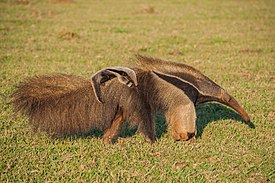
The giant (three-fingered, large) anteater [1] ( lat. Myrmecophaga tridactyla ) is the largest representative in the order of the non-toothed , its body length reaches 110-130 cm. The appearance of the anteater, like other representatives of the non-toothed, is very bizarre: a long narrow muzzle, resembling a tube, tiny narrow eyes, a long tail, compressed from the sides, taking into account wool, reaches 95 cm, often somewhat more. No teeth. The mass of an adult is up to 40 kg, the total body length from the nose to the tip of the tail is about 2.3 m.
| Giant anteater |
 |
| Scientific classification |
|---|
| No rank : | Bilateral symmetrical |
| Gender: | Giant Anteaters ( Myrmecophaga Linnaeus, 1758 ) |
|
| International scientific name |
|---|
Myrmecophaga tridactyla
Linnaeus , 1758 |
| Area |
|---|
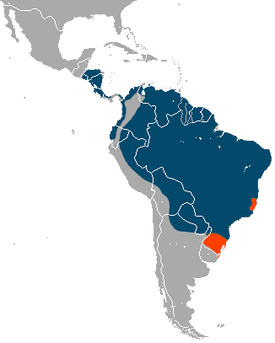
|
| Security status |
|---|
Vulnerable speciesIUCN 3.1 Vulnerable : 14224 |
|
Content
The giant anteater leads a terrestrial lifestyle. Unlike the dwarf anteater , he does not know how to climb trees. Like its tree relatives, it is active mainly at night, but in deserted places it often roams during the day. Sleeps up to 16 hours a day. Walking on the ground with such long claws is difficult, and the anteaters are forced to bend their claws and lean on the back of their forepaws. Claws are easy to defend against enemies - with one paw strike a large anteater is able to gut the dog.
Nutrition
The anteater eats ants and termites . Destroying the claws of a termite mound or anthill , he proceeds to a meal. The anteater throws out a 60-centimeter tongue moistened with sticky saliva at a speed of 160 times per minute, extracting 30,000 insects per day. Also recently [ when? ] it was found that anteaters can eat the fruits of a palm tree, tearing the fruit with sharp claws, thus extracting moisture and vitamins for themselves.
Reproduction
Anteater females carry the only cub on the back and do not part with it from birth until the next pregnancy. Thanks to a coloration similar to that of the mother, the cub is almost imperceptible.
