Santo Stefano ( Italian: Basilica di Santo Stefano ) - a complex of Christian religious buildings in the city of Bologna , Italy . Located on the eponymous square. This place is also known as the "Seven Churches" (Sette Chiese).
| Complex of catholic churches | |
| Santo Stefano | |
|---|---|
| Santo stefano | |
 | |
| A country |  Italy Italy |
| Bologna | |
| Denomination | Catholic Church |
| Diocese | |
| Architectural style | Essentially Romance |
| Established | OK. 440 years |
| Site | abbaziasantostefano.it |
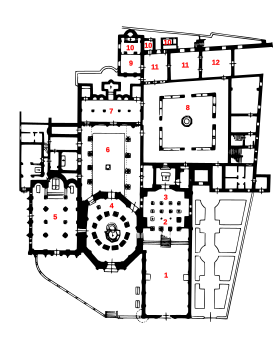
1-3. Church of the Crucifixion of the Lord or St. John the Baptist
2. Crypt
4. Church of the Holy Sepulcher
5. The Basilica of St. Martyrs Vitali and Agricola
6. Yard of Pilate
7. Martyrium, or Calvary, or Trinity Church
8. Patio
9-10-11-12. Benda Church and Museum
According to legend, in the 5th century, on the site of the temple of the goddess Isis, Bishop of Bologna St. Petronius erected a complex that was to repeat the basic elements of the Church of the Holy Sepulcher in Jerusalem. The temples of the existing complex, in any case, belong to the early Middle Ages: the Church of St. John the Baptist (or Holy Crucifix) dates from the 8th century , the Church of the Holy Sepulcher - from the 5th century (reconstructed in the 8th and 12th centuries ). A 13th-century portico known as Pilate's Courtyard connects the rest of the buildings with the Holy Trinity Church ( 13th century ). The complex acquired its modern appearance after numerous and highly controversial restorations of the late XIX - early XX centuries.
The complex is one of the most integral in design and the best preserved of the reproductions of Jerusalem in Europe (along with the New Jerusalem near Moscow).
In other places of Bologna there were holy places of biblical and gospel history: the Church of the Ascension , the Mount of Olives, Mount of Olives , Jehoshaphat Valley , Akeldam , Siloam font .
Content
Temple of the Crucifixion of the Lord
The Crucifixion Temple is of Longobard origin and dates back to the VIII century. This is a one-nave Romanesque temple with a vault under the roof truss and presbytery (the so-called Pilate Hall), erected over the crypt.
In the center of the presbytery, rebuilt in the 17th century, the Crucifix of the work of the Bologna sculptor Simone dei Crocifissi ( Simone dei Crocifissi , c. 1380) is placed. The frescoes of the 15th century on the plots of the life of St. Stefan. The main staircase leads to the presbytery - the result of numerous restorations and alterations, completed only in 1958.
Under the presbytery is a crypt, divided into five naves with columns of various kinds. One of them, according to legend, from the cap to the capital has a height exactly equal to the growth of Jesus (about 1.7 meters). At its base in the urn placed on the altar, the remains of St. Martyrs Vitali and Agricola . Recently, two murals of the 16th century dedicated to the lives of these saints were found on a nearby wall under a layer of stucco. A small fresco of the beginning of the 15th century, the so-called Madonna della Neve, has been preserved in the left nave.
Church of the Holy Sepulcher
The Church of the Holy Sepulcher - the oldest in the complex, is an octagonal building in plan, inside of which 12 columns (7 of marble, the rest of brick) support the dome. In the very center is Edicola St. Petronius (the relics of St. Petronius themselves were transferred from here to the Cathedral of St. Petronius in 2000, where previously only his head was stored). Inside the church, there is a source that tradition connects with the waters of the Jordan, and a separate column of black marble, symbolizing the one on which Christ was scourged. The source and columns of columns made of African marble probably belonged to the temple of Isis, which existed here in the ancient Roman period.
The arch and walls of the church were decorated with frescoes of the 13th century, which were removed during the controversial restorations of the 19th century, some of their fragments are now stored in the museum of the cathedral.
Gallery
Seven Churches Square
The interior of the Church of the Holy Sepulcher.
Covered arcade
Notes
- ↑ archINFORM - 1994.