The building of the Hungarian Parliament ( Hungarian. Országház - Orsaghaz ) is the seat of the Hungarian Parliament on the Danube in Budapest . In its architecture, neo-Gothic elements were intricately intertwined along the lines of the Westminster Palace and the influence of the Parisian Boz-ara ( Hotel de Ville could serve as a prototype here).
| Sight | |
| Hungarian Parliament Building | |
|---|---|
| A country | |
| Location | |
| Architectural style | |
| Architect | |
| Established | |
| Height | |
As early as 1843, a decision was made to build the Hungarian Parliament building in Pest. However, due to the outbreak of the Hungarian Revolution and the establishment of a regime of oppression of the Hungarian people by the authorities after its suppression, the plan was not implemented.
The decision to build the parliament building was made after the unification of Buda and Pest in 1873. The competition was won by renowned neo-Gothic enthusiast Imre Steindl . The site was selected on the eastern bank of the Danube between the first two permanent bridges in Budapest - the Sechenyi Chain Bridge and the Margit Bridge . Construction was carried out from 1885 to 1904. Even before the end of construction, in 1896, magnificent celebrations were held there in honor of the millennium of the conquest of Hungary by the Magyar tribes. For the celebration, the Dome Hall of the Parliament was opened. The building was erected in a neo-Gothic style with elements of oriental architecture. Given the geography of these places, Steindl arranged the Parliament so that from all sides it was equally possible to see its most remarkable features. According to the projects submitted to the contest by rivals of Steindl, the Ethnographic Museum and the Ministry of Agriculture were erected next to the parliament on Lajos Koshut Square .
The parliament building is the largest in Hungary; it has 691 rooms, 29 stairs and 10 courtyards. The building was planned to be erected by 1896, but by this time only the central domed hall was built. The height of the central dome is 27 m, the diameter of the dome is 20 m. In the outbuildings located on both sides of the dome are the conference rooms (previously the Hungarian parliament was bicameral). The second conference room is currently used for conferences. The facade is decorated with statues of the rulers of Hungary and Transylvania . The interiors are lavishly decorated in a medieval manner using mosaic panels , stained glass and gilding. During the years of socialism, the spire of the building was crowned with a red star, like the towers of the Moscow Kremlin .
In the domed hall of the parliament, decorated with 16 statues of kings and rulers of Hungary, from January 1, 2000 (the 1100th anniversary of the statehood of Hungary) the crown of St. Stephen, along with a scepter , power and sword, has been kept. The first twenty minutes of every hour at the coronation regalia is a guard of honor in historical uniform. Due to its dilapidation, the coronation mantle of St. Stephen was deposited in the Hungarian National Museum and exhibited there along with chests in which the coronation regalia of Hungary were kept. The Frescoes and paintings adorn the Hunting Hall and the Hall of Deputies. The building of the Hungarian Parliament provides tours for tourists, including in Russian.
Inside the building is a small museum of parliament.
Near the parliament building are the Kossuth memorial, monuments to Ferenc Rakoczi II , Imre Nagy , Attila Jozsef and participants in the 1956 uprising in Hungary .

Parliament Building - Budapest Business Card
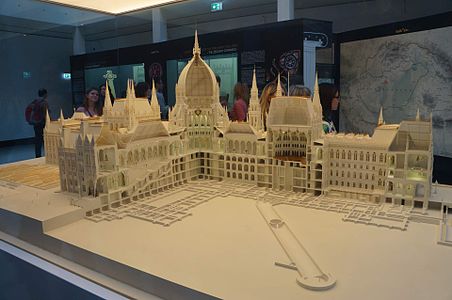
Model of the building in the Museum of Parliament

Notes
- ↑ 1 2 archINFORM - 1994.