Zelda II: The Adventure of Link ( Japanese ゼ ル ダ の 伝 説 (パ ー ト) 2 リ ン ク の 冒 険 Zeruda no Densetsu (Pa: then) Tsu: Rinku no Bo: ken ) is a video game developed and released by Nintendo System for the Nintendo Entertainment platform 1987 , the second (by release date) of the The Legend of Zelda series of games .
| Zelda II: The Adventure of Link | |
|---|---|
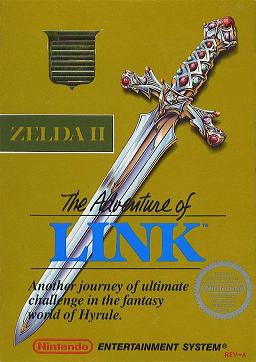 North American version cover for NES | |
| Developer | Nintendo EAD |
| Publisher | Nintendo |
| Part of a series | The legend of zelda |
| Release dates | NES / FDS :  January 14, 1987 January 14, 1987  December 1988 December 1988  November 26, 1988 November 26, 1988 Game Boy Advance :  August 10, 2004 October 25, 2004 January 7, 2005 August 10, 2004 October 25, 2004 January 7, 2005 Virtual Console : January 23, 2007 February 9, 2007 June 4, 2007 |
| Genre | action - role playing game |
| Age ratings | CERO : Z -Ages 18 and up only ESRB : E - Everyone OFLC (A) : G - General PEGI : 3 USK : and |
| Creators | |
| Producer | |
| Game designer | Shigeru Miyamoto |
| Composer | Akito Nakatsuka |
| Technical details | |
| Platforms | NES , Famicom Disk System , Game Boy Advance , Wii ( Virtual Console ) |
| Game mode | single user |
| Carriers | floppy disk (FDS), cartridge (NES, GBA) |
| Control | NES controller |
The Adventure of Link is a direct continuation of the 1986 The Legend of Zelda game, although it differs markedly from its technical execution. Despite the fact that now the game has a reputation among fans as a kind of deviation from the ideas and traditions of the series, at one time the game was quite successful and introduced elements into the series that took root and later became part of the recognizable style of the entire series.
Content
Story
The protagonist of the game is again a young man named Link. After the victory over Ganon, Link helped restore order in the kingdom of Khairul for several years. Once he noticed a strange mark in the form of three triangles on the back of his hand. Having met with an old woman named Impa, the former nurse of Zelda (having rescued which from trouble, he was involved in adventures last time), Link showed her a sign on his hand. Impa escorted him to the North Castle, the gates of which were magically “sealed for centuries”. From the touch of the mark on Link’s hand to the door, the magic dissipated and Link’s gaze appeared to the sleeping maiden. She turned out to be Zelda, Princess of Hyrul. Impa said that after the death of King Hailour, Zelda’s father, her brother demanded that she reveal the secret location of the ancient treasure in the form of three golden triangles, known in the assembled state as Triforce of Courage and part of another ancient artifact known as Triforce and able to fulfill the will of the owner. Zelda refused, and the prince's friend, the sorcerer, tried to enchant her in anger. As a result of the spell, the sorcerer himself died, and Princess Zelda fell into a deep, endless dream. The prince, unable to dispel witchcraft, placed her in the castle tower in the hope that someday she would wake up. The prince also issued a decree according to which from now on all the girls born in the royal family will be called Zelda in memory of the tragedy.
The sign on Link’s hand, according to Impa, means that he was elected to become the hero who would wake Princess Zelda. To do this, he will need to find the third fragment of Triforce, Triforce of Courage, hidden from the forces of evil in the Great Palace. The impa hands Link six precious stones and ancient letters indicating in which Khairul's palaces these stones should be placed. This ritual will open the entrance to the Grand Palace and awaken the servants of Ganon, who will kill Link for the return of their master. In the Grand Palace, Link will find an ancient sage who agrees to give him Trifors, having tested his courage: Link will have to fight his doppelganger (known as the Shadow of Link). After defeating the Shadow, Link finally receives the Triffors of Courage, returns to the tomb of Zelda, the three golden Trophors are combined into one Trophors, with the help of which he will wake Princess Zelda from a magical dream.
Gameplay
The gameplay and appearance of Zelda II: The Adventure of Link has undergone a number of significant changes, not all of which were accepted favorably by the players.
The main innovation was the use of the traditional two-level system for moving around the game world for JRPG . A “world map” was introduced, using, like the previous game, a “top-side” view, but with a reduced scale, with a schematic designation of locations (villages, castles, dungeons). And a separate engine for moving inside locations (using the type of arcade platformer with side scrolling). The size of the game world available for research has significantly increased, and the number of non-game characters inhabiting the world has also increased significantly.
The Adventure of Link , remaining an arcade with quest elements, now included several RPG elements. So, for killing monsters, Link gets a certain number of points that are not directly called experience , but when you score a certain number of points, you go to the next level, accompanied by an increase in some parameters of the character (for example, health ).
Among the innovations, one can also note the possibility of limited use of magic (in the previous game, Link could use magic only by finding a magic wand), the need to purposefully pick up bonuses knocked out of the opponent (previously, to raise a bonus from the ground, it was enough to walk on it, or reach it with sword or boomerang), a simplified form of communication with the NPC (now the player could, when in contact with a non-player character, press a button and get advice, a hint or a comment).
In addition, there were a number of changes that were identified by the players as controversial and caused a rather negative reaction. Only one type of weapon is available in the game - the sword (in the previous game there were several types of auxiliary weapons: two types of boomerangs that paralyze the enemy, and two types of arrows that could fire from a bow, as well as bombs). The number of life points was displayed in red squares instead of traditional (and considered by some players as more atmospheric) hearts. Killed enemies could leave two types of bonus - jugs that restore the supply of magic (blue jugs restored one division, red ones - the whole stock) and the so-called P-bags, which added experience points to Link. The player could now restore Link's health level only using magic, as well as resorting to the help of fairies (which were much less common than in the previous game).
Recognition
In total, 4.38 million copies of the game were sold [1] . The monthly edition of Nintendo Power placed the game in 110th place on its list of 200 best games [2] .
Play magazine wrote that the game’s gameplay is “a combination of unique elements that creates a different action RPG effect”, and Nintendo Power called the game “a fun and natural step in the evolution of franchised brands,” recognizing The Adventure of Link in 1988 of the year.
Reprint
Despite its reputation as a spin-off , the game nevertheless survived three re-releases:
- In 2003, Nintendo released a compilation for the GameCube called The Legend of Zelda: Collector's Edition , which along with other games in the series also included The Adventure of Link .
- In 2004, the game was ported to Game Boy Advance as part of the Classic NES Series .
- In 2007, the game was reissued for the Wii Virtual Console service .
- In 2011, the game was reissued for the Virtual Console service for Nintendo 3DS and distributed free of charge as part of the Ambassador Program
Interesting Facts
- The phrase “I AM ERROR”, which arose due to an error in the localization of the Japanese version into English, [3] became an Internet meme .
- The side-view two-dimensional arcade mode used for locations caused a number of complaints from the players and was never used by Nintendo in The Legend of Zelda games (with the exception of some dungeon rooms in games on GameBoy and GameBoy Color: Link's Awakening / Link's Awakening DX, Oracle of Seasons, Oracle of Ages, and also during the battle with the Angler Fish boss in the fourth dungeon (Angler's Tunnel) in the game Link's Awakening / Link's Awakening DX, maybe somewhere else).
- Link in this game is 16 years old [4] .
- Although the game uses the idea proposed by Miyamoto [5] , he himself did not participate in the work on the project. Just like the key figures of the previous project, the designer Tezuka Takashi and composer Koji Kondo did not work on the game.
Sources, notes
- ↑ Parton, Rob: Xenogears vs. Tetris Archived March 12, 2013. 03/03/2004
- ↑ “NP Top 200,” Nintendo Power, February 2006, pp. 58-66.
- ↑ I AM ERROR , Know Your Meme . Date of treatment February 19, 2017.
- ↑ Nintendo Virtual Console: Adventure of Link .
- ↑ Miyamoto's Interview on Myamoto Shrine: Shigeru Miyamoto's Home on The Web .
Links
- The Adventure of Link on Zelda.com
- Zelda II: The Adventure of Link on the Zelda Wiki
- Zelda II: The Adventure of Link at RPGClassics.com
- Zelda II: The Adventure of Link on GameFAQs
- Amateur translation of the game into Russian