
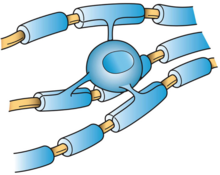
Oligodendrocytes , or oligodendroglia, is a type of neuroglia discovered by Pio del Rio Ortega (1928). Oligodendrocytes exist only in the central nervous system , which in vertebrates includes the brain and spinal cord .
Their main function is to provide assistance and isolation to the axons of neurons located in the central nervous system of vertebrates (similar to Schwann cells in the peripheral nervous system . Oligodendrocytes fulfill their function by creating a myelin sheath, which consists of 80% lipids and 20% of proteins. Each oligodendrocyte has many processes, each of which wraps itself part of a certain axon. One oligodendrocyte can serve up to 50 axons. Schwann cells, in turn, can turn Download only one axon.
Content
Origin
Oligodendroglia develops from oligodendrocyte progenitor cells .
Most oligodendrocytes develop during embryogenesis and early infancy from near-ventricular germinal regions .
The cells of the subventricular zone migrate from the embryonic zones to populate the developing white and gray matter , where they differentiate and mature into myelin-forming oligodendroglia.
However, it is not yet known whether all oligodendroglial precursors undergo such a sequence of events. It has been suggested that some of them undergo apoptosis , that is, self-destruct, while others cannot differentiate into mature oligodendroglia and persist as adult oligodendroglial progenitors. It is noteworthy that the population of oligodendrocytes that originated in the subventricular zone can be dramatically expanded by the introduction of epidermal growth factor (EGF).
Now the origin of oligodendrocytes is actively discussed by scientists.
At birth, myelination is common only in some regions of the brain; it continues until the age of 25-30 years.
Functions
Oligodendrocytes are closely associated with nerve cells, and, like other glial cells, oligodendrocytes provide neurons with support as well as trophic support by producing glial neurotrophic factor (GDNF), cerebral neurotrophic factor (BDNF) and insulin-like growth factor-1 (IGF-1) . In addition, the mammalian nervous system is highly dependent on the myelin sheaths, which reduce ion leakage and decrease the capacity of the cell membrane. Myelin also increases the speed of conduction of nerve impulses, when the abrupt distribution of action potentials occurs through Ranvier intercepts between Schwann cells (in the peripheral nervous system) or oligodendrocytes (in the central nervous system). In addition, the propagation velocity of the myelinated axon impulses increases in proportion to its diameter, while the non-myelinated fiber impulse velocity increases only as the square root of the axon diameter. Insulation in thickness should be proportional to the diameter of the fiber. The optimum ratio of the axon diameter divided by the diameter of the entire fiber (including the myelin sheath) for the maximum speed of conducting pulses is 0.6.
Satellite oligodendrocytes are functionally different from other oligodendrocytes. They are not attached to neurons and therefore do not perform an insulating role. They regulate the composition of extracellular fluid. Satellite oligodendrocytes are considered part of the gray matter, while myelinating oligodendrocytes are part of the white matter.
Myelination is an important factor affecting intelligence. Neuroscientist Vincent J. Schmithorst suggested that there is a relationship between the volume of white matter in the brain and intelligence. People with more white matter have a higher IQ. A study by Janice M. Juraska on rats showed that rats grown in an enriched medium had a high degree of myelination in their corpus callosum .
Pathology
Damage to oligodendrocytes is observed in demyelinating diseases, such as multiple sclerosis and various leukodystrophies . Oligodendrocyte dysfunction may also be associated with the pathophysiology of schizophrenia and bipolar disorder .
Injuries to the body, such as spinal cord injuries, can also cause demyelination. Cerebral palsy (sometimes developing from periventricular leukomalacia , which is local or widespread aseptic necrosis of the white matter of the cerebral hemispheres and is most often found in premature babies) is mainly congenital or caused by damage to the newly formed brain (trauma to the structures of the brain during the period of fetal development and childbirth). In cerebral palsy, spinal cord injury, stroke, and possibly multiple sclerosis, oligodendrocytes are thought to be damaged by excessive release of the neurotransmitter glutamate . It has also been shown that damage is mediated by glutamate NMDA receptors .
Oligodendrocytes are also susceptible to infection by human polyomavirus (JC virus), which causes progressive multifocal leukoencephalopathy (PML), a condition that specifically affects the white matter, usually in immunocompromised patients.
Tumors of oligodendroglia are called oligodendrogliomas . The chemotherapeutic agent fluorouracil (5-FU) causes damage to oligodendrocytes in mice, which leads to both sharp acute disorders of the central nervous system and gradually delayed central nervous system degeneration, which gradually increases over time.
Notes
- ↑ Pelvig DP, Pakkenberg H, Stark AK, Pakkenberg B (November 2008). "Neocortical glial cell numbers in human brains." Neurobiology of Aging 29 (11): 1754-62. DOI : 10.1016 / j.neurobiolaging . 2007.04.013 . PMID 17544173 .
Literature
- Baumann, Nicole. Biology of Oligodendrocyte and Myelin in the Mammalian Central Nervous System (Eng.) // Physiological Reviews : journal. - 2001. - Vol. 81 , no. 2 - P. 871-927 . - PMID 11274346 .
- Fadi; Ragheb. The M3 Muscarinic Acetylcholine Receptor Mediates p42 mapk Activation and c-fos mRNA Expression in Oligodendrocyte Progenitors : journal. - Ottawa: National Library of Canada, 1999.
- Raine, CS (1991). Oligodendrocytes and central nervous system myelin. In Textbook of Neuropathology, second edition, RL Davis and DM Robertson, eds. (Baltimore, Maryland: Williams and Wilkins), pp. 115-141.
- Tkachev D., Mimmack ML, Ryan MM et al. Oligodendrocyte dysfunction in schizophrenia and bipolar disorder (English) // The Lancet : journal. - Elsevier , 2003 .-- September ( vol. 362 , no. 9386 ). - P. 798-805 . - DOI : 10.1016 / S0140-6736 (03) 14289-4 . - PMID 13678875 .
- Káradóttir, R .; D. Attwell. Neurotransmiter receptors in the life and death of oligodendrocytes (English) // Neuroscience : journal. - Elsevier , 2007 .-- April 14 ( vol. 145 , no. 4 ). - P. 1426-1438 . - DOI : 10.1016 / j.neuroscience.2006.08.070 . - PMID 17049173 .
- Carlson, Neil. Physiology of Behavior. - Boston, MA: Allyn & Bacon, 2010. - P. 38–39. - ISBN 0-205-66627-2 .
- Sokol, Stacey The Physiology and Pathophysiology of Multiple Sclerosis (Link unavailable) . Multiple Sclerosis: Physiological Tutorial . Date of treatment April 29, 2012. Archived July 16, 2012.
- Fields, Douglas. White Matter Matters // Scientific American . - Springer Nature , 2008 .-- February 18 ( vol. 298 , no. March 2008 ). - P. 54–61 . - DOI : 10.1038 / scientificamerican0308-54 . - .
- Menn, Benedicte; Oscar Gonzalez-Perez . Origin of Oligodendrocytes in the Subventricular Zone of the Adult Brain (Eng.) // The Journal of Neuroscience : journal. - 2006 .-- 26 July ( vol. 26 , no. 30 ). - P. 7907-7918 . - DOI : 10.1523 / JNEUROSCI.1299-06.2006 . - PMID 16870736 .
- Gonzalez-Perez, O., B; Romero-Rodriguez, R; Soriano-Navarro, M; Garcia-Verdugo, JM; Alvarez-Buylla, A. Epidermal growth factor induces the progeny of subventricular zone type B cells to migrate and differentiate into oligodendrocytes. (English) // Stem Cells: journal. - 2009. - Vol. 27 , no. 8 - P. 2032-2043 . - DOI : 10.1002 / stem.119 . - PMID 19544429 .
- Vallstedt, A; Klos JM; Ericson F. Multiple dorsoventral origins of oligodendrocyte generation in the spinal cord and hindbrain (English) // Neuron : journal. - Cell Press 2005 .-- 6 January ( vol. 1 , no. 1 ). - P. 55-67 . - DOI : 10.1016 / j.neuron.2004.12.0.026 . - PMID 15629702 .
- Thomas, JL; Spassky N; Perez Villegas EM; Olivier C; Cobos I; Goujet-Zalc C; Martínez S; Zalc B. Spatiotemporal development of oligodendrocytes in the embryonic brain (Eng.) // Journal of Neuroscience Research : journal. - 2000 .-- February 15 ( vol. 59 , no. 4 ). - P. 471—476 . - DOI : 10.1002 / (SICI) 1097-4547 (20000215) 59: 4 <471 :: AID-JNR1> 3.0.CO; 2-3 . - PMID 10679785 .
- Richardson, WD; Kessaris, N; Pringle, N. Oligodendrocyte wars (Eng.) // Nature Reviews Neuroscience : journal. - 2006. - Vol. 1 , no. 1 . - P. 11-18 . - DOI : 10.1038 / nrn1826 . - PMID 16371946 .