The New Guinea Campaign (1942-1945) is one of the main campaigns in the Pacific Theater of War during World War II .
| New Guinea Campaign |
|---|
| Main Conflict: World War II |
|
| date | 1942 - 1945 |
|---|
| A place | Pacific Ocean |
|---|
| Total | Allied victory |
|---|
|
 USA USA
 Australia Australia
|  Japan empire Japan empire
|
|
|
Douglas MacArthur | Hitoshi Imamura |
|
|
: about 7,000 killed and died of disease
: about 7,000 killed and died of disease [1] | : over 200,000 killed and died of disease [1] |
|
|
|
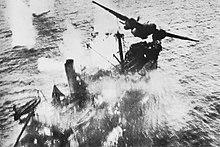
American
A-20 bomber attacks Japanese ships during the Battle of the Bismarck Sea, (March 1943)

2 dead Japanese soldiers in the water
Japanese troops landed in Papua on March 7, 1942 at Lae and Salamaua and on July 21-22, 1942 in the Buna-Gona region. A series of battles began, known as the Battle of Kokoda . The Japanese almost reached Port Moresby , but problems under Guadalcanal forced the command to begin a retreat. Japanese troops in New Guinea were subordinated to the 18th Army of Lieutenant General Adati, created on November 9, 1942.
By January 23, 1943, the 7th Australian Division, the 32nd and part of the 41st US Division had cleared the Buna-Gon area from them, losing 8,500 people. with 12 thousandth Japanese losses. The 5th, 7th and 9th Australian divisions and the 6th US Army, with the support of the 5th and 7th US fleets from spring 1943 to the end of September 1944, later participated in the battles in New Guinea. During the New Guinean campaign, the Japanese more than 200,000 people lost their lives, most of whom died from starvation and disease.


