
Own motion refers to changes in the coordinates of stars in the celestial sphere caused by the relative motion of stars and the solar system . They do not include periodic changes caused by the motion of the earth around the sun ( parallax ).
A more rigorous definition: “The proper motion of a star in astronomy is the value that characterizes its angular displacement on the celestial sphere in a given coordinate system per unit time”
If any star was observed twice in an era and era and its visible coordinates - right ascension (α) and declination (δ) - are given in the fundamental catalog system FK5 (era T0), then its own motion is defined as


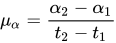
dimension - angular second per year,
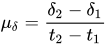
dimension - angular second per year.
The proper motion of stars defined in this way is sometimes called meridian, since they are determined by comparing two positions obtained through observations on meridian circles . Mass definitions of the meridian proper motions of stars became possible already in the 19th century as a result of the creation of several dozen meridian catalogs, reduced to a single fundamental system. The largest number (33,342) of positions and proper motions of stars (including weak ones - up to the 9th magnitude ) in one system is given in the well-known general catalog “General Catalog” of Lewis Boss ( 1910 ). Errors of proper motions in this catalog are ± (0.005–0.15) ″ / year. The positions and movements of stars are not free from systematic errors. The new fundamental catalogs of stars FK4 and FK5 retain errors of their own motions at the level of ± (0.002-0.005) ″ / year, however, these catalogs cover only a small number of selected, mostly bright stars. By 1995, at least 50,000 meridian proper motions of stars from the brightest to the 9th magnitude were known. Errors of these proper motions can be from ± 0.002 ″ to ± 0.010 ″ depending on the length of the observation history. In magnitude, most of the known proper motions are less than 0.050 ″ / year, but there are also large proper motions. So, the “flying” Star of Barnard has the highest value of his own motion - 10.358 ″. The second and third lines in the ranking of the fastest moving stars in the celestial sphere are Kaptein's Star (8.670 ″ / year) and Lacaille 9352 (6.896 ″ / year).
The relationship between the distance and the proper motion of the star is determined from the relation:
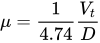
Here Is the projection onto the celestial sphere of the spatial velocity of the star in the coordinate system moving with the Sun, D is the distance to the star in parsec (1 pc = 206,265 astronomical units = 3.26 light years). Dimension - km / s, dimension ″ - angular second per year.

Content
Measurement Methods
At the end of the 19th century, photography was firmly rooted in the practice of observational astronomy. In this regard, photographic methods have been developed to determine the proper motions of stars.
The photographic proper motions of stars are determined by comparing the measured positions of the stars on various plates obtained in different eras. Owing to this, the photographic proper motions inevitably remain relative, that is, they determine the motion of some stars relative to a certain group of other stars (the so-called reference stars), the movement of which is made more or less plausible assumptions. Thus, in order to move from the photographic proper motions of stars to the meridian ones (meaning inertial or “absolute”), it is necessary to carry out additional research, which astronomers are sometimes called absolutization and which are rarely impeccable.
The main advantage of their own photographic movements in their relatively high accuracy and mass in relation to the faintest stars. This circumstance makes them an indispensable observational material in statistical studies related to the determination of dispersions of peculiar (individual) stellar motions and the distribution of stellar motions assigned to different types of stellar populations.
A significant drawback of the photographic proper motions of stars is their lack of freedom from all sorts of systematic errors associated with the photographic method of observation. These are the so-called errors of the "light equation", "color equation" and some others related to the imperfection of the optics of wide-angle telescopes used in astrophotography. The listed errors are expressed in the systematic shift of the images of stars on the plate, depending on the brightness, color of the stars and their position on the plate. These errors are difficult to calibrate, since they also depend on constantly changing observation conditions (transparency of the atmosphere, wind, image quality).
The new era in the determination of their own motion of stars was the flight of the Hipparcos satellite ( HI gh P recision PAR arallax CO slecting Atellite), which over the course of 37 months of operation carried out millions of measurements of stars. As a result of work, two star catalogs turned out. The HIPPARCOS catalog contains coordinates measured with an error of the order of one thousandth of an arc second, proper motions and parallaxes for 118,218 stars. This accuracy for stars was achieved in astrometry for the first time. The second catalog, TYCHO, provides slightly less accurate information for 1,058,332 stars. The creation of these two catalogs marked the birth of a new direction - space astrometry .
Now in many countries work is underway to create new projects of astrometric measurements from space. There are two such projects in Russia - LOMONOSOV and Struve, prepared respectively by astronomers of the Sternberg State Astronomical Institute in Moscow and astronomers of the Pulkovo Observatory in St. Petersburg .
In 2013, the European Gaia apparatus (Global A Strometric Interferometer for A Strophysics) was launched. The aim of this project is to measure coordinates, proper motions and parallaxes for 50 million stars with an accuracy better than 10 microseconds of an arc.
Discovery History
The discovery of the motion of “ fixed ” stars belongs to the famous English astronomer Edmund Halley , who discovered in 1718 that some bright stars from the Hipparch-Ptolemy catalog noticeably changed their positions among other stars. These were: Sirius , shifted to the south by almost one and a half diameters of the moon, Arcturus - by two diameters to the south and Aldebaran , shifted by 1/4 of the diameter of the moon to the east. The noticed changes could not be attributed to the errors of the Ptolemy catalog, usually not exceeding 6 ′ (1/5 of the diameter of the moon) . Halley's discovery was soon ( 1728 ) confirmed by another English astronomer, James Bradle , who is better known as the discoverer of the year-long aberration of light . Subsequently, Tobias Mayer ( 1723 - 1762 ), Nicola Lacaille ( 1713 - 1762 ) and many other astronomers up to Friedrich Bessel ( 1784 - 1846 ), who laid the foundation for the modern fundamental system of positions of stars, dealt with the definitions of stars.
Literature
Links
- Own motion of stars , interactive circuits of constellations.