
Overpopulation - a type of demographic crisis [1] , which is characterized by an excess of population in relation to livelihoods (lack of resources to maintain hygienic living standards) or an excess of population in relation to demand for labor [2] .
Overpopulation is a relative concept , depending on the resource base and the level of economic development of the territory of a given population, and also includes an assessment of the possibilities of replenishing and expanding sources of livelihood.
The threat of overpopulation is estimated by various methods (the following are simplified examples of estimates, excluding unemployment and living standards ):
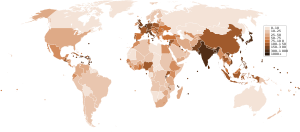
- a simple estimate: the ratio of the population to the area (soil surface) on which it lives (see population density );
- regenerative assessment: the ratio of the rate of consumption of food resources of a given population to the rate of renewal of the same resources, minus the amount of resources needed to maintain the ecosystem and the regenerative system of nature (theoretically, over 25 billion people will be overpopulated according to this position ) [3] ;
- assessment of expansion opportunities: estimated by the ratio of the population growth rate to the rate of progress (economic, social, etc.), which provides the possibility of the emergence of new sources and the potential for expanding the resource base.
It manifests itself in socio-economic contradictions and conflicts: a decline in the standard of living of the majority of the population, high unemployment, hunger, war [4] .
The problem of overpopulation of the Earth was first raised by the Club of Rome 30 years ago. When I was a member of the Club of Rome, global issues were discussed there - the nuclear arms race, missile defense and others. Then it became clear: the main problem is the problem of the growth of mankind.
Types and causes of overpopulation
The types of overpopulation are distinguished, depending on the factors causing a shortage of livelihoods, were originally identified in the works of Karl Marx [4] :
- Absolute - due to the low level of technological development in pre-capitalist society, the shortage and depletion of food resources necessary to maintain the normal life of an increasing population [6] . Occurs when population growth overtakes growth in food production [4] .
- Relative - due to the lack of coordination of socio-economic mechanisms in capitalist society [6] , an excess of labor [7] can occur without population growth.
Ushakov’s Dictionary (published 1935-1940) gives the following expanded definition of the types of overpopulation: “A provision in which in a capitalist society a part of the able-bodied population is not able to use its forces to earn a living due to the anarchy of production and class contradictions (relative overpopulation ) , or, in pre-capitalist society, the situation when the amount of livelihood obtained is insufficient, compared with the population, due to the extremely low level of technology (absolute overpopulation) . "
Big cities consume a significant amount of water, food and fuel per day, and in return emit a huge amount of gaseous, liquid and solid waste into the atmosphere.
While maintaining the existing population growth rate and concentrating it in large industrial cities in the coming decades, the consumption of energy and mineral resources will increase several times. This will necessitate the development of principles for the development of new natural resources, including through the use of deposits of the seas and oceans. The intervention of people in natural processes will increase sharply and may contribute to a change in the regime of groundwater and groundwater, degradation of farmland, a change in microclimate, etc.
Another important problem is the uneven distribution of the population across the globe. Currently, about half of its population lives in only six countries. More than 90% of the population is concentrated in the Northern Hemisphere. The process of urbanization continues - the growth of the urban population. If in 1950 in the world there were only 5 cities with a population of over 5 million people. in each, then in 1980 there were already 26 such cities, and in 2000 - about 50. The emergence of giant cities with a population of 25-30 million people. The largest modern cities are Mexico City , New York , São Paulo and others. At the same time, urbanization, thanks to a rapid decrease in the birth rate in an industrial society , helps smooth out the negative effects of the population explosion in developing countries [8] .
The most densely populated cities in the world (according to S. Connolly and others)
At present, China holds the palm by the number of cities with a million population: in 2012 there were more than 100 cities with a million population [9] , including Shanghai (24 million people), Beijing , Chongqing , Tianjin and Guangzhou , each of which more than 10 million people live. Other major cities in the world:
| City | Population, million people | |
| 1980 year | 2000 year | |
| Mexico city | 15.0 | 26.0 |
| Tokyo | 17.0 | 17.0 |
| New York | 15.6 | 15,5 |
| Sao paulo | 13.0 | 24.0 |
| Calcutta | 9.5 | 16.6 |
| Rio de Janeiro | 9.2 | 13.3 |
| Bombay | 8.5 | 16,0 |
Social and psychological causes of overpopulation
| 7-8 children 6-7 children | 5-6 children 4-5 children | 3-4 children 2-3 children | 1-2 children 0-1 children |
The reasons for overpopulation, not related to the level of technological development and agricultural resources, are:
- low level of education, especially for women (including the lack of family planning [11] );
- religious and cultural traditions that encourage the birth of a large number of children in the family (including the prohibition of abortion and contraception, the inferior status of women, the restriction of women's rights compared to men (rejection of education for women; restrictions on the employment of women, except for homework and childcare) ) [11] [12] ;
- a warm climate in tropical countries, which makes it possible for a large number of people to live year-round in unsuitable dwellings, slums, favelas (in countries with a temperate and cold climate in winter it is impossible to stay in unheated and unadapted housing for a long time);
- Psychology rooted in psychology and poverty (including due to constant armed conflicts and disasters, such as in Africa and the Middle East)
According to foreign authors ( The New York Times ), countries and regions of the world with a constant burden of war and disease (such as AIDS ), contrary to popular belief, do not experience less population growth in the long run. This is because parents, brothers and sisters in a family that has experienced the death of relatives suffer from a kind of post-traumatic stress (family member loss syndrome) and, in order to compensate for it, they have “extra” babies. For example, in most countries of sub -Saharan Africa, it is customary to have 5-7 or more children in families (despite the fact that the unemployment rate there exceeds 50%). These “extra” babies and ongoing disasters give rise to a vicious cycle, and only in rare cases can it be broken. The cycle has been exacerbated over generations, and disasters, war or disease produce only a multiplier effect. For example, the AIDS crisis in Africa, which has claimed the lives of about 30 million people today, has led the international community to focus only on HIV and not on family planning and birth control programs. As a result, as a result of the population explosion in Africa, since 1990, the population of this continent has increased from 600 million to more than 1,030 million people today; the specific area of farmland per 1 person decreased by more than 30% [13] .
Population Theories
The problem of overpopulation bothered people in ancient Rome . Quint Septimius Tertullian (lived in the II — III centuries A.D.) wrote [14] :
| We are a burden on the world; his wealth is barely enough to support our existence. As our needs increase, so does the murmur that nature is no longer able to provide us with food. |
Malthusianism
The English economist Thomas Malthus in 1798 published the book " The Experience of the Population Law " with a demographic theory, according to which, if population growth is not constrained by any reason, then the population will grow exponentially , while food production grows only in arithmetic . Resources, moreover, may be exhausted over time. This contradiction (the “ Malthusian trap ”) will inevitably lead to poverty, hunger, war and social upheaval. The increasing population growth, according to Malthus, is the cause of all poverty and vice:
| The main and continuous cause of poverty, little or no depends on the form of government, or on the uneven distribution of property; - the rich are not able to deliver the work and food to the poor; - therefore, the poor, by the very essence of things, have no right to demand work and food from them [15] . |
In his book, the scientist first used the category of “struggle for existence,” which was then used by the biologist C. Darwin in his Origin of Species, and is also one of the foundations of the theory of economic development.
In the XIX century, supporters of the teachings of T. Malthus, the Neo-Malthusians , recommended striving to limit childbearing, which was supposed to alleviate the need among low-income classes . To do this, they proposed the use of various "harmless" contraceptives .
As a continuation of the Malthusian theory, at the end of the 19th century the concept of social Darwinism (a market analogue of natural selection) appeared, the followers of which explained the evolution of social life by the biological principles of natural selection and the struggle for existence [16] .
K. Marx and Soviet Marxist scholars considered the Malthusian theory of overpopulation to be hateful. In their opinion, the phenomena described by the Malthusian theory were not some natural law of nature, but were generated by the capitalist conditions of production, which make a significant part of the working class “redundant”, in the face of reduced demand and the growth of monopolies in the world market [15] .
Modern scholars believe that Malthus’s approach, which puts population growth in direct dependence on resources, turned out to be wrong. First of all, because it did not take into account the systemic nature of the development of human civilization. Malthus did not consider the possibility of developing and introducing new sources of resources - due to the development of engineering and technology, the " green revolution " [17] . Malthus also did not take into account the modern concept of the demographic transition - a rapid decline in the birth rate in industrial society to the level of generational replacement [18] . Nevertheless, in the 21st century, the threat of the “Malthusian trap” is still relevant for underdeveloped agricultural countries, mainly on the African continent [ 19] , for most developing countries the greatest danger is relative overpopulation.
Population growth
For most of human history, population growth has been negligible. According to the estimates of the famous demographer, Paul Erlich , about 5 million people lived on the planet 10,000 years ago.
20th Century Population Burst
It took 10,000 years for the number of inhabitants of the planet to reach 2 billion (in 1930), and only about 40 years to double this number [20] , which gave rise to a population explosion - a steady excess of fertility over mortality. In many ways, the population explosion is associated with the development and improvement of medicine in the 20th century.
Population growth on Earth [3] [20]
| Period years | Population, mln. | Doubling time, years |
|---|---|---|
| 3500 BC e. - 2500 BC e. | 10 - 20 | 1000 |
| 2500 BC e. - 1100 BC e. | 20 - 40 | 1400 |
| 1100 BC e. - 600 BC e. | 40 - 80 | 500 |
| 600 BC e. - 300 BC e. | 80 - 160 | 300 |
| 300 BC e. - 800 n. e. | 160 - 330 | 1100 |
| 1650 g | ~ 500 | 1000 |
| 1850 | ~ 1000 | 200 |
| 1930 year | 2000 | 80 |
| 1974 [21] | 4000 | 44 |
| 2025 (forecast) [22] | 8100 | 51 (forecast) |
The maximum relative population growth (2.2% per year) was noted in 1963, the absolute annual maximum - in 1990 (87.4 million per year) [23] .
The 21st Century Situation
Currently, the world's population is increasing daily by approximately 250 thousand people. The annual population growth on Earth is up to 80 million people, and the total number of inhabitants by 2011 reached 7 billion [24] . Growth rates vary significantly across countries. The main population growth of the planet (about 97%) falls on the developing countries of Africa , Latin America , Southeast Asia and the Hindustan Peninsula [25] . Rapid population growth in developing countries sharply exacerbates environmental and social problems, causing migrant flows to more prosperous countries.
Demographers suggest that the high growth rates of the world’s population will continue until 2025. Then, the growth rate will drop sharply, and upon reaching a population of 12–14 billion, approximately by 2100–2135, stabilization will begin [3] . However, according to some forecasts, even if the population is stabilized at the level of 9 billion people, provided that the scale of production activity is maintained, the planet’s climate change may result in irreversible degradation of natural life support systems, which can put humanity on the brink of survival [26] .
Despite the fact that the annual relative population growth rate has halved (to 1.1% per year), compared with 1963, the number of people on the planet continues to grow rapidly (by 74 million in 2002 [23] ) and is expected , by 2025 their number will amount to 8.1 billion people, and by 2050 - 9.6 billion [22] .
In July 2015, the UN submitted an annual report on the global demographic situation and its development prospects. Its authors concluded that the world 's population continues to grow, with nearly half of the population growth occurring in African countries. In terms of population growth, China has yielded to India , and the number of residents of post-Soviet countries will decline [27] . According to forecasts, the population of Africa and Asia will increase significantly in the coming decades. Moreover, African countries account for about half of the total population growth.
On the other hand, due to the low birth rate, the population of a number of countries is likely to decline. This mainly applies to European regions, including the countries of the former USSR , such as Lithuania , Latvia , Moldova , Ukraine , and Belarus .
Processes and measures affecting population growth
Natural processes of population decline
The following processes may play the role of overpopulation compensators :
- Refusal of the birth of offspring for economic reasons
- Migration
- Wars
- Epidemics
- Mass hunger
- Geronticide [28] and infanticide (practiced among the peoples of primitive cultures who lived by hunting and gathering, with the depletion of food sources, as well as in Ancient Rome)
According to the research of S. P. Kapitsa , despite the fact that world wars in the 20th century led to the deaths of about 100 million people (5% of the world's population), and from the “ black death ” - the plague pandemic - in the 14th century 30% of the European population died out , “Mankind has always very quickly made up for losses and returned to its former steady growth trajectory” [3] .
Ways to Combat Overpopulation
1. Limiting the influx of new citizens:
- Birth control policy - the creation of legal or economic, as well as religious prerequisites for stabilizing the population. Legislative birth control was adopted in China and Iran [29] ; in these countries it was possible to reduce the birth rate to the level of generational replacement. In countries of Africa and Southeast Asia, awareness-raising programs aimed at family planning [11] , the promotion of the use of contraceptives, with the aim of restricting fertility, are carried out.
- The decline in fertility is an integral consequence of economic progress and women's access to education. UN analysts believe that for many poor countries, the threshold level of education for women, at which the birth rate will drop by 20% or more, is seven-year education. Women with a higher level of education later create a family, are more likely to not marry at all, increasing the level of education of women increases the use of contraceptives that can prevent pregnancy [30] .
- Restriction of immigration , foreign labor migration to the country. Immigration often leads to a decrease in the standard of living of the local population, due to the fact that immigrants occupy the jobs of local citizens, agree to a lower level of wages, increase the burden on social structures of the state (payment of social benefits, medical care, etc.). The governments of many developed countries impose restrictions on the influx of immigrants, such as Switzerland, Great Britain [31] [32] , Australia. Strong immigration laws apply in the United States .
2. Outflow of citizens:
- Creation of conditions for emigration from the country or, in the past, for colonization (settlement of empty land) [33] . Since there were practically no empty lands on planet Earth in the 21st century (with the exception of deserts and circumpolar regions unsuitable for settlement), emigration from overpopulated and poorer countries is carried out to richer countries that have not yet introduced strict immigration bans. For example, labor migration to Russia of the population from the countries of the Caucasus, Central Asia, Moldova and Ukraine. So, according to the FMS of Russia, as of 2015, Russia ranks 2nd in the world, after the United States, in the number of foreign migrants (10.9 million) [34] [35] . According to the UN, the number of international migrants in 2013 reached almost 232 million people compared to 175 million in 2000 and 154 million in 1990 [36] .
3. Subsidies by the state and business to create new jobs, introduce modern technologies in agricultural production and industry:
- Creation by the state of favorable conditions for the development of new enterprises and technologies, the emergence of new jobs.
- Import substitution in mechanical engineering and agricultural production.
4. Control and restriction by the state of capital, increasing the social responsibility of the state and business:
- Since the goal of any capital is to maximize profits, then the business, in the absence of restrictions, goes for any measures, including the import of cheap labor , which is ready to work for a minimum payment, buying up agricultural land, for building up and stopping agricultural production [37 ] , environmental pollution [38] , the bankruptcy of city-forming enterprises in mono-cities, and even the bankruptcy of entire cities . All this, in the absence of state control, can also lead to unemployment , overpopulation, increased crime, impoverishment of the population of certain territories, as has already happened in several countries of South America and in some large cities of the United States, such as Detroit . Currently, most developed countries (USA, Germany, Japan, Great Britain) have adopted strict antitrust laws, strengthened mechanisms for controlling the business and its social responsibility [39] . In order to prevent dumping in the labor market and maintain solvent demand among the population, in many developed countries the state has set high minimum wage rates [40] in excess of the cost of living.
5. Ensuring sustainable development of mankind as a whole, international coordination in solving demographic problems:
- The sustainability of human development in the process of growth in its numbers and demographic transitions is extremely important from a historical and social point of view. For example, in 19th-century Europe, demographic prerequisites arose for rapid economic growth and powerful waves of emigration, which led to the settlement of America , Siberia, and Australia. But they could not stabilize the processes of world development and prevent the crises that led to world wars. A similar situation may arise in the XXI century, says S. P. Kapitsa [3] .
Ways to artificially maintain a high population density
- State and political - the creation by the state of favorable social, economic, legal and political conditions for the artificial maintenance of a large population density. In many developed countries (Great Britain, Germany, Sweden, Norway, France, Canada, the Netherlands), universal free state compulsory medical insurance of the population is in effect [41] [42] [43] , created taking into account the experience of the USSR. In the USSR there was universal free medical care, the healthcare sector was fully supported by the state budget [44] . In order to maintain a high density of the working-age population and its income in a limited territory, free economic zones are created and a favorable investment climate is maintained, for example, in Singapore , Macau , Hong Kong , and Taiwan . В СССР применялись и более радикальные, но непродуманные меры — для обеспечения всеобщей занятости трудоспособного населения, как главного преимущества социализма, искусственно создавались и консервировались ненужные рабочие места, с минимальной заработной платой и видимостью полезного труда, что препятствовало модернизации экономики. После распада СССР, многие предприятия оказались убыточны в условиях рыночной экономики, это привело к их закрытию, массовому сокращению рабочих мест, а в итоге — безработице, падению уровня жизни населения, особенно в малых городах и сельской местности [45] . В развитых странах Европы безработным выплачиваются относительно высокие пособия, в ряде стран они имеют право на бесплатное жильё [46] . В СССР также многие семьи рабочих и служащих обеспечивались практически бесплатным государственным жильем [47] .
- Экономическое поощрение — модель, которая позволяет передавать определённое количество ресурсов тем людям, которые увеличивают численность своего потомства (например, выплата материнского капитала за рождение второго ребенка в России). В СССР государство предоставляло многим семьям рабочих и служащих бесплатные государственные квартиры (на правах бесплатной аренды у государства) [48] . С холостяков и бездетных замужних женщин в СССР, напротив, взимался налог на бездетность (6 % от зарплаты).
- Религиозная пропаганда — создание религиозной модели, которая включает в себя запреты на контроль со стороны человека распоряжаться своей жизнью и судьбой (принадлежность человека к Богу, запрет на аборты, ограничения прав женщин).
- Нормативно-моральная модель контроля — выработка такой модели контроля, которая заставляла бы трудоспособное население равномерно распределять ресурсы среди всех членов общества и стремиться к «идеальной» цивилизации (см. коммунизм ).
Отдельные аспекты перенаселения
Проблема нехватки пресной воды
Потребление пресной воды на планете за последние 50 лет утроилось, а орошаемые площади за этот период увеличились в 2 раза, что связано в первую очередь с демографическим ростом. По расчетам экспертов ООН, в 2030 г. 47 % мирового населения будут жить под угрозой водного дефицита. Только в Африке к 2020 г. из-за изменений климата в этой ситуации окажется от 75 до 250 млн человек. Нехватка воды в пустынных и полупустынных регионах вызовет интенсивную миграцию населения. Ожидается, что это коснется от 24 до 700 млн человек. Согласно данным ООН , если в 2000 г. дефицит воды в мире, включая сельскохозяйственные и промышленные нужды, оценивался в 230 млрд куб. м./год, то к 2025 г. дефицит пресной воды на планете увеличится до 1,3-2,0 трлн куб. м./год. До 80 % заболеваний в развивающихся странах, от которых каждый год умирает почти 3 млн человек, связаны с плохим качеством воды. [49]
Потребление воды может увеличиваться также в связи с ростом благосостояния населения и комфортабельности жилья, это видно на следующем примере. Потребление воды одним городским жителем южных районов России составляло, согласно нормативам, принятым в СССР в 1974 г.: в доме без канализации 75, в доме с канализацией 120, с газовым водонагревателем 210 и со всеми удобствами 275 л./сут. Нормативное потребление воды в России в настоящее время, согласно действующим «Расчетным расходам воды» (СП 31.13330.2012), составляет: в домах без ванн 125—160, с ваннами и нагревателями 160—230 и при централизованном горячем водоснабжении 220—280 л./сут на 1 жителя [50] .
Потери пресной воды растут с ростом её потребления на душу населения и связаны с использованием воды на хозяйственные нужды. Чаще всего это объясняется несовершенством технологии промышленного, сельскохозяйственного производства и коммунальных служб. Потери воды из водонесущих коммуникаций в городах России достигают 30 %, из-за износа сетей трубопроводов, построенных еще во времена СССР [51] . Большие потери пресной воды происходят при разработке месторождений полезных ископаемых, мелиорации заболоченных земель, строительном осушении территорий.
Значительные объемы пресной воды теряются из-за нерационального использования при орошении земель в засушливых районах. К 2010 г. более 70 % имеющихся ресурсов пресной воды в сельскохозяйственных регионах расходовалось на орошение, что во многих районах уже привело к катастрофическим последствиям для экологии. Так, экстенсивный разбор вод рек Амударьи и Сырдарьи на орошение сельскохозяйственных земель в Средней Азии в 1960—1990 г. г., призванный обеспечить потребности растущего населения, потери воды в оросительных системах, привели к исчезновению Аральского моря и стали причиной экологических, социальных, межэтнических и политических проблем в регионе [26] [52] [53] [54] .
Угрозу водоснабжению Москвы в XXI веке стало составлять загрязнение зон санитарной охраны источников питьевого водоснабжения, из-за бесконтрольной застройки берегов водохранилищ, расположенных в Московской области. [55]
Последствия водного кризиса
Сейчас наблюдаются вооруженные конфликты на почве недостатка пресной воды. Также недостаток пресной воды может повлечь за собой проявления сепаратизма и терроризм. Самые конфликтные в этом отношении — регионы Ближнего и Среднего Востока, Центральной Азии и Северной Африки [54] [56] .
Примером может служить инцидент, имевший место 26 марта 2008 года на киргизско-таджикской границе. Около 150 жителей таджикского района Исфара во главе с губернатором и в сопровождении таджикской полиции прорвались через границу в Баткенский район Киргизии и попытались разрушить дамбу, построенную несколько лет назад с финансовой помощью Всемирного банка . Тем самым они хотели восстановить прежнее течение из Киргизии в Таджикистан реки Аксай , которая является основным источником воды для Исфары. Губернатор подверг критике киргизские власти, заявив, что они не имели права возводить дамбу, поскольку эта территория является спорной. [57]
Способы решения проблемы
Основными путями решения проблемы нехватки пресной воды, очевидно, являются:
- Рациональное использование пресной воды , в том числе:
- внедрение бессточных или малосточных технологий в промышленности;
- внедрение капельного орошения вместо традиционного поливного земледелия;
- сокращение потерь воды в сетях трубопроводов, за счет реконструкции и замены изношенных и корродированных трубопроводов из бетона, стали или чугуна, на трубопроводы из полимерных материалов, не подверженных коррозии;
- улучшение качества очистки сточных вод, для снижения нагрузки на водоисточники по загрязнениям и для уменьшения последующих затрат на водоподготовку питьевой воды;
- повторное использование очищенных сточных вод, там где это целесообразно, например, для полива технических сельхозкультур;
- создание автоматизированных систем управления расходами воды в сети, контроль утечек в сети;
- Переброска вод из многоводных в засушливые районы по водоводам и закрытым каналам, при соответствующем экологическом и экономическом обосновании.
- Опреснение морской воды , которое пока не получило широкого распространения из-за высокой себестоимости и энергозатрат.
В перспективе возможно использование альтернативных источников питьевой воды, например, таких, как айсберги , которые содержат миллионы тонн чистой пресной воды. Возможны проекты буксировки айсбергов в ближайшие города — для их водоснабжения.
В 2013 году Всемирный экономический форум в швейцарском Давосе посвятил семь своих заседаний проблеме недостатка воды. Также эта проблема поднимается в ООН . Генеральная Ассамблея провозгласила 2005—2015 годы Международным десятилетием действий «Вода для жизни».
Проблема недостатка воды решается и в отдельных регионах. Например, в Москве , в которой проживает около 10 % населения России, с конца 1990-х годов отмечается устойчивая тенденция к снижению водопотребления. Это связано как с установкой современных систем учета и экономии воды, повышением тарифов на водоснабжение, сокращением потерь воды в трубопроводах путём их ремонта и восстановления, так и с закрытием или модернизацией ряда крупных нерентабельных промышленных предприятий (заводов «ЗиЛ», «Серп и Молот», «АЗЛК» и др.). Так, в период с 1993 по 2011 г.г. среднесуточное водопотребление в Москве, несмотря на рост населения, снизилось почти в 2 раза — с 6 млн куб. м./сутки в 1993 г. [58] — до 3,18 млн куб. м./сутки в 2011 году [59] . При этом общая мощность 4 московских станций водоподготовки, построенных в XX веке, составляет 6,7 млн куб. м./сут. [60] питьевой воды.
В Израиле и в других развитых странах с засушливым климатом и нехваткой воды, в орошаемом земледелии уже давно преобладает наиболее рациональное капельное орошение . Перспективным и экономным способом выращивания сельхозкультур является аэропоника , для которой не требуется даже почвенный субстрат.
Проблема ограниченности продовольственных товаров
Задача обеспечения населения планеты продуктами питания имеет давние исторические корни. Дефицит продуктов сопровождал человечество на всем протяжении его истории. С ростом населения очень сильно растет важность этой проблемы.
Наиболее остро проблема дефицита продуктов питания стоит во многих развивающихся странах (к ним по статистике ООН относится и ряд постсоциалистических государств). В частности, к числу наиболее нуждающихся стран, где среднедушевое потребление продовольствия по энергетической ценности составляет менее 2000 ккал в день, относится Монголия , где в 2005—2007 г. г. недоедали 34 % населения.
Мировое производство сельскохозяйственной продукции сдерживается как ввиду глобальной ограниченности плодородных земель ( англ. agricultural land ), так и ввиду локального аграрного перенаселения в конкретных странах. Невозможность увеличения площади пашен и пастбищ связана с высоким уровнем урбанизации, необходимостью сохранения лесных массивов, ограниченностью водных ресурсов. Наиболее остро проблема дефицита продовольствия стоит перед беднейшими странами, которые не в состоянии выделять значительные средства на импорт продуктов питания.
Важным фактором является неравномерность распределения сельскохозяйственных ресурсов по планете. В перенаселенных странах они практически исчерпаны, или близки к исчерпанию. Аргентина, например, имеет площадь лишь на 30 % меньше, чем Индия, население которой в 30 раз больше, и живет оно очень бедно. Зато Аргентина, современное развитие которой началось лишь 2 века назад, могла бы, как утверждают эксперты ООН, прокормить весь мир. [3]
Эксперты ФАО отмечали, что за 1970-80-е годы доля населения развивающихся стран, испытывающего постоянный голод, уменьшилась в абсолютном выражении — с 918 до 820 млн человек, что было связано с улучшением продовольственной ситуации в густонаселенных странах Азии и Латинской Америки благодаря «зелёной революции » [61] . В 1990-е годы произошло увеличение числа голодающих до 1,1 млрд человек, в связи с глобальными экономическими кризисами . ФАО указывает, что к 2014 г. общее число голодающих в мире снизилось до 795 млн человек (голодал каждый 9-й человек в мире), что на 216 млн меньше, по сравнению с 1990 г. Тяжелая ситуация с обеспечением продовольствием остаётся в странах Африки, где доля голодающих в 2014 г. составляла в среднем 20,7 % населения (в центральной Африке — 41 %), в абсолютном выражении — 232 млн человек [62] .
К началу XXI века появились новые отрицательные тенденции в продовольственной сфере: рост производства продовольствия замедлился, затормозилось снижение его себестоимости, так как выросли экологические издержки, связанные с интенсификацией сельхозпроизводства (в том числе деградация почв, засоление, опустынивание ) [63] . Дальнейшему росту сельхозпроизводства препятствует дефицит водных ресурсов для орошения земель [49] , который ощущается уже в 80 странах, где живет 40 % населения мира [64] . Эксперты ВОЗ отмечают, что интенсификация сельского хозяйства за счет расширения спектра химических удобрений, ядохимикатов, гормонов роста и применение новых пищевых добавок в производстве продуктов питания привели к резкому росту аллергических заболеваний, которым уже подвержены 30 % населения мира [65] , и являются причиной онкологических и многих хронических заболеваний [64] [66] . Так, по данным НИИ питания РАМН , от 30 до 50 % всех заболеваний граждан России связаны с некачественным питанием, содержащим химические пищевые добавки, антибиотики и гормоны роста [67] .
По мнению специалистов ФАО (2015 г.), производственная база сельского хозяйства в последние годы является крайне нестабильной на фоне признаков истощения подземных вод, загрязнения окружающей среды и утраты биоразнообразия , что свидетельствует о конце существующей модели « зеленой революции ». Между тем, чтобы прокормить растущее население мира, к 2050 г. потребуется увеличить глобальное производство продовольствия на 60 %, в основном на уже существующих пахотных землях и в условиях изменения климата [68] .
Сокращение сельскохозяйственных угодий
Изменение климата уже приводило в прошлом к тому, что огромные заселённые территории превращались в пустыню, как это произошло в древности с Сахарой [69] , оно же вызвало Великое переселение народов . Традиционный сельский ландшафт с его национальными особенностями также является национальным культурным достоянием каждой страны. С увеличением импорта продуктов питания, возникает угроза экономической зависимости от стран-экспортёров продовольствия, а также безработицы среди сельского населения. Эта проблема особенно актуальна для стран ЕС , которые долгое время пытались путём экономической поддержки собственных фермеров решать и эту проблему. Об особой актуальности именно аграрного протекционизма свидетельствует то, что на протяжении всей послевоенной истории проблема его устранения занимает важнейшее место в ряду проблем международной торговли. Этот вопрос был основным при разработке Римского договора , с которого начался Европейский экономический союз .
В настоящее время используется практически вся или почти вся . Распахивание новых, менее удобных площадей может привести к удорожанию сельскохозяйственной продукции и к отрицательным последствиям для окружающей среды, как это уже произошло в зоне нестабильного земледелия, например в ряде стран Африки . Около 30 % орошаемых и 73 % пастбищных земель в мире подвержены опустыниванию . Рост потребности в сельскохозяйственных площадях уже привел к уничтожению 60-80 % площадей лесов на планете [70] , ежегодное сокращение площади лесов с 2005 г. составляет до 13 млн га в год [71] . Хотя сельскохозяйственные площади все ещё увеличиваются, происходит это замедленными темпами, причем рост пахотных земель заметно отстает от расширения сельскохозяйственных угодий. Согласно данным Продовольственной и сельскохозяйственной организации ООН ( ФАО ), доля сельскохозяйственных земель за последние 30 лет возросла с 33,13 до 35,71 % всей суши, а доля пашни — с 10,41 до 11,03 %, то есть на доли процента. Площадь обрабатываемых земель за 1961—1990 годы увеличилась с 1,3 млрд га. до 1,4 млрд га. Практически произошла стабилизация площади пахотных земель.
В густонаселённых и слаборазвитых аграрных странах Азии и Африки « мальтузианская ловушка » (нехватка и истощение сельхозземель из-за роста населения) всё ещё является основной причиной безработицы, бедности, войн и конфликтов [19] . Ярким примером может служить геноцид в перенаселённой Руанде [72] , где в 1994 г. в межэтнических столкновениях погибло около миллиона человек (20 % населения страны). На постсоветском пространстве — это беспорядки в Оше в 1990 г. [73] и, там же, в 2010 г. , в Ферганской долине (Киргизия) [74] , с тысячами погибших.
В России, по разным причинам, за последние 25 лет площадь сельхозугодий сократилась на 33 млн га. В расчете на одного жителя России это уменьшение составило 24 %. [37] [75] Страны с ограниченными сельхозугодьями (Китай, Швеция), а также крупные российские компании проводят массовую скупку лучших пахотных земель в России, что привело к росту цен на сельхозземли. [76] [77]
«Мясная» революция
Процесс индустриализации и урбанизации вызывает сдвиги в рационе миллионов людей, переселяющихся в города, то есть увеличивает потребление продукции животноводства. Этот сдвиг, получивший название «мясной революции», влечет за собой изменение производственной специализации всей аграрной сферы. Доминирующей отраслью сельского хозяйства становится животноводство, как это произошло в странах Южной Америки. Возникает потребность в увеличении продуктивности и общего объема производства, поскольку возрастающая часть растениеводческой продукции идет не на питание людей, а на корм скоту, что значительно снижает эффективность её использования и, в конечном счете, приводит к обострению глобальной продовольственной проблемы [64] .
Согласно подсчетам ученых из Мировой программы по борьбе с голодом (Брауновский университет, США ) Р. Кейтса, Р. Чена и др., мирового урожая полеводческих продуктов в 80—90-х годах XX века при равномерном распределении и без отвлечения их на корм скоту могло бы хватить на вегетарианский рацион для 6 млрд человек. При рационе, когда почти 15 % калорий получаются от животноводческих продуктов (типичном для стран Южной Америки ), питанием могли бы быть обеспечены 4 млрд человек. При рационе, в котором на животноводческие продукты приходится около 30 % потребляемых калорий (в основном развитые страны), продовольствием было бы обеспечено лишь 2,6 млрд людей [64] [78] .
Последствия проблемы ограниченности продовольственных товаров
В 2006—07 годах инфляция цен на продовольственные товары в разных странах региона повысилась с 5,6 до 13,8 % в странах, недавно вступивших в ЕС , и с 6,5 до 20,3 % в странах СНГ со средним уровнем дохода. Это могло оказать существенное влияние на распределение доходов в странах с низким уровнем дохода, поскольку в этих странах доля продовольственных товаров в потребительской корзине населения доходит до 40 % [79] . К примеру, по данным РАНХиГС , расходы на покупку продуктов питания составляли около 50 % всех трат домохозяйств России в 2008—2009, 2015—2016 годах [80] .
Способы решения
Решение продовольственной проблемы связано не только с увеличением производства продуктов питания, но и с разработкой стратегий рационального использования продовольственных ресурсов [81] , в основе которых должно лежать понимание качественных и количественных аспектов потребности человека в питании.
В результате реализации мер, направленных на ослабление протекционизма в производстве сельскохозяйственных товаров, можно ожидать усиления позиций на мировом продовольственном рынке тех стран, которые обладают наиболее развитым сельским хозяйством, ориентированным на потребности внешнего рынка (США, ЕС, Канада, Австралия, Аргентина и др.). В то же время производители сельскохозяйственной продукции в государствах — нетто-импортерах продовольствия, если не сумеют приспособиться к новым условиям, понесут значительные потери в случае сокращения субсидирования их производства.
Сегодня в развитых странах 3-4 % населения могут прокормить всю страну. По утверждению экспертов Продовольственной и сельскохозяйственной организации ООН , в настоящее время на планете есть и в обозримом будущем останется достаточно резервов для пропитания 20-25 миллиардов человек. [3] Например, за счет внедрения интенсивных методов сельскохозяйственного производства, Индия , с населением в 1,2 млрд человек, уже является экспортером отдельных видов продовольствия. [82]
Проблема обеспеченности топливно-сырьевыми и энергетическими ресурсами
Минеральное сырьё является исходным материалом любого производственного процесса, поэтому оно оказывает влияние на экономику и может вызвать серьёзные потрясения. Напряженность в использовании минеральных ресурсов связана с ограниченностью природных ресурсов, неравномерностью размещения минеральных ресурсов и уровня развития производительных сил, кроме того горная промышленность в целом создает 10 % ВВП мира.
Необходимо усилить режим экономии сырья, снизить материалоемкость производства, создать резервные запасы критических видов минерального сырья, увеличить использование вторичного сырья, проводить политику на усиление самообеспеченности. Франция : более 70 % электроэнергии производится на АЭС . В период 70—80-х г. г. в промышленно развитых странах была создана мощная горнодобывающая промышленность ( Австралия , Канада , ЮАР , США ). Были открыты 2 района нефтедобычи: Северное море и Аляска . Развитые страны взяли курс на распространение своего влияния. США — Персидский залив . Вывоз капитала начала Япония . В развивающихся странах происходит развитие собственной газодобывающей промышленности, политика удержания части доходов от экспорта сырья. Были созданы межгосударственные организации стран-производителей минерального сырья с целью получения стабильного дохода, в том числе ОПЕК .
In the 21st century, a steady tendency has been observed all over the world for the depletion of readily available reserves of fossil energy resources [83] [84] [85] and an increase in the cost of their production [86] [87] [88] . Since 1984, the annual volume of world oil production exceeds the volume of explored reserves [89] . Despite the global economic downturn, accompanied by crises of overproduction , falling demand and oil prices, from 1991 to 2015, world oil prices more than doubled, from 18 to 38-48 USD per barrel (average for 2015. ) [90] [91] In developed countries, the use of renewable energy sources (hydro, wind power plants, solar panels, geothermal energy) is encouraged at the state level, but so far they satisfy 19% of the world's energy demand [92] .
Environmental Pollution and Climate Change
One of the most negative consequences of industrialization , caused by the need to accelerate production to maintain the incomes of a growing population, is environmental pollution. Pollution of water, air, soil leads to an increase in the incidence of the population, the deterioration of the environment. According to some estimates, from 60 to 80% of all oncological diseases, as well as a steady increase in the spread of various types of allergies and chronic diseases, are the result of the presence of chemicals in air, water and products [64] [65] [66] . So, in 2013, in 2013, due to pollution by industrial waste, water in 40% of drinking water supply sources became unfit for drinking, air quality in 99% of large cities in China did not meet WHO standards, was able to cover almost half of the country. Due to soil pollution with pesticides and industrial waste, China annually loses about 10 million tons of food [38] . A similar situation is observed in India [93] , the country with the second largest population after China. The environmental conditions of drinking water supply sources are deteriorating in other countries (including Russia) due to the poor state of wastewater treatment facilities, as well as due to growing accumulations of anthropogenic waste [94] [95] .
According to experts of leading world scientific organizations, global climate warming on the planet since the middle of the 20th century is associated with an increase in the concentration of carbon dioxide in the atmosphere (the “ greenhouse effect ”) due to the growth of the industry burning organic fuel [96] . An increase in the concentration of carbon dioxide in the atmosphere, in turn, leads to a decrease in the amount of phytoplankton by 1% per year in the oceans, which produces about 50% of the oxygen on the planet. Deforestation accelerates this process. As a result, if international measures to reduce greenhouse gas emissions are not taken, climate warming can lead to droughts and a gradual decrease in agricultural productivity in the most densely populated tropical and subtropical regions [97] , and a reduction in ocean fish stocks [98] [99] [100 ] ] . ( Note: At the same time, climate warming in Russia may lead to an improvement in agricultural production conditions [64] ). Scientists at American Duke University believe that the world in the 21st century is on the verge of the sixth extinction of plant and animal species, and human activity accelerates this process 1000 times [101] . Climate change leads to hunger and increased migration from arid and overpopulated regions of Africa and Asia [102] .
According to FAO experts (2015), in order to provide the growing population of the Earth with stable food under the conditions of climate change and degradation of farmland, the main priority in agriculture by 2030 should be the “ecosystem approach”, that is, reducing the dependence of agriculture on chemical fertilizers by use of natural ecosystem processes [68] .
Labor surplus and impoverishment
The reason for the relative overpopulation (or surplus labor) , in which part of the able-bodied population is not able to use their forces to obtain livelihoods, is the imbalance of social, economic and state mechanisms [7] . Excess labor, or, in other words, an increase in the “reserve army” of the unemployed , creates additional pressure on workers, leading to the depreciation of labor and a decrease in the level of wages [103] . Excess labor and its depreciation, in particular cases, are the result of economic crises , high birth rates, social inequality , the dependence of the economies of developing countries on fluctuations in world prices for the raw materials they export. For example, Bloomberg estimates that the fall in oil prices in 2014, as a result of the overproduction crisis , made the Russian ruble the second fastest depreciating currency among emerging economies [104] and led to a sharp drop in the purchasing power of the Russian population. The number of poor (people with incomes below the subsistence level ) in Russia in the first quarter of 2015 reached 22.9 million (15.9% of the population), an increase of 1.5 times since the beginning of 2014 [105] [106] . According to the RAS report, 73% of employees of Russian enterprises in 2013 had wages lower than the average wage in Russia [107] .
According to the report of the international humanitarian organization Oxfam , the poorest half of humanity in 5 years since 2010 has become impoverished by 1 trillion. $. At the same time, 1% of the richest population of the Earth in 2015 owned the same amount as the rest of humanity. According to the organization, the causes of inequality are associated with tax evasion by wealthy people, other reasons are a reduction in workers' wages and an increase in the difference between the minimum and maximum wages [108] .
Due to the population explosion in developing countries , the relative economic inequality between the population of developed and developing countries is growing. If in 1950, approximately one in three lived in developed countries, then by 2010 - only one in five [23] [26] .
The rapid growth of the population and labor force in the countries of Africa, Asia and Latin America, where the demographic transition has not yet completed, exceeded the ability of the economies of these countries to provide employment, which caused international labor migration of the population from these regions (about 75 million people in 2005 ) According to the World Bank for 2007, in Tajikistan, migrant remittances accounted for 46% of GDP (the highest rate in the world), in Honduras 25%, in Lebanon - 24%. A similar situation is observed in Armenia, Kyrgyzstan, Uzbekistan, Peru, Nepal, Nigeria, India [109] [110] , Ukraine [111] . The depreciation of the Russian ruble in 2014 led to further impoverishment of the Central Asian population, which depends on remittances from labor migrants working in Russia [34] .
The highest unemployment rate in Russia in 2016 was observed in the republics of the North Caucasus ( Ingushetia - 31.1%, the Chechen Republic - 16.6%, Karachay-Cherkessia - 14.2%), as well as in the Republic of Tyva (Siberian Federal District ) - 17.1% of the economically active population [112] . In these republics, there is an excess of labor resources, as the demographic transition did not end there with a lack of jobs. Thus, the highest birth rate among all regions of Russia since 2010 has been observed in Chechnya (21 per 1000 people per year), Ingushetia is in second place (19 per 1000 people per year), and Dagestan is in 4th place (13 per 1000) . For comparison, in Moscow - 1.2 [113] .
The total number of economic international migrants from poorer countries, according to the UN, in 2013 increased to 232 million people [36] . The main cause of the European migration crisis - the flows of migrants from the countries of the Middle East and Africa, demographers call the rapid population growth and the resulting massive unemployment and impoverishment of the population of these regions. The overpopulation of Asian and African countries, in turn, is one of the main reasons for the spread of ideas of religious extremism in them [114] .
Critique of Population Theories, Forecasts
Optimistic estimates
The Danish economist, Lomborg Björn, conducted a study of the threat of overpopulation, which served as the basis for the book en: The Skeptical Environmentalist with the following optimistic conclusions:
- Now the main limit of the cost of natural resources is reduced - the costs of exploration and production;
- the concept of the population explosion is doubtful;
- the number of hungry people falls, as does the price of food
- the level of biodiversity needed for the biosphere is too high
- technology development and social responsibility reduce environmental pollution
Many of Lomborg’s conclusions did not find wide support in the world scientific community and do not meet the global trends of the 21st century mentioned in this article, such as: anthropogenic growth of carbon dioxide emissions into the Earth’s atmosphere [96] , reduction of biodiversity [100] [101] , increase in prime cost extraction of fossil energy [84] [85] [86] [88] . The growth of agricultural production in the world has slowed down due to a shortage of water resources for irrigation [49] , the effects of pesticides, growth hormones and artificial food additives on human health [63] [64] [66] . Lomborg does not take into account many factors in its study, critics say. For example, his conclusions that water and air pollution has decreased in developed countries simply do not take into account the transfer of “dirty” metallurgical, chemical and coal industries from developed countries to countries with cheaper labor (China, India) and lower costs, where environmental pollution has become catastrophic [38] [93] . In that various measures are needed to even out the incomes of the rich and poor countries, the conclusions of Lomborg coincide with the opinion of other researchers ( S.P. Kapitsa ).
According to Igor Beloborodov, the theory of overpopulation is largely contrary to elementary statistics, especially the so-called “food crisis”: 1 billion people were starving in 1990, after an increase in the population by 2013, this figure dropped to 842 million starving people [115] . Beloborodov refers to the calculations of the little-known Romanian physicist Viorel Badescu, who claimed that at least 1.3 quadrillion people could theoretically settle on Earth, and contrasts allegations of a lack of resources with statistics on the prevalence of obesity and its accompanying diseases. [116] In order to accommodate the existing population of the Earth , in his opinion, the territory of Australia will be sufficient, with 0.1 hectares (10 acres) of free space per person. At the same time, I. Beloborodov does not consider economic factors (unemployment, lower living standards in large families) [117] .
Notes : 1 I. Beloborodov does not take into account that 3/4 of Australia is occupied by waterless deserts. He also does not indicate how in practice a comfortable existence of such a number of people will be ensured (work, transport, delivery of food, water and utilities, waste disposal, etc.). 2 Obesity is a consequence of monotonous nutrition, stress, illness, a sedentary lifestyle and cannot be a sign of an improvement in the quality of life [118] .
On the problem of exhaustion of resources, supporters of the theory of overpopulation suffered a “crushing defeat” from their opponents: in 1980, Julian Simon and Paul Erlich made a bet - Erlich (biologist, ecologist and demographer) argued that after 10 years, due to the exhaustion of five metals, prices for them will increase significantly, Simon (economist) argued the opposite. After 10 years, as Simon predicted, the cost of resources fell, because the base of new proven reserves increased significantly and their consumption decreased. However, according to critics, on the horizon of 30 years (by 2011), Ehrlich would have won this “dispute”, since during this time four of the five metals prices rose [119] ; The increase in prices for the majority of non-ferrous metals observed in the 2000s is associated, in particular, with an increase in their consumption in the rapidly growing Chinese economy [120] .
At the same time, the dynamics of prices for metals mentioned in betting (copper, chromium, nickel, tin and tungsten) does not play a significant role in the problem of overpopulation, in contrast to the dynamics of prices for energy resources (oil, gas), on which the cost directly depends transportation, agricultural production, electricity, utilities, etc. As mentioned above in this article, the cost of oil production is growing due to a decrease in readily available reserves [84] [86] [88] , and since 1984 d. annual global oil production exceeds newly explored sites births [89] .
Other scholars, including the academician of the Russian Academy of Natural Sciences, S.P. Kapitsa , do not share apocalyptic prophecies and, on the whole, look with hope at the future of mankind, but at the same time point out the need for significant changes. Briefly, the main conclusions can be formulated in the following sentences:
- The priority of world development in the near future will be healthcare, science [121] and education.
- Refusal of excessive hopes for market mechanisms in the economy that condemn large segments of the world population to poverty, loss of health and unemployment without proper social guarantees.
- With a predictable population growth, prudent and coordinated management of the world economy, food resources will be enough.
- Enhancing the role of ecology and achieving greater economic equality. Global security is associated with this, which should also lead to a significant reduction in the level of social and international tension in the world.
- The priority of women's rights in stabilizing the world's population.
- The need to introduce a tax on international financial transactions, which would allow the implementation of sustainable development programs [18] .
According to S. P. Kapitsa’s estimates, by the 2130s there will be stabilization of the Earth’s population, when its population reaches 12-14 billion people [3] , according to UN forecasts, stabilization will occur by 2100, with a population of 11 billion [122] .
The approach, which implies the possibility of unlimited economic growth and denying the inevitability of rapid depletion of resources in the assumption that the rate of technological growth will outstrip the rate of population growth, is sometimes referred to as Cornucopianism (from Latin cornu copiae - “cornucopia”) [123] [124] .
Pessimistic grades
According to the calculations of the American professor Dennis Meadows (2004), the author of the report “ Limits of Growth ” on the exhaustion of resources, with reasonable and coordinated management of the world economy, austerity of resources and family planning at the state level, it is theoretically possible to stabilize the world's population at 8 billion people . Only in this case, the ecosystems and resources of the planet will be able to stably maintain the existence of the entire population for a long time. Moreover, according to D. Meadows, the impending global decline in average living standards is inevitable [125] . Using mathematical modeling, D. Meadows investigated several dozen options for the development of mankind and its consumption of resources in the 21st century. As a result, he came to the conclusion that if in the near future we do not make a “serious correction” of human consumption of natural resources, then the collapse of humanity in one form or another (socio-economic, environmental, etc.) will be inevitable and “it will come during the lifetime of the current generation ” [126] .
According to the calculations of the Meadows group, while maintaining the current growth rate of mankind, its consumption of natural resources and environmental pollution, the most likely outcome (if no action is taken) is the collapse of mankind with a sharp drop in its number from a peak of 10-12 billion people to the level of 1-3 billion people by 2100, as a result of hunger and social disasters - the consequences of the exhaustion of non-renewable resources, the degradation of farmland and biological resources of the seas and oceans (see " Limits of growth "). Причём для предотвращения неблагоприятных сценариев требуются не столько технологические прорывы, сколько политические и социальные изменения, в том числе жёсткая политика ограничения рождаемости , повышение и выравнивание среднего уровня жизни.
Директор Института демографии НИУ-ВШЭ , Анатолий Вишневский , считает, что оптимальный способ сохранить в будущем стабильный уровень жизни всего населения, в условиях роста антропогенной нагрузки на окружающую среду и грядущего истощения ресурсов, — это постепенный возврат к численности населения Земли, которое было в середине XX века (около 2,5 млрд человек [127] ): « Это значит, что на какое-то, довольно долгое время, всё человечество должно перейти к рождаемости, которая будет ниже уровня простого замещения поколений » [26] .
Bibliography
- Коротаев А. В. и др. Законы истории: Математическое моделирование и прогнозирование мирового и регионального развития . Ed. 3, сущ. перераб. and add. М.: URSS, 2010.
- Ш. Коннолли, Э. Мейсон, Д. Мёрден. Вокруг света. Географическая энциклопедия. - 2nd ed. — Нью-Йорк: Ларусс Кинг Фишер Чемберс Инк, 2000.
- Стадницкий Г. В. , Родионов А. И. Экология: Учеб. пособие для вузов / В. А. Соловьева, Ю. А. Кротова. - 2nd ed. — Спб: Химия, 1997.. — 240. с.
- В. В. Елизарова, И. В. Дзарасовой. Демография и социально-экономические проблемы . - 2nd ed. — М. : МАКС Пресс, 2005. — Т. Ch. 1. — 72 с.
- Е. Ковалев. Глобальная продовольственная проблема . — Опубликовано в журнале "Мировая экономика и международные отношения" №10 2004 с. 26-34, 2004.
- Яргин С. В. Перенаселение с позиций медицинской и общей этики. Ukr. honey. журнал № 6(74) XI—XII 2009 г. http://www.umj.com.ua/article/2895/perenaselenie-s-pozicij-medicinskoj-i-obshhej-etiki
- С.П. Капица. Сколько людей жило, живет и будет жить на земле. . — М. : Наука, 1999. — С. гл. 9.6. — ISBN 5-02-008299-6 .
- Paul R. Ehrlich. The Population Bomb . — USA: Buccaneer Books; Reprint edition, 1995. — С. 5. — 201 с. — ISBN 978-1568495873 .
- Д. и Д. Медоуз. Пределы роста. 30 лет спустя = Limits to growth.The 30-year update. — М. : Академкнига, 2007. — 342 с. — ISBN 978-5-94628-218-5 .
See also
- Демографический взрыв
- Демографический переход
- Пределы роста
- Суммарный коэффициент рождаемости
- Золотой миллиард
- Закон гиперболического роста численности населения Земли
- Движение за добровольное исчезновение человечества
- Население Земли
- Непослушное дитя биосферы
- Список организаций, занимающихся проблемами народонаселения
- Всемирный день экологического долга
- Мальтузианская модель роста
- Кэлхун, Джон (этолог)#Эксперименты с мышами смотри: Фаза D существования мышиного «рая»
Notes
- ↑ §37. Демографический кризис современного общества. // Право России // ALLPRAVO.RU . www.allpravo.ru. Дата обращения 27 июня 2016.
- ↑ Покровский В. И. Население // Энциклопедический словарь Брокгауза и Ефрона : в 86 т. (82 т. и 4 доп.). - SPb. , 1890-1907.
- ↑ 1 2 3 4 5 6 7 8 Редакция журнала Наука и жизнь. РОСТ НАСЕЛЕНИЯ ЗЕМЛИ И ЕГО МАТЕМАТИЧЕСКАЯ МОДЕЛЬ . Дата обращения 4 октября 2015. Архивировано 7 декабря 2016 года.
- ↑ 1 2 3 Перенаселение - Демографический энциклопедический словарь - Словари и Энциклопедии . www.endic.ru. — «К. Маркс различал докапиталистический и капиталистический характер перенаселения. На ранних этапах развития человечества, когда не существовало отделения человека от земли как органического условия его природного бытия, перенаселение впервые имело место в период верхнего палеолита , экономической основой которого была охота на крупных животных. Созданные приёмы такой массовой охоты сделали возможным относительно быстрый рост численности населения в условиях изобилия пищи, в то же время они способствовали исчерпанию органических природных ресурсов для такой охоты. В первобытно-общинную эпоху перенаселение у охотничьих племён проявлялось в борьбе отдельных племён за охотничьи угодья (см. Маркс К. Экономические рукописи 1857—1859 годов ». Дата обращения 7 декабря 2016. Архивировано 30 августа 2017 года.
- ↑ Почему нас так много?
- ↑ 1 2 Перенаселение — Толковый словарь Ушакова
- ↑ 1 2 Относительное перенаселение // Большая советская энциклопедия : [в 30 т.] / гл. ed. A.M. Prokhorov . - 3rd ed. - M .: Soviet Encyclopedia, 1969-1978.
- ↑ Этология.Ру: НЕПОСЛУШНОЕ ДИТЯ БИОСФЕРЫ (Библиотека) . ethology.ru. — «У людей скучивание принимает несколько форм, но самая мощная из них — урбанизация, собирание в городах. Достойно удивления, что у многих народов плодовитость жителей гигантских городов (в отличие от маленьких) уже во втором поколении падает настолько, что не обеспечивает воспроизводство. Город засасывает из деревни молодёжь с высокой потенциальной плодовитостью и снижает её обычно до очень низкого уровня (в среднем это 0,7 дочери на мать).». Date of treatment November 25, 2016.
- ↑ Население: Сколько национальностей проживает в Китае и кто представляет большинство - Правда в Чае . Правда в Чае (17 декабря 2014). Дата обращения 20 августа 2016.
- ↑ Total fertility rate . ЦРУ (США).
- ↑ 1 2 3 Планирование семьи в странах Азии и Африки . demoscope.ru. Дата обращения 23 января 2016.
- ↑ Женщина в исламе .
- ↑ Rosenthal, Elisabeth . In Nigeria, a Preview of an Overcrowded Planet , The New York Times (14 апреля 2012). Дата обращения 7 ноября 2015.
- ↑ Редакция журнала Наука и жизнь. "ЗОЛОТАЯ ДЕСЯТКА" . www.nkj.ru. Дата обращения 21 марта 2016.
- ↑ 1 2 Значение народонаселения | Проект «Исторические Материалы» . istmat.info. Дата обращения 20 февраля 2016.
- ↑ Автаркия или интеграция . expert.ru. Дата обращения 29 марта 2016.
- ↑ Редакция журнала Наука и жизнь. "ЗОЛОТАЯ ДЕСЯТКА" . www.nkj.ru. Дата обращения 29 марта 2016.
- ↑ 1 2 Капица, 1999 , с. ch. 9.6.
- ↑ 1 2 Administrator. - Ловушка на выходе из ловушки? Часть 1 . cliodynamics.ru. Дата обращения 19 сентября 2016.
- ↑ 1 2 Paul Ehrlich. The Population Bomb (revised) (англ.) // Riversity Press, USA : pdf. — 1975. — Т. Ch. 1 . — С. 5 .
- ↑ Население мира. Численность и воспроизводство населения. География, Архив . www.yaklass.ru. Date of treatment January 17, 2016.
- ↑ 1 2 ООН: население Земли достигло 7,2 млрд человек . vestifinance.ru. Date of treatment January 24, 2016.
- ↑ 1 2 3 Темпы прироста населения мира сокращаются, но абсолютное число жителей планеты все еще быстро растет . demoscope.ru. Дата обращения 23 января 2016.
- ↑ United Nations News Service Section. UN News Centre - Opening remarks at press event on Day of Seven Billion (неопр.) . UN News Service Section. Дата обращения 7 ноября 2015.
- ↑ Население растет только за счет развивающихся стран . demoscope.ru. Дата обращения 2 декабря 2016.
- ↑ 1 2 3 4 Мировой демографический взрыв и антропогенное давление на климат . demoscope.ru. Дата обращения 23 сентября 2016.
- ↑ Центр новостей ООН — Доклад ООН: численность мирового населения выросла на миллион человек
- ↑ Антон Александрович Смолькин. Исторические формы отношения к старости // Отечественные записки. — 2005-01-01. — Вып. 3 .
- ↑ Снижение рождаемости в странах Юга: политика вокруг политики . demoscope.ru. — «Было провозглашено, что ислам благословляет только двухдетные семьи...В 1993 г. парламент принял законы, лишившие третьих детей и детей более высоких порядков рождения продовольственных талонов и социальных субсидий, а их матерей - декретных отпусков. Прохождение учебного курса планирования семьи стало условием заключения брака.». Дата обращения 15 декабря 2016.
- ↑ Образование — лучшая контрацепция (недоступная ссылка) . Дата обращения 6 сентября 2014. Архивировано 7 марта 2016 года.
- ↑ Кэмерон обнародовал план ограничения миграции в Британию - BBC Русская служба . Дата обращения 2 октября 2015.
- ↑ Ограничение на приток иммигрантов в Швейцарии - тревожный знак для ЕС . ИноСМИ. Дата обращения 2 октября 2015.
- ↑ Колонизация — Гуманитарный словарь — Яндекс. Словари (недоступная ссылка с 14-06-2016 [1172 дня])
- ↑ 1 2 Исследование РБК: как из России уезжают иностранцы . RBC. Дата обращения 17 февраля 2016.
- ↑ Федеральная миграционная служба России - ФМС России - Официальные статистические данные - Сведения в отношении иностранных граждан, находящи... . www.fms.gov.ru. Дата обращения 3 октября 2015.
- ↑ 1 2 18 декабря ООН отметила День международных мигрантов, число которых возросло до 232 млн человек . demoscope.ru. Дата обращения 17 февраля 2016.
- ↑ 1 2 Сельхозземли не для строительства? . www.bkn.ru. Дата обращения 3 октября 2015.
- ↑ 1 2 3 Китай на грани экологической катастрофы: необходимы срочные меры . ИноСМИ. Дата обращения 6 октября 2015.
- ↑ Экономика США: Роль государства в американской экономике . www.ereport.ru. Дата обращения 5 октября 2015.
- ↑ Почасовая оплата труда в разных странах. Досье (рус.) , ТАСС . Дата обращения 5 сентября 2017.
- ↑ Модели систем здравоохранения мира . old.duma.tomsk.ru. Дата обращения 6 декабря 2016.
- ↑ Медицинское страхование в ЕС, или На вкус и цвет товарищей нет? . www.apteka.ua. Дата обращения 6 декабря 2016.
- ↑ Обязательное медицинское страхование и реформирование здравоохранения в России и за рубежом | Экономика здравоохранения, 9 сентября 1996 г. , Страхование сегодня . Дата обращения 6 декабря 2016.
- ↑ Медицинское страхование . librisum.com. Дата обращения 6 декабря 2016.
- ↑ Герман Шелков. Хорошо и плохо было жить в СССР. Книга вторая . — Litres, 2017-02-28. — 161 с. — ISBN 9785040449927 .
- ↑ Пособия в Европе: кто не работает - тот ест? . BBC Русская служба. Дата обращения 4 сентября 2017.
- ↑ С.Г.Кара-Мурза "Советская цивилизация" (том II) . www.kara-murza.ru. Дата обращения 24 октября 2017.
- ↑ С.Г.Кара-Мурза "Советская цивилизация" (том II) . www.kara-murza.ru. — «...в 1989 г. в городских поселениях СССР 83,5% граждан жили в отдельных квартирах, 5,8% в общих квартирах, 9,6% в общежитиях, 1,1% - в бараках и других помещениях. Чтобы проклинать за "коммуналки" советский строй, надо было просто не считать за людей ту треть населения даже богатого Запада, которая проживает именно "в иных помещениях" и считала бы за счастье иметь собственную комнату в общей квартире. О трущобах Рио де Жанейро, в которых без воды и канализации живет 3 млн. человек, и говорить нечего.». Date of treatment November 25, 2016.
- ↑ 1 2 3 Дефицит пресной воды в странах мира. Справка . Дата обращения 2 октября 2015.
- ↑ СП 31.13330.2012 Водоснабжение. Наружные сети и сооружения. Актуализированная редакция СНиП 2.04.02-84*, СП (Свод правил) от 29 декабря 2011 года №31.13330.2012 . docs.cntd.ru. Дата обращения 2 октября 2015.
- ↑ Росстрой: водопровод изнашивается в 2 раза быстрее, чем его ремонтируют - Мнения и факты - Качество воды - Каталог статей - НОВОГОР Прикамье . www.novogor.perm.ru. Дата обращения 21 января 2016.
- ↑ Кто забрал Амударью? . www.fergananews.com. Дата обращения 2 октября 2015.
- ↑ ВОДНО-ЭНЕРГЕТИЧЕСКИЕ РЕСУРСЫ СРЕДНЕЙ АЗИИ: статьи, карты, источники . Дата обращения 19 сентября 2016.
- ↑ 1 2 Бомба замедленного действия (10 ноября 2015). Дата обращения 19 сентября 2016.
- ↑ Дело пахнет керосином . Дата обращения 1 октября 2015.
- ↑ Недостаток воды может стать причиной новых войн на планете . Российская газета. Дата обращения 3 октября 2015.
- ↑ Кыргызско-таджикские споры из-за воды — что ожидает страны в будущем?
- ↑ Экономия и рациональное использование воды . presnya.mos.ru. Дата обращения 1 октября 2015.
- ↑ В Москве отмечается устойчивая тенденция снижения водопотребления - Мосводоканал . www.mosvodokanal.ru. Дата обращения 1 октября 2015.
- ↑ Станции водоподготовки - Мосводоканал . www.mosvodokanal.ru. Дата обращения 1 октября 2015.
- ↑ Голод: . Существует несколько способов определения обеспеченности . economylit.online. Дата обращения 7 января 2016.
- ↑ Доклад. Положение дел в связи с отсутствием продовольственной безопасности в мире // ФАО (Продовольственная и сельскохозяйственная организация ООН) : pdf. - 2015.
- ↑ 1 2 FAO - Новостная статья: ФАО и ОЭСР прогнозируют замедление роста в сельском хозяйстве . www.fao.org. Date of treatment January 24, 2016.
- ↑ 1 2 3 4 5 6 7 Глобальная продовольственная проблема . demoscope.ru. Дата обращения 7 января 2016. Архивировано 7 декабря 2016 года.
- ↑ 1 2 [ http://kiai.com.ua/article/729.html Белая книга по аллергии Всемирной организации по аллергии (World Allergy Organization), 2011–2012 | Клиническая иммунология. Аллергология. Инфектология] . kiai.com.ua. Дата обращения 8 января 2016.
- ↑ 1 2 3 The Return of the Population Bomb — Environmental Health News . www.environmentalhealthnews.org. Date of treatment January 17, 2016.
- ↑ До 50 процентов всех заболеваний россиян связаны с плохим питанием . Российская газета. Date of treatment February 11, 2016.
- ↑ 1 2 FAO - Новостная статья: Расширение внедрения экосистемного подхода в сельском хозяйстве . www.fao.org. Дата обращения 21 января 2016.
- ↑ Ученые разгадали тайну Сахары . Дата обращения 27 июня 2016.
- ↑ Факты о пустынях и опустынивании (неопр.) . www.un.org. Дата обращения 7 января 2016.
- ↑ Ежегодно в мире теряется 13 миллионов гектаров леса . www.wood.ru. Дата обращения 8 января 2016.
- ↑ Даймонд Джаред. Глава 10. Мальтус в Африке: геноцид в Руанде - Коллапс . www.e-reading.club. Дата обращения 19 сентября 2016.
- ↑ Аграрное перенаселение как одна из причин ошского конфликта | Центр стратегической конъюнктуры . conjuncture.ru. Дата обращения 19 сентября 2016. Архивировано 7 декабря 2016 года.
- ↑ История межэтнических отношений в Киргизии. Справка . Дата обращения 20 сентября 2016.
- ↑ сокращение площади сельскохозяйственных угодий . ru-ecology.info. Дата обращения 3 октября 2015.
- ↑ ЕЖЕДНЕВНОЕ АГРАРНОЕ ОБОЗРЕНИЕ - Иностранные компании начали скупку земли в России - СТАТЬИ И КОММЕНТАРИИ . agroobzor.ru. Дата обращения 2 октября 2015.
- ↑ В России подскочили цены на сельхозземли . www.irn.ru. Дата обращения 3 октября 2015.
- ↑ Paul Ehrlich. The Population Bomb: Food: The Ultimate Resource. 1990
- ↑ ФАО ООН. Положение дел в связи с отсутствием продовольственной безопасности в мире (2009).
- ↑ Впервые за восемь лет расходы россиян на еду превысили остальные расходы . www.vedomosti.ru (19 апреля 2016). Дата обращения 12 июня 2016.
- ↑ Возможно, людям придется отказаться от говядины, сыра и молока . www.gismeteo.ru. Дата обращения 27 февраля 2016.
- ↑ Индия и Тунис намерены увеличить поставки продовольствия в Россию . Дата обращения 4 октября 2015.
- ↑ В России истощились легкодоступные запасы нефти и газа . Российская газета. Дата обращения 2 октября 2015.
- ↑ 1 2 3 Доказанные запасы нефтяных гигантов тают на глазах . Дата обращения 2 октября 2015.
- ↑ 1 2 Дешевая нефть закончится вместе с глобализацией . Дата обращения 2 октября 2015.
- ↑ 1 2 3 Скважина инноваций: что мешает снизить себестоимость нефти . RBC. Дата обращения 16 января 2016.
- ↑ Среднемировая себестоимость добычи нефти за 7 лет выросла в 5 раз . Росбалт. Дата обращения 14 января 2016.
- ↑ 1 2 3 Жизнь на дне: как западные нефтяники приспосабливаются к обвалу цен . RBC. Дата обращения 18 января 2016.
- ↑ 1 2 Запасы, производство и потребление нефти по странам мира . www.ereport.ru. Дата обращения 18 января 2016.
- ↑ Динамика цен на нефть с 1990 г. Досье . Дата обращения 2 октября 2015.
- ↑ Динамика цены нефти Брент за 2015 год . www.calc.ru. Дата обращения 16 января 2016.
- ↑ American Council on Renewable Energy. RENEWABLES 2014. Global Status Report (англ.) : pdf. — 2013. — С. 13 .
- ↑ 1 2 Всемирный банк: Экономические потери в результате загрязнения воздуха могут стоить Индии 8,5% от ВВП . www.ereport.ru. Дата обращения 19 сентября 2016.
- ↑ Ученые успокоили: Байкал не превращается в болото, хотя от воды и исходит запах гнили (ВИДЕО) . www.newsru.com. Дата обращения 2 октября 2015.
- ↑ Озеро Байкал душат водоросли . www.gismeteo.ru. Дата обращения 4 октября 2015.
- ↑ 1 2 BBC Russian - В мире - Мировой уровень выбросов СО2 в атмосферу рекордно возрос . www.bbc.com. Дата обращения 7 января 2016.
- ↑ Возможные последствия . www.climatechange.ru. Дата обращения 14 января 2016.
- ↑ Глобальное потепление «играет на руку» богачам . www.gismeteo.ru. Дата обращения 27 февраля 2016.
- ↑ Потепление вод мирового океана приводит к вымиранию планктона . wek.ru. Дата обращения 11 декабря 2015.
- ↑ 1 2 Уродливый планктон — предвестник катастрофы . Газета.Ru. Дата обращения 11 декабря 2015.
- ↑ 1 2 Учёные: Мир находится на грани великого вымирания видов растений и животных . RT на русском. Дата обращения 11 декабря 2015.
- ↑ Голодный год: поток мигрантов увеличивается . www.meteovesti.ru. Дата обращения 27 июня 2016.
- ↑ Наемный труд: . Стремительное сокращение рабочих мест в промышлен- | ности . lib.sale. Дата обращения 7 августа 2016.
- ↑ Bloomberg причислил рубль к самым быстро обесценивающимся валютам . RBC. Дата обращения 18 января 2016.
- ↑ Уровень бедности в России в первом квартале подскочил до 16% . Interfax.ru. Дата обращения 19 января 2016.
- ↑ За год бедняков в России стало почти в полтора раза больше | РИА ФедералПресс . fedpress.ru. Дата обращения 29 февраля 2016.
- ↑ Россия на пути к современной динамичной и эффективной экономике . www.ras.ru. Дата обращения 19 января 2016.
- ↑ Половина человечества обеднела на $1 трлн за последние пять лет . RBC. Дата обращения 18 января 2016.
- ↑ ФАО (Продовольственная и сельскохозяйственная организация ООН). Недоедание в мире : pdf. — 2009.
- ↑ Страны-поставщики гастарбайтеров соберут хороший урожай денежных переводов - $550 млрд (3 октября 2013). Дата обращения 20 августа 2016.
- ↑ МОМ: трудовые мигранты дают Украине больше денег, чем все международные доноры . Banks.ru. Дата обращения 19 февраля 2016.
- ↑ Занятость и безработица в Российской Федерации в мае 2016 года (недоступная ссылка) . www.gks.ru. Дата обращения 25 августа 2016. Архивировано 13 апреля 2017 года.
- ↑ Исследование РБК: 20 главных фактов о Чечне . RBC. Дата обращения 1 февраля 2016.
- ↑ Ярослав КОРОБАТОВ | Сайт «Комсомольской правды». На Европу идет демографическое цунами . KP.RU - сайт «Комсомольской правды» (9 февраля 2016). Дата обращения 12 июня 2016.
- ↑ Игорь Иванович Белобородов. Грядущий голод или кризис изобилия? .
- ↑ Белобородов Игорь Иванович. Перенаселение или грядущее вымирание? Мировые демографические тенденции . Демографические исследования, №12 .
- ↑ Перенаселение планеты: мифы и действительность . — интервью с Игорем Белобородовым.
- ↑ Влияние некачественного питания на состояние здоровья и смертность населения Украины . demoscope.ru. Date of treatment February 11, 2016.
- ↑ Grantham, Jeremy,. "Resource Limitations 2: Separating the Dangerous from the Merely Serious" (англ.) // GMO Quarterly Letter (GMO LLC) : pdf. — 2011. — С. 12 .
- ↑ Иван Рубанов. Дешевле не будет . Журнал "Эксперт. Дата обращения 22 марта 2016.
- ↑ Центр новостей ООН. Центр новостей ООН - В мире наблюдается стремительный рост расходов на научные исследования . UN News Service Section. Date of treatment January 17, 2016.
- ↑ Население Земли в 2100 году составит 11 миллиардов человек . Дата обращения 5 сентября 2017.
- ↑ Какие у Вас проблемы, господа, экологические?
- ↑ Стивен Котлер, Питер Диаманди. Профилактика // Изобилие = Abundance: The Future is Better, than You Think.. — AST Publisher, 2018.
- ↑ Медоуз, 2007 , с. 40—41.
- ↑ Медоуз, 2007 , с. 32.
- ↑ US Census Bureau, Demographic Internet Staff. Historical Estimates of World Population (неопр.) . www.census.gov. Date of treatment June 18, 2016.