The Duchy of Amalfi is a feudal state with its capital in Amalfi , which existed in southern Italy in the 10th and 11th centuries. For some time it was a republic and argued with Genoa and Pisa for the title of the main maritime power of the Western Mediterranean.
| Historical State | |||
| Amalfi Duchy | |||
|---|---|---|---|
| |||
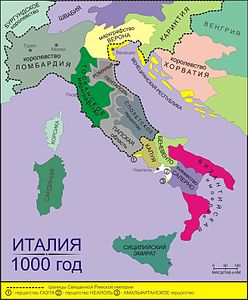 Italy in 1000 | |||
| Capital | |||
| Official language | |||
History
Amalfi was founded in 339 . The first Amalfi bishop was appointed in 596 .
Later, the city of Amalfi and the surrounding area were part of a large neapolitan duchy ( lat. Ducatus Neapolitanus ), ruled by a patrician.
In 838, the city was captured by Sicard , Prince of Benevento , and in 839 the townspeople regained their independence and chose a prefect . The neighboring city of Atrani also participated in the elections. Then the city helped free Sicard's opponent, Sikonulfa from Salerno .
In the 9th century, Amalfi was a republic that was formally still a vassal of Byzantium. In 897, the republic lost the war with Sorrento and Naples , the prefect of Amalfi was captured and later released for ransom.
In 914, the prefect Mastal I was appointed the supreme judge.
In 958, Mastal II was assassinated, and for the first time Amalfi chose the duke ( Doge ), who became Sergius I.
Pretty soon, the Amalfi duchy became a significant trading power; Amalfi's merchants dominated trade in the Mediterranean and in Italy for almost a century, and only later did they surpass the rich northern Italian cities, such as Pisa and Genoa .
From 981 to 983, Amalfi ruled the principality of Salerno , and in 987 Bishop Amalfi was elevated to the rank of archbishop.
In the X-XI centuries, the population of Amalfi was 50-70 thousand people [1] .
Amalfi Expansion in a period of maximum expansion |
Since 1034, Amalfi fell under the control of the principalities of Capua , and later Salerno.
The Duchy finally lost its independence in 1073 , when Robert Guiscard won Amalfi and assumed the status of Lat. dux Amalfitanorum ("Duke of the Amalfi"). The Amalfi duchy fell under the rule of the Normans , from which it made two unsuccessful attempts to free themselves, in 1096 (the uprising was suppressed in 1101 ) and in 1130-1131 . The last uprising was suppressed with the participation of the Sicilian troops and the fleet of George of Antioch .
In 1135 and 1137 Pisa robbed Amalfi, putting the final end to the commercial power of the city.
See also
- Amalfi Maritime Law
Notes
- ↑ D., Aczel, Amir. The riddle of the compass: the invention that changed the world . - 1st. - New York: Harcourt, 2001. - ISBN 0151005060 .
Literature
- Skinner, Patricia. Family Power in Southern Italy: The Duchy of Gaeta and its Neighbors, 850-1139 . Cambridge University Press: 1995.
- Norwich, John Julius. The Normans in the South 1016-1130 . London: Longmans, 1967.
- Norwich, John Julius. The Kingdom in the Sun 1130-1194 . London: Longmans, 1970.
- Matthew, Donald. The Norman Kingdom of Sicily (Cambridge Medieval Textbooks) . Cambridge University Press, 1992.
- Houben, Hubert (translated by Graham A. Loud and Diane Milburn). Roger II of Sicily: Ruler between East and West . Cambridge University Press, 2002.