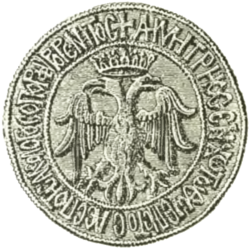
Despot (from the Greek δεσπστης , "lord") - the supreme court title of the late Byzantine Empire , introduced in the middle of the XII century . Up to this point, the title was used by the emperors themselves from the time of Justinian I , and also as an honorary address to the sons of the ruling emperors, often appeared on coins instead of basil . Emperor Manuel I Komnenos made the despot a separate title, the highest award after the imperial one, displacing the title of a sevastocrat from this place, which had until this time a similar arrangement in the Byzantine hierarchy. The female form of the title is pronounced in different forms - despotina , as well as despotissa or despots .
After the collapse of Byzantium in 1204, the title was used in the Latin , Nicene , Thessalonian and Trapezund empires. In the XIII-XIV centuries, this title was introduced in the states bordering on Byzantium - in the Second Bulgarian Kingdom and the Serbian Greek Kingdom . In the XV century, the Venetian rulers of the Greek island of Corfu also used the title of despot [1] .
Starting from the 13th century, a despot could be an autonomous or independent ruler of a territory, variously denoted in different linguistic forms - despotat ( Greek Δεσποτάτο ), despotovina ( Serbian despotovina ) or despotism ( Bulgarian despotsry ).
Terminology Problem
In the Byzantine history, the term "despotat" is mainly applied to areas such as Epirus and Morea . However, it is important to emphasize that this term is technically inaccurate: the title of despot, at least in the Byzantine hierarchy, was not hereditary and was not characteristic of a particular territory. Even in the so-called "despots" the son of the despot could succeed in the territory of his father, but could not own the title if this title was not confirmed by the Byzantine emperor. Nevertheless, the close connection of the title with the territory, which was controlled by the despot, began already from the end of the XIII century and became widespread from the middle of the XIV century. This was due to the fact that in areas such as Morea, Vidin , Serbia, and partly in Epirus, there was a steady succession of rulers with this title [1] [2] .
In this regard, for a long time it was believed that the first rulers of Epirus, Michael I Komnin Duca and his brother Theodore Komnin Duca , possessed the titles of a despot, which gave rise to the use of the term despotat to this state, founded in 1204. However, in the future, it was convincingly proved that these rulers did not use this title [3] [4] . The first despot who ruled Epirus was Michael II Comnenus Duca , who came to power around 1231 and was granted this title by his uncle, the Thessalonian Emperor Manuel . Later, in 1249, in order to emphasize his suzerainty over Epirus, Michael II was also granted the title of despot by the Nicene Emperor John III, Duca Vatac [5] [6] .
After the death of Nikifor II of Orsini in 1359, the title despot in Epirus became episodic. The state itself disintegrated into several parts. For example, the title of despot was not used by the titular king of the Serbs and Greeks, Simeon Siniša Nemanić , who came to power after the death of Orsini. And who ascended, in 1366, to the throne of Yanina (fragment of Epirus) Thomas Prelyubovich , received the title only in 1382. But there is also an assumption that the title was given to him even earlier by Simeon Nemanich in 1367. The only known document bearing his name and describing it as "Thomas Despot Comnenus Prelub" [7] [8] may testify to this.
Also, the status of the Artsk despot , ruled by Albanian tribal leaders, is not fully known. The first rulers of Arta, Peter Loeshe and Gene Bois Shpat , were granted the title of despot by the titular king of the Serbs and Greeks Simeon Sinisa Nemanic. However, the further use of the title is no reliable information. As a rule, all subsequent rulers of Arta are considered self-proclaimed despots [1] [9] .
Title History in Byzantium
The title of despot was introduced by Emperor Manuel I Komnin in the XII century . The first despot in 1163 was the future Hungarian king Bela III , in which Manuel I for some time saw his successor to the Byzantine throne. The despot had the right to wear clothes similar to those of the emperor, and had other privileges. For example, he also had the right to sign his letters in dark red (the imperial signature was bright red). The title of despot was usually awarded to adopted children and younger sons [10] [11] .
After the seizure of Constantinople by the fourth crusade in 1204, the despots became independent rulers of entire territories. So, for example, Theodore I Lascaris, before taking the imperial title, ruled Nikaiah as a despot [12] . In 1224, on the European lands of Byzantium, the Thessalonian Empire was formed , headed by the emperor Theodore Comnenus Dooka . However, already in 1230, Theodore's army was defeated by the Bulgarians, and the emperor himself was captured. The Thessalonian Empire split into several territories. In this regard, the relatives of Theodore became independent from Thessaloniki rulers. Konstantin Comnenus Duca became the despot of Acarnius and Aetolia , and Michael II Comnenus Duca became the despot of Epirus [13] [5] .
However, in the XII century. known case of an independent sovereign government, who used the title of despot. During the reign of the Byzantine emperor Andronik I Komnenos, his relative, Isaac Komnenos rebelled against the emperor and captured Cyprus , establishing itself as a completely independent ruler of the island in 1184. At the same time, he took the title of despot of Cyprus. Having consolidated his strength on the island, Isaac appointed his independent patriarch, who crowned him with the imperial crown in 1185 [14] [15] [16] .
With the restoration of the Byzantine Empire in 1261, the despot could be completely independent of the emperor of Constantinople or act as an autonomous unit. For example, the autonomous Morea despot , formed in 1349 with the capital in Mystra , was ruled by the heirs of the Byzantine throne. During the Kantakuzin dynasty, the despot was practically independent, but with the Palaeologs coming to power, Moray became more closely connected with the policies of Constantinople [17] .
In the XIV - early XV centuries. during the period of the weakening of Byzantium, especially when Thessaloniki was isolated by land from Constantinople, the region was also endowed with autonomy. But not all the rulers of Thessalonica bore the title of despot. At the same time, Despot Manuel Paleologue and after him the emperor of the whole of Thessaly John Paleologus , ruled Thessalonica in fact as independent sovereigns. In 1423, having no power to keep Thessaloniki from the blows of the Ottoman Turks, the despot Andronicus Paleolog sold the city of Venice . But the republic could not keep Thessaloniki and it was conquered by the Ottoman Empire in 1430 [18] .
From 1231–1337 the rulers of Epirus continually bore the title of despot, who was bestowed by the Byzantine emperors, but unlike Moray, the Epirus despot retained its independence and only temporarily recognized vassalitet from Byzantium. But even during these periods, the epirus despots, such as Nikifor I Duca , also entered into alliances with opponents of Byzantium [19] . And in 1323, the despot Nikolai Orsini laid siege to the Byzantine fortress [20] [5] . In 1337 Epirus was completely captured by Byzantium. The regent-ruler, with her young son, Despotina Anna Palaeologus was imprisoned in Thessalonica [21] .
Soon the empire fell into a civil war in connection with which Epirus managed to restore its statehood in 1356. At the same time, in the south of the state, as a result of the insurrection of the Albanian clans, two states were formed: Arta Despotat and Despotat Angelokastron and Lepanto . Despot Nicephorus II Orsini tried to quell the rebellion, but died in a battle with the Albanians in 1359. During this instability, the center for the fight against Albanians was Yaninsky despoat (Northern Epirus). Only in 1416, the Yaninsky ruler Carlo I of Tokko managed to restore Epirus. And although the Byzantine emperor Manuel II bestowed the title of despot Tokko, subsequently Carlo I led military actions against the Byzantine forces of the sea despot Theodore II Palaeologus [22] [23] .
After the fall of Byzantium, the title despot also ceased to exist after the Ottoman conquest of the last fragments of the former empire: the Mores despotat was conquered in 1460, the Trebizond empire in 1461, and in 1478 the Epirus state fell. Nevertheless, purely nominally, until 1502, the title of despot Morea was worn by Andrei Paleolog [24] .
Title History in Bulgaria
The first known carrier of the title of despot in Bulgaria was Alexy Slav , who received this title from the Latin Emperor Henry I of Flanders in 1208 and controlled the vast lands of the Rhodopes and Eastern Macedonia [25] .
After the death of Bulgarian Tsar Ivan Assen II in 1241 and the subsequent struggle for the Bulgarian throne, the Bulgarian state weakened and a number of nobles declared the independence of their possessions. So in 1261, the Vidinsky despot was formed, which was completely independent during the first despots Jacob Svyatoslav and Shishmane I [26] . Moreover, they challenged the royal title of the rulers of Bulgaria. In 1323, Despot Mikhail was elected Bulgarian king and Vidin became an autonomous unit. However, the new despot Belaur , after the death of Michael, did not recognize the power of the new Bulgarian Tsar Ivan Alexander . In the ensuing war in 1335–1336, Ivan Alexander was victorious, the despot was eliminated, and the power of Bulgaria in Vidin was restored [27] [28] .
By 1280, the was formed, which was autonomy within Bulgaria. But already in 1305 the Bulgarian tsar liquidated the inheritance due to the not loyal policy of the despot Aldimir [29] . Later the despot was restored, since - the father of the Bulgarian Tsar Ivan Alexander, is referred to as the despot Kryna before and during the reign of his son. About the further development of the territory is not known, and in the interval between 1370-1380. the region was invaded by the Turks [30] .
In 1322 the Dobrudzhansky despoat was formed, which remained independent from Bulgaria until the end of its existence. As a result of the help to the Bulgarian Tsar Ivan Alexander in the war with the Hungarians, the despot even received a number of cities as a payment for the help. In 1387 Ottoman Turks invaded Dobrudja. Despot Ivanko became a vassal of the Ottoman Sultan. However, the despot led a disloyal policy to the sultan, which led to the destruction of the state as a result of the new Turkish campaign in 1395. With the fall of the Dobrudzhan despotat, the title “despot” ceased to exist on the territory of Bulgaria [31] [32] .
Title History in Serbia
In Serbia, the title of despot was introduced between 1345-1347 by Tsar Stefan Dusan , who appointed despots on lands conquered from Byzantium [33] [34] . After the death of Dusan, the despots of Serbia declared independence by creating their own state formations, such as the despotat Valon and Kanin , or for a short time became an autonomous unit, like the Prilepsky and the Weelsuch despots. At the same time, the ruler of Prilep Vukashin Mrnyavchevich took the royal crown in 1365 and became co-ruler of the king of the Serbs and Greeks, Stefan Uros V. After the death of the latter in 1371, he was declared a complete independence by [ Well ] [35] [36] .
However, the Serbian despots did not last long in the Balkans . So, at this time the Ottoman Turks began to conquer the region. In the battle of Maritz , which took place in 1371, the Serres despoat was eliminated. Despots Velbuzhda recognized themselves as vassals of the Turks. In 1395, the despot Konstantin Dragash took part in the military company of the Turks against Wallachia , where he died in battle. After that, the Turks captured Velcients [37] .
In 1402, the title of despot was accepted by the rulers of Serbia, due to the weakening of the state due to a series of defeats from the Ottoman Empire [38] . In 1459, the despot was completely conquered by the Ottoman Empire [39] . But even after this, the so-called “Hungarian exile” of Serbian despots continued for another 80 years. Thus, in 1471, the Hungarian King Matthias I, in the territory of Srem, revived the Serbian despotat with the recognition of the Serbian rulers of vassalage. In the same year, the king gave Vuk Brankovich the title of despot. Some of the despots of Srem, such as John Brankovich , tried to fight the Turks on the territory of Bosnia and Serbia themselves, trying to revive the state. They managed to expand the influence of Srem, but they did not succeed in achieving the main goal. And with the strengthening of the Ottoman Empire and the loss of the sovereignty of Hungary, put an end to the Serbian despot in Srem in 1540 [40] [41] .
Despots
- The Epirus despotat (1204–1337; 1356–1479) was an independent state that was formed after the capture of Constantinople by the fourth crusade. From 1359-1416 temporarily disintegrated into several states [42] [43] .
- The Despotat of the Rhodopes (1208–1230) is a territory independent of Bulgaria and controlled by Alexy Slava . After his death, the Rhodopes became part of the Second Bulgarian Kingdom [25] .
- The despot of Acarnius and Aetolia (1224–1242) is a short-lived specific state formation under the control of Konstantin Comnenus Duca . After the collapse of the Thessalonian Empire in 1230, the despotus became virtually independent. After the death of Constantine, his lands became part of Epirus [13] .
- Vidinsky Despotat (1261-1336) - a semi-independent state, which at times was autonomy within Bulgaria.
- 12 (1280-1370 / 1380) is an autonomous state entity within the Second Bulgarian Kingdom. For some time it was under the direct rule of the Bulgarian king [30] .
- Dobrudzhansky despotat (1322-1395) - an independent state split off from the Second Bulgarian Kingdom.
- The Valon despotat (1346-1417) is a fragment of the Serbian kingdom , formed after the death of the king of the Serbs and Greeks, Stefan Dusan. The state cannot be fully qualified as a “despotat”, since it is reliably known only about one carrier of this title - the founder of the state, Ivan Komnina Assen [44] .
- The Sea despotat (1349–1460) is an autonomous state within the Byzantines [17] .
- The Serre despotat (1355–1371) is a fragment of the Serbian kingdom, formed after the death of the king of the Serbs and Greeks, Stephen Dusan. State rules Uglesh Mrnyavchevich , who took the title of despot in 1365 and died in the battle with the Turks [45] .
- The Welch despotat (1355–1395) is a state formed after the collapse of the Serbian kingdom [37] .
- Despotate Angelokastron and Lepanto (1358–1374) is a state entity formed as a result of the rebellion of the Orthodox Albanians against the power of the despot Epirus Nikifor II Orsini [46] .
- The Arts Despoat (1358–1416) is a state entity formed as a result of the insurrection of Orthodox Albanians against the power of the despot Epirus Nikifor II of Orsini [46] .
- Despotus of Yaninsky (1366-1416) - Fragment of Epirus under the control of the Serbian and then Italian dynasties [43] .
- The Serbian Despotat (1402–1459; 1471–1540) is a state formed after the defeat of the Serbs in the Kosovo field [38] .
Notes
- ↑ 1 2 3 Kazhdan, 1991 , p. 614.
- ↑ Guilland, 1959 , pp. 71-77.
- ↑ Ferjanchi, 1960 , p. 207.
- ↑ Stiernon, 1959 , pp. 122-126.
- ↑ 1 2 3 Fine, 1994 , p. 128
- ↑ Skazkin, vol. 3, 1967 , chapter 4.
- ↑ Nicol, 2010 , pp. 143–144.
- ↑ Soulis, 1984 , pp. 122–123.
- ↑ Guilland, 1959 , pp. 77–78.
- ↑ Skazkin, vol. 2, 1967 , chapter 13.
- ↑ Failler, 1982 , pp. 180-185.
- ↑ Skazkin, vol. 3, 1967 , chapter 3.
- ↑ 1 2 Skazkin, vol. 3, 1967 , chapter 3-4.
- ↑ Uspensky, 2011 , p. 521.
- ↑ Ostrogorsky, 2011 , Section VI, Chapter 3.
- ↑ Choniates, 1860 , Volume I, Book 2.
- ↑ 1 2 Skazkin, vol. 3, 1967 , chapter 9.
- ↑ Norwich, 2010 , p. 518-519.
- ↑ Uspensky, 2011 , p. 858.
- ↑ Skazkin, vol. 3, 1967 , chapter 5.
- ↑ Uspensky, 2011 , p. 891–892.
- ↑ Ostrogorsky, 2011 , p. 671.
- ↑ Medvedev, 1973 , Chapter II.
- ↑ Ransimen, 1983 , Chapter XIII.
- ↑ 1 2 Skazkin, vol. 3, 1967 , chapter 2, 4.
- ↑ Koledarov, 1989 , p. 147.
- ↑ Andreev, 1993 , pp. 33-41.
- ↑ Fine, 1994 , pp. 269, 273.
- ↑ Pavlov, Plamen. "Avantyurist-skit" Aldimir and Theodor Svetoslav // Bounty and adventure in medieval Bulgaria: [] . - Varna: LiterNet, 2005. - ISBN 954-304-152-0 .
- ↑ 1 2 Fine, 1994 , pp. 175-184.
- ↑ Mutafchiev, 1973 , p. 120-129.
- ↑ Mutafčiev, 1927 , pp. 27-41.
- ↑ Fine, 1994 , p. 310
- ↑ Matanov, 1986 , p. thirty.
- ↑ Fine, 1994 , pp. 310, 347, 357.
- ↑ Fine, 1994 , pp. 362-364.
- ↑ 1 2 Blagoevi, 2000 , p. 231.
- ↑ 1 2 Chirkovich, 2009 , Part 31. Despot and his state.
- ↑ Chirkovich, 2009 , Part 36. Chronicle of death.
- ↑ Lemajić, 2005 , pp. 153-169.
- ↑ Božanić, 2007 , pp. 72–88.
- ↑ Uspensky, 2011 , p. 708-709.
- ↑ 1 2 Nicol, 2010 , p. 143.
- ↑ Fine, 1994 , p. 320, 391.
- ↑ kovirković, 2004 , pp. 78-79.
- ↑ 1 2 Hammond, 1976 , p. 59.
Literature
- Koledarov P. Political Geography of the Medieval Bulgarian State Part II (1186–1396) . - Bulgarian Academy on Naukite, 1989. - 248 p.
- Medvedev I.P. Mystra. Essays on the history and culture of the late Byzantine city . - Leningrad: Science, 1973.
- Norwich D. History of Byzantium . - Moscow: AST, 2010. - 542 p. - ISBN 978-5-17-050648-4 . Archived copy January 31, 2018 on Wayback Machine
- Ostrogorsky G. А. The history of the Byzantine state . - M .: Siberian Spinebone, 2011. - 914 p. - ISBN 978-5-91362-458-1 .
- Ransimen S. Fall of Constantinople in 1453 . - Moscow: Science, 1983.
- Skazkin SD The history of Byzantium . - Moscow: Science, 1967. - T. 2. - 472 p.
- Skazkin SD The history of Byzantium . - Moscow: Science, 1967. - T. 3. - 508 p.
- F. Uspensky. History of the Byzantine Empire. Flourishing. Wreck - Moscow: AST, 2011. - 1008 p. - ISBN 978-5-17-072040-8 .
- Choniates N. History, beginning with the reign of John Comnenus / Byzantine historians, translated from the Greek at the St. Petersburg Theological Academy. - SPb. 1860
- Chirkovich S.M. History of the Serbs . - M .: All World Publishing House, 2009. - 448 p. - ISBN 978-5-7777-0431-3 .
- Andreev J. Bǎlgarija prez vtorata četvǎrt na XIV v. - Veliko Tarnovo: Sv. Kliment Ohridski, 1993. - ISBN 978-0-472-08260-5 .
- Failler A. Les insignes et la signature du despote (Fr.) . - 1982. - Vol. 40. - DOI : 10.3406 / rebyz.1982.2136 .
- The Antarwyshawl: The Critical Survey from the Lion Twelfth Century to the Ottoman Conquest. - University of Michigan Press, 1994. - ISBN 978-0-472-08260-5 .
- Guilland R. Recherches sur l'histoire administrative de l'Empire byzantin: Le despote, δεσπότης (fr.) // Revue des études byzantines. - 1959. - N o 17 . - P. 52-89 .
- Nicol DM The Despotate of Epiros 1267–1479: A Contribution to the Middle Ages . - Cambridge University Press, 2010. - ISBN 978-0-521-13089-9 .
- Stephen Dušan (1331–1355) and his successors. - Dumbarton Oaks , 1984. - ISBN 0-88402-137-8 .
- Hammond, Nicholas Geoffrey Lemprière. Migrations and invasions in Greece and adjacent areas . - Noyes Press, 1976. - ISBN 978-0-8155-5047-1 .
- The Oxford Dictionary of Byzantium : [ eng ] : in 3 vol. / ed. by Dr. Alexander Kazhdan . - N. Y .; Oxford: Oxford University Press , 1991. - 2232 p. - ISBN 0-19-504652-8 .
- Blagojevi M. History srpske dzhavnosti . - Novi Sad: Oranak SANU, 2000.
- Matanov H. Yugozapadnite Bulgarian land of the 14th century prez . - Sofia: Science and Art, 1986. - 214 p.
- Mutafchiev P. Osche for Dobrotitsa. - Sofia: Sofia: Science and Art, 1973. - T. II.
- Mutafčiev P. Dobrotič-Dobrotica et la Dobrudža Revue des études slaves . - 1927. - T. VII.
- Lemajić N. Revue des études slaves . - Istraživanja, 2005. Archival copy dated March 17, 2012 on Wayback Machine
- Božanić S. Srem in the period between 1502 and 1526 . - 2007. - T. VII. Archived copy of March 17, 2012 on Wayback Machine
- Kovirković, S. The Serbs . - Malden: Blackwell Publishing, 2004.
- Stiernon L. Les origines du despotat ďEpire. - REB, 1959. - T. 17.
- Ferjanci B. Despoti in Byzantium and the South Slovenian Land. - Beograd, 1960.