Wei Yuan ( Chinese trad. 魏源 , pinyin : Wèi Yuán [Comm. 1] , 1794-1856) is a Confucian scholar and political figure in China of the Qing era. The most famous geographical and geographic works, giving an idea of the states of Europe and America. After the “ opium wars ”, he became a supporter of moderate modernization of China by borrowing Western scientific and technological achievements (the so-called “self-reinforcement”). In 1844 he was awarded the highest Confucian degree Jinshi , was friends with Gong Zizheng and Lin Zesyuyu . His intellectual constructions were in demand in Meiji Japan and served as the starting point for the 1898 Reform Movement .
| Wei Yuan | |
|---|---|
| 魏源 | |
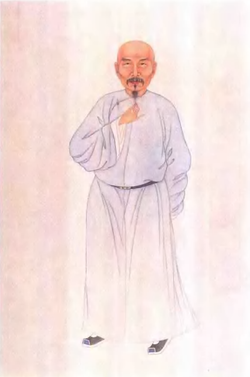 Portrait from a book of Qingdai Xuezhe Xiangzhuan (artist Shae Yanlan) | |
| Birth name | Wei Yuand |
| Date of Birth | April 23, 1794 |
| Place of Birth | Shaoyang |
| Date of death | March 26, 1857 (62 years) |
| Place of death | Hangzhou |
| Allegiance |  Qing Empire Qing Empire |
| Occupation | scientist encyclopedist and politician |
Biography
Wei Yuan was born in 1794 in Hunan Province . The beginning of Wen Yuan's academic career was traditional. After leaving his native province, he continued his education in the capital, where he began to be interested in practical issues ( Jing Shi School). Soon he discovered a great interest in geography, the result of which was his work “The Geographical Description of Overseas States” (“Haigo Tuji”). In the foreword to this work, Wei Yuan put forward his famous thesis - "to learn from the barbarians their advanced techniques in order to keep them under control."
This thesis is remarkable primarily because it introduced the concept of hua and , for the first time, some adjustments, although it continued to assume that the surrounding nations, including those inhabiting the countries of the West, remain “barbarians”. This is confirmed by the next well-known work of his "Sheng yi" ("Notes on the wars of the wise [emperors]." The work was completed in 1842 and is a direct response to the defeat of China in the First Opium War and the conclusion of the Nanking Treaty .
Political views
Wei Yuan belonged to the traditional type of Chinese scholars, who believed that all the necessary knowledge of man is contained in the classical Confucian texts, and did not realize that there is something in the world that can argue with the authority of the "perfect wise."
The crushing defeat of China in the First Opium War did not shake Wei Yuan’s confidence in the exceptional and sacred character of the Chinese monarchy, as well as the omnipotence of the Chinese emperors, whose strength "rests on inner purity and is found in the temple of the ancestors." As for foreign policy problems, Wei Yuan recommends shifting attention from the “barbarians” to the borders. He was still convinced that, having strengthened state power, it was possible to achieve that “barbarians of the four sides would come to the emperor”.
Impact
According to B. Elman (Classicism, Confucianism in late imperial China), Confucianism of the “new textual school,” one of the important proponents of which was Wei Yuan, served as a “screen” for the activities of the initiators of the reform of 1898.
Comments
- ↑ At birth, was given the name whale. Exercise 远达 , Pinyin : Yuǎndá - “Far reaching”. The nickname is “The Hidden Silent ” ( Chinese ex. 默 深 , pinyin : Mò Shēn ) or “Master of the Ink” ( 墨 生 ) with similar reading. Literary pseudonyms: “Han soldier” ( Kit. Ex. 汉 士 , Pinyin : Hàn Shì ) and “Great Strategist” ( Kit. Ex. 图 , Pinyin : Liáng Tú ).
Literature
- Confucianism in late imperial China. - Berkeley: University of California Press, 1990. - xxxiii, 409 p. - ISBN 0585041083 .
- From the Philosophy of Philosophy to Late Imperial China. - Second printing. - Cambridge (Mass.), L.: The Council on East Asian Studies at Harvard University, 1990. - 368 p. - (Harvard East Asian Monographs; 110). - ISBN 0-674-32526-5 .
- Leonard JK Wei Yuan and China's rediscovery of the maritime world. - Cambridge (Mass.), L.: The Council on East Asian Studies at Harvard University, 1984. - 276 p. - (Harvard East Asian monographs; 111). - ISBN 0-674-94855-6 .
- Mitchell P. Wei Yuan (1794-1857): Dissertation, submitted for the degree Doctor of Philosophy. - Indiana University, 1970. - 322 p.
- History of the East: 6 t. / Otv. ed. L. B. Alaev . - M .: Vost. lit., 2005. - T. 4. East in modern times (late XVIII - early XX century): Book. 2. - p. 507-508. - 574 s. - ISBN 5-02-018472-X .
- Kobzev A., I. Wei Yuan // Spiritual Culture of China: Encyclopedia: 5 t. / Ed. M. L. Titarenko , A. I. Kobzev , A. E. Lukyanov . - M .: Vost. lit., 2006. - T. 1: Philosophy. - p. 191. - 727 s. - ISBN 5-02-018431-4 .