Ratko Mladić ( Serb. Ratko Mladi , Serbo- Horv . Ratko Mladić ; born March 12, 1942 , Bojanovic village, Independent State of Croatia ) - Serbian general and military leader, Chief of Staff of the Republic of Serbian Army ( 1992 - 1995 ), one of the Serb leaders during the collapse of Yugoslavia . He led a number of operations during the wars in Croatia and Bosnia and Herzegovina . In 1996, Mladic, along with other leaders of the Republika Srpska, was accused by the Hague International Tribunal of war crimes and genocide in connection with the siege of Sarajevo , as well as in connection with the Srebrenica massacre . His capture and extradition to the tribunal was one of the conditions for Serbia’s accession to the European Union ; for information about the location was awarded a reward of 10 million euros. In 2011, Mladic was arrested in Serbia and extradited to The Hague. The trial of Mladić began on May 16, 2012. The Hague Tribunal sentenced Mladic to life imprisonment on November 22, 2017, convicting him of genocide and crimes against humanity .
| Ratko Mladic | |||||
|---|---|---|---|---|---|
| Ratko Mladi | |||||
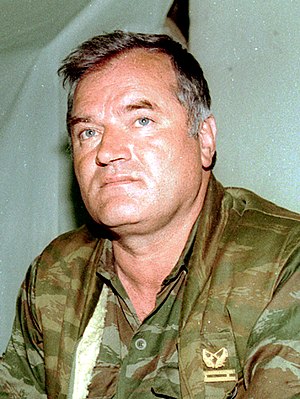 Ratko Mladic during negotiations brokered by the United Nations at Sarajevo Airport, 1993 | |||||
| Date of Birth | March 12, 1942 (77 years) | ||||
| Place of Birth | Bozhanovic village, Independent State of Croatia | ||||
| Affiliation |  Yugoslav People's Army Yugoslav People's Army Bosnian Serb Army Bosnian Serb Army | ||||
| Type of army | |||||
| Years of service | November 4, 1965 - February 28, 2002 | ||||
| Rank | Colonel-General (since 1994) | ||||
| Commanded | 9th building JNA Chief of Staff of the Second Military District JNA Army of the Republika Srpska General Headquarters of the Armed Forces of the Republika Srpska | ||||
| Battles / Wars | War in croatia
Bosnian war :
| ||||
| Awards and prizes |
| ||||
| Retired | Life imprisoned (from November 22, 2017) | ||||


Biography
Youth and Education
Ratko Mladic was born on March 12, 1942 [1] (according to other sources in 1943 ) in the village of Bozhanovici ( Bosnia and Herzegovina ), which at that time was part of the Independent State of Croatia , created by the occupying authorities in the territory of the Kingdom of Yugoslavia . His father, Neja Mladić (1909–1945), was the commander of a partisan detachment and died in battle with the Croatian Ustash [2] in 1945 . His mother, Stana Mladic (nee Lalović; 1919–2003), one raised a daughter Militsa (born in 1940) and two sons - Ratko and Milivoia (born in 1944).
Just before Ratko was born, his mother and father had typhus . Ratko was a very painful child. The life was saved by the Italian military. After graduating from school in Kalinovik in 1958, Ratko Mladich moved to Belgrade , where he graduated from the Military Industrial School in Zemun . On October 20, 1961, by competition, he entered the Military Academy (18th classroom) and thus became a member of the Yugoslav People’s Army. Education in the IA was as follows: the first year of preliminary training, another two years, the students studied basic subjects, and in the fourth year they were divided into specialties. Mladic, among 145 cadets, was sent to the Infantry Training Center in Sarajevo, where he passed the exams after completion of the training [3] .
February 12, 1964 joined the Union of Communists of Yugoslavia . He was accepted into active military service on September 27, 1965 , when he signed the military oath [1] .
Military career
On September 27, 1965, Mladic was assigned to the 3rd Military District, to the garrison of Skopje , where, with the rank of lieutenant ( serb. Warrant ), he was commanded by a rifle platoon of the 89th infantry regiment. In 1967, he graduated from a three-month course of reconnaissance and intelligence work and a course in Greek , after which he was given the rank of senior lieutenant ( guardian) . In 1968, Mladic was appointed commander of a reconnaissance platoon. In 1970 he was promoted to captain. On November 27, 1974, he was promoted to captain of the first class and was appointed assistant commander of the rear of the 87th separate infantry brigade. In 1976, he enrolled at the Command and Staff Academy in Belgrade , where he graduated from the combined arms and military course [4] . In 1977, with the rank of major, he was sent to serve in the 3rd Military District, in the Kumanov garrison, as commander of the 1st infantry battalion of the 89th Infantry Brigade [5] .
On December 25, 1980, Mladic was promoted to lieutenant colonel and served as head of the operational training department of the garrison command in Skopje. He was then sent to the city of Shtip by the commander of the 39th Infantry Brigade. After some time, he again serves in the garrisons of Skopje and Ohrid . After assigning him the rank of colonel in August 1986, he was appointed commander of the 39th Infantry Brigade of the 26th Infantry Division in the city of Stip . In September of the same year, Mladic was sent for annual training at the School of Operational Art. January 31, 1989 Mladic headed the department for educational work at the headquarters of the 3rd Military District. On January 25, 1991, he was transferred to Pristina [4] to the post of assistant commander for the rear of the 52nd Corps [5] .
Disintegration of Yugoslavia
During the war in Croatia
In 1991 - Assistant Commander of the Pristina Corps in Kosovo . Shortly after his appointment against the background of a rapidly deteriorating situation in Croatia and the hostilities that began between the Croatian forces and units of the Yugoslav army, at the end of June he was transferred to Knin ( Republic of Serbian Krajina ) by the commander of the 9th corps of the Yugoslav Peoples Army (JNA) [4] . His predecessor, General Shpiro Nikolic , characterized Mladić [6] :
| He has a restless, searching spirit and therefore constantly participates in the promotion of initiatives and their implementation ... Honest, valiant officer, distinguished by high human moral qualities |
Lilyana Bulatovich writes in a book about General Mladić that before the new uniforms and insignia clearly divided the parties, Mladić crossed the front line in civilian clothes, using documents from a Croatian officer, often with Slavko Lys . Slavko Lisitsa recalled Mladichi:
| Once we were on the Proklyansky lake , opposite the Ustashian positions. He says: “Lily, do you have swimming trunks?” I didn’t swim, but I wanted to eat, and Mladic booted into the water - an hour on his back, an hour in another style. Enough, shouting to Mladich, near Ustashi , can see us and start shooting ... Later, I believed that this person had removed fear. Later I asked him to take care of himself, because if we take care and God will keep us ... |
According to the estimates of the American military historian David Isbi, until the appointment of Mladić as commander, the 9th Knin Corps performed peacekeeping functions, preventing local Serbian and Croatian forces from engaging in direct battles. After being led by Ratko Mladic, corps units increasingly began to take part in repelling Croatian attacks, and then gradually moved directly to offensive actions. Important operations under the leadership of Mladic at that time were the capture of the Croat-held village of Kievo on August 26 and the Maslenitsky Bridge on September 11 [7] . On October 4, 1991, Ratko Mladić was given the extraordinary rank of Major General . At the same time, he became the first officer of the JNA after the Second World War, who became a general without passing special examinations [8] .
On April 24, 1992, Mladic received the extraordinary rank of Lieutenant General (Lieutenant-Colonel General) [9] .
During the Bosnian War
In the spring of 1992, Bosnia and Herzegovina declared independence. The Bosnian Serbs refused to recognize her. On the territory of the republic began clashes, which grew into hostilities. Croatian troops were introduced into Bosnia, attacking units of the Yugoslav army and Bosnian Serb detachments [10] . The leader of the Bosnian Muslims, Aliya Izetbegovic, ordered an all-out attack on the JNA barracks. On April 27, the Presidium of BiH, meeting in an incomplete composition, demanded that the Yugoslav Army lay down their arms and leave the territory of the republic. On May 2, Muslim forces laid siege to the JNA barracks in Sarajevo and launched a series of attacks on patrols and military facilities [11] [12] . On May 9, Mladic was appointed chief of staff and deputy commander of the Second Military District of the JNA with headquarters in Sarajevo, and on May 10 became the commander of the district [9] [13] . At this time, Sarajevo was already blocked by the Bosnian Serbs, whose troops were organized in the regular army [11] .
On May 12, the National Assembly of the Republika Srpska decided to create the Army of the Republika Srpska [4] . General Mladic was appointed commander-in-chief of the Army of the Republika Srpska [14] [15] . He held this post until December 1996 [13] [9] . In May 1992, after the withdrawal of JNA forces from Bosnia and Herzegovina, the former JNA military district became the core of the Republika Srpska Army (VRS).
In March 1993, Mladic led the units advancing on the Srebrenica enclave , from where the Bosnian Muslim formations attacked Serb villages. These attacks were accompanied by mass killings of civilian Serbs and became the pretext for the onset of VRS on the enclave [16] . In July 1993, Mladic led the operation " Lukavac 93 ", as a result of which Trnovo and the mountains near Sarajevo came under the control of the Serbs [16] . In the spring of 1994, the units under the direct leadership of Mladić carried out a major attack on the Muslim enclave in Gorazde . On June 24, Mladic was promoted to colonel general [9] [13] [4] .
The Bosnian Serb army under the command of General Mladić attacked Srebrenica on July 6, 1995, and fully occupied the city in five days - on July 11 . Until July 19 , according to the ICTY [17] [18] , she killed from 7 to 8 thousand male Muslims (the exact number of victims has not been established yet) [19] . Another 36 thousand women and children were deported from the city and transported by bus to Kladan , which was under the control of Muslim formations [20] .
On 2 August , before the start of the Croatian offensive against the Serbian Krajina , Radovan Karadzic announced that he was taking the leadership of the Bosnian Serb army and about the removal of Mladić from the post of commander in chief. Karadzic blamed Mladic for the loss of two major Serb cities in western Bosnia - Glamoc and Bosansko-Grahovo , which had been taken by the Croats shortly before during Operation Summer-95, which soon led to the rapid collapse of the RSK. Mladic was offered a new position - a special adviser to the supreme commander in charge of coordinating the joint defense of the Republika Srpska and Republika Srpska Krajina . Mladic was popular among the Serbian military and refused to carry out this order. Karadzic was forced to cancel it a week later [21] .
Post-war time
On November 8, 1996, by decree of the President of the Republika Srpska of Biljana Plavshich, General Ratko Mladic was removed from his post as Commander of the Main Headquarters of the VRS, which was transformed into the General Staff [13] . At the same time he continued to be registered as a regular military of the Yugoslav army. On February 28, 2001, the President of the Federal Republic of Yugoslavia, Vojislav Kostunica, dismissed Mladic from the ranks of the Armed Forces of Yugoslavia. By the decree of the President of the Republika Srpska on March 7, 2002, professional military service of Mladic was terminated “for official use”. March 8, 2002 Mladic dismissed from professional military service. Since then he has officially been retired [22] . Mladic received the right to pay in accordance with the Treaty on the method of solving employment issues for professional military personnel from the JNA, who remained to serve in the VRS. The pension was transferred to Mladić until November 2005 , then payments were stopped under pressure from the European Union and the International Tribunal for the Former Yugoslavia [13] [9] .
Search and Catch
In 1996, NATO demanded the transfer of Mladic and Radovan Karadzic to the Hague Tribunal. At the same time, Mladic disappeared from Bosnia. Soon he appeared in Belgrade , where in subsequent years he lived freely and openly under the protection of Slobodan Milosevic . After the overthrow of Milosevic in 2000, Mladic disappeared again, and officially his whereabouts were unknown, although witnesses often saw him at football matches. The last time he was spotted was in the summer of 2002 near Divchibari . In 2006, the Serbian police arrested several individuals who helped to hide Mladić [9] . Until 2010, false reports about the detention of Mladić appeared in the media. In October 2010, the Serbian government raised the remuneration for information that helps capture Mladic from 1 million euros to 10 million euros [23] . According to the documents published by WikiLeaks , the FSB of Russia knew about the whereabouts of Mladic, but hid this information [24] .
In May 2010, the Mladic family announced their intention to obtain recognition of the general as dead. According to the laws of Serbia, a person over 70 years old can be recognized as dead, about which nothing is known for certain within five years. The application was filed in June of the same year. However, the Serbian authorities said that the search for Mladic will not be terminated, regardless of the claim. At the end of June 2010, the petition of the General’s family was rejected due to procedural violations [25] .
On the morning of May 26, 2011, Ratko Mladic was detained in the village of Lazarevo (about 80 km north-east of Belgrade ), said Serbian President Boris Tadic [26] , and the interrogation was postponed due to the arrested person [27] . June 1, taken by helicopter to The Hague [28] . On June 3, he appeared before the Hague Tribunal [29] .
Protest actions against the arrest of Ratko Mladic were held from the day of his arrest on May 26 until the beginning of June 2011 in the cities of Lazarevo , Novi Sad , Belgrade , Banja Luka , Istochno-Sarajevo , Kozarska Dubica , Vlasenica , Trebinje , Bielina and Derventa . The most prominent performances were held in Belgrade on May 29 [30] and in Banja Luka on May 31 .
Mladic Diaries
On February 23, 2010, during a search of the house of the Mladic family, 18 notebooks were seized, for a total of more than 3,500 pages. Mladic's wife signed the last page of each notebook, confirming the seizure of the documents during the search. Records were kept between June 29, 1991, and January 28, 1995, and from July 14, 1995, to November 28, 1996. [31] Lubodrag Stojadinovic, a retired Serbian military man and colleague of Mladić before the start of the Yugoslav Wars, noted that keeping military diaries as important documentation was common practice for immigrants from the Yugoslav army [32] . The Italian newspaper La Repubblica noted in September 2010 that ethnic cleansing at any cost was an obsession of the leader of the Bosnian Serb army, reflected in his manuscripts. In particular, Mladic in his diaries left the following entry [33] [34] :
| We will not win anything if we kill 50 thousand Muslims. Our true priority is getting rid of the Muslim population (replacing them with Serbs and Croats) |
Family
Wife - Bosa, nee Yedich, comes from Herzegovina . They met when Mladic served in Macedonia , where they married in the summer of 1966. Son Darko is married, his wife Bilyana on March 2, 2006 gave birth to a boy. The grandson of Ratko was given the name Stephen in honor of St. Stephen , the patron saint of Republika Srpska. His parents live in the Belgrade area of Banovo Brdo . On March 11, 2009, the Ratko Mladić Imperial Culture Award ceremony was held at the Writers' Union of Russia , which Darko received for it [35] .
Mladic also had a daughter named Anna, but on March 24, 1994 , her life was tragically cut short: for reasons unknown so far, Anna shot herself with a pistol [36] .
Daughter suicide
On March 24, 1994, 23-year-old Anna Mladich, a medical student, shot herself with a premium pistol that her father, Ratko Mladic, once received at a military school for her academic achievements. The circumstances of Anna's death still remain a mystery: media representatives claimed that her body was found not in the bedroom, spattered with blood, or in the park or the forest near the Topchider cemetery [37] . The question of the reason for committing suicide also remains open: according to one of the versions, Anna found out from the newspapers about the accusations against her father of war crimes, which led her to commit suicide; Mladic himself said that the daughter would never have thought of taking her father's weapon, and claimed that Anna was killed [38] . As Mladic's son Darko and Bose's wife recalled, that night they did not hear anything suspicious, including a pistol shot. According to them, Anna was killed [39] .
From the words of those who knew Mladic, the death of his daughter was a serious blow to Ratko. In an interview with Newsweek, one of the Serbian commanders said that the death of his daughter divided Mladic's life into two parts, and he could not recover from this blow. Shortly before his arrest, Ratko Mladić was allowed to visit his daughter’s grave, where he stayed for several minutes. [40]
War crimes and court charges
On July 25, 1995, the International Tribunal for the Former Yugoslavia (ICTY) filed the first charges against Mladic on 16 counts, one of them under the “ genocide ” article and three for “crimes against humanity”. These most serious articles covered the following points:
- The blockade of Sarajevo, which killed up to 10,000 residents of the city, including military and civilians (the city was shelled by artillery and snipers, deliberately selecting civilians, including children).
- Taking hostages from among UN personnel in May and June 1995 [41] .
- The massacre of the Muslim population in Srebrenica : the charge of 20 counts pertaining to this case was brought forward on November 16, 1995 [42] . Prosecutors argued that Mladic personally ordered the destruction of all Muslim men between the ages of 10 and 65 [43] [44] . Judge Fuad Riad personally read the charges and compared what happened in Srebrenica with scenes from hell, described "in the darkest pages of the book of human history" [45] .
At the request of the Hague Tribunal, Mladic was deprived of his pension, which was regularly paid until November 2005. All his real estate is frozen in accordance with the Law on the Freezing of the Property of the Hague Fugitives, adopted by the Parliament of Serbia and Montenegro on April 7, 2006 [13] [9] . Mladic was taken to The Hague, although he called his arrest unacceptable from the point of view of both jurisprudence and moral and ethical standards: he insistently demanded that in this case commanders, accused of crimes against the civilian population of Vietnam and Yugoslavia , should come to court [46] . The trial of Mladić began on May 16, 2012 , but was suspended the next day after the prosecutor’s opening speech was announced due to procedural violations and continued only on July 9 [47] . The indictment has 11 points: Mladic is accused of violating the laws and customs of war, genocide , and other crimes against humanity committed in 1992-1995 in Bosnia and Herzegovina [48] .
Starting from the first meeting, Ratko Mladic denies all accusations and accuses the International Tribunal of extreme subjectivity, calling it a “trial” and claiming that the court specifically tries to accuse Republika Srpska and Serbia of inciting war. At the first meeting, he said that he defended his people and homeland and killed opponents not because of nationality, but to save his country [49] . The defense appeals to the fact that Mladić simply executed orders and cannot be held criminally liable because of a memory disorder, since it is difficult for him to draw the line between reality and fiction [50] . But in December 2012, Deputy Mladic General Zdravko Tolimir was sentenced to life imprisonment for crimes in Srebrenica [51] .
In October 2014, Theodor Meron , Chairman of the ICTY, said that the verdict in the case of General Mladic is expected no earlier than March 2017. At the same time, doctors report that for health reasons, Mladić cannot take part in the trial more than four days a week [52] . In the summer of 2015, Russian doctors specially examined Mladic's condition [53] , which gave rise to rumors about the possible treatment of Mladic in Russia under the guarantee of the Russian Government [54] . During his imprisonment, Mladic suffered two strokes and a heart attack [55] . However, the Russian side was denied a request to temporarily release Mladic for treatment in Russia [56] . In the meantime, Mladic’s defense continued her work: in July 2015, the media reported that Mladic was looking for a certain Norwegian officer who was ready to appear in court as a defense witness [57] .
On December 7, 2016, prosecutor Alan Thieger demanded that Mladic be sentenced to life imprisonment [58] , stating that “any sentence other than the harshest will be an“ insult to the victims ”” [59] .
On November 22, 2017, Mladic was sentenced to life imprisonment, being convicted on 9 out of 10 counts [60] [61] [62] . The Russian Foreign Ministry called the verdict "biased and politicized" [63] .
Trial of those who sheltered Mladić
After the arrest of Mladic, a criminal case was initiated against 11 persons who sheltered him from 2002 to 2006. The accused were [64] :
- Marco Lugon;
- Stanko Ristic;
- Lilyana Vaskovich;
- Borislav Ivanovich;
- Predrag Ristic;
- Sasha Bodnyar;
- Ratko Vuchetich;
- Tatyana Vaskovich-Yanushevich;
- Boyana Vaskovic;
- Blagoya Govedaritsa.
The trial lasted 11 years [64] . The defendants pleaded guilty and made a deal with the prosecutor's office that they would be given suspended sentences [64] . However, during the trial, the statute of limitations for the criminal case has expired. In 2010, the court released all defendants from criminal responsibility for the expiration of the statute of limitations for prosecution [64] . This decision was reversed and the case was considered by the Belgrade Court of Appeal, which in August 2017 acquitted all the accused (except Marco Lugoni), finding them guilty unproven [64] . Marco Lugonya received 6 months of imprisonment for one year probation [64] .
Opinions
Positive
Ratko Mladic is considered a hero among the circles of Serbian nationalists as a defender of the Serbian people. The support of Mladic by the Serbian people was confirmed by the results of several polls.
- The NGO Strategic Marketing survey was conducted in March 2009 by the B92 channel ; 1,050 Serbian citizens took part in the survey. Participants were asked if they were ready to provide the information needed to catch Ratko Mladic in exchange for a million euros. 65% of respondents said they would never take such a step; 21% of respondents found it difficult to answer, and only 14% of participants said that they would agree to do so. The reason for the survey was the announcement by the US Embassy in Serbia of a reward in the amount of 1.3 million euros for any information about the whereabouts of Mladic [65] . The question wording was considered by many to be incorrect: some of the 14% who gave their consent to participate in the search for Mladic could do it without remuneration, and the majority of those who answered "No" stated that they would not agree to assist in the capture of Mladic for any money [66] .
- The National Committee for Cooperation with the ICTY also conducted another survey, the results of which were as follows [67] :
- 78% of respondents said they oppose the extradition of Ratko Mladic to the ICTY.
- 34% supported the idea of arresting Ratko Mladic.
- 40% of respondents said that Mladic is not a war criminal, but a Serb hero.
Protests against the arrest of Ratko Mladic, organized in Belgrade on May 29, 2011 [68] and in Banja Luka on May 31, 2011 [69] , gathered 10 and 20 thousand citizens, respectively. At the protests, the words in support of Mladic were spoken in Belgrade mainly by representatives of the Serbian Radical Party headed by Dragan Todorovic (deputy Vojislav Seselj , leader of the PSA); also moral support for the general was provided by actress Elena Zhigon , Professor, Faculty of Law, University of Belgrade, Costa Chavosha , son of General Darko Mladic and children of Vojislav Seselj. In Banja Luka, at a rally, the chairman of the war veterans of the Republika Srpska Panteliya Churguz spoke , Minister of Labor and Protection of Veterans of the Republika Srpska Petar Jokic , as well as Colonel General of the Army of the Republika Srpska Manoylo Milovanovic .
Many citizens of Russia express their support for Mladić, sympathizing with the Serbs as victims of the Yugoslav wars and condemning the double standards of EU and US foreign policy: this is confirmed in letters sent from Mladić from his detention center with gratitude to everyone who supported the general [70] .
Negative
In the eyes of Muslim Slavs (Bosnians), Croats and other residents of the former Yugoslav republics, Mladić appears mostly as a war criminal or even a maniac accused of killing thousands of civilians. In the European Union, Mladic, along with Radovan Karadzic and Goran Hadzic, are considered the main military-political leaders of the Serbs in the Yugoslav wars and one of the main defendants in the ICTY defendants [71] . The Western press, which supports the trial of Mladić, calls the general only the "Bosnian butcher" [72] . Thus, the arrest of Mladic was perceived positively by both the supporters of European integration of Serbia and the relatives of those killed in Srebrenica. The chairperson of the Srebrenica Mothers Association, Munira Šubašić, congratulated those who managed to achieve the arrest of Mladic, and expressed regret that many of the victims of the Bosnian war did not live to see this day [73] .
Of the international leaders, the arrest of Mladic was supported by US President Barack Obama , who was at that time at the G8 summit in France and expressed the hope that the families of those killed in Srebrenica would finally stop suffering; French President Nicolas Sarkozy , who supported similar actions by Serbia in the context of joining the European Union ; and UN Secretary-General Ban Ki-moon , who called it a step towards victory over impunity for criminals [74] . The decision was welcomed by the Chief Prosecutor of the ICTY, Serge Brammertz as Serbia’s fulfillment of the main requirement of the Hague Court [75] .
The arrest and trial of Mladic was supported by some Serbian politicians: thus, the arrest and extradition of Mladic to The Hague was personally approved by the acting Serbian President Boris Tadic , who called it one of the steps to reconciliation in the former Yugoslavia and the completion of one of the chapters of the history of Serbia [76] . In this undertaking, Tadic was supported by Serbian Prime Minister Mirko Cvetkovic , President of the Assembly, Slavica Dukic-Dejanovic , members of the coalition government, and representatives of a number of non-governmental organizations. According to CNN , it was Boris Tadic who was the main person who managed to capture Mladic [77] .
Image of Ratko Mladic in art
- Serbian performers Zhare and Gozi dedicated a song to the general [78] .
- Canadian band Godspeed You! Black Emperor recorded the 20-minute song “Mladic” [79] .
- Rodolyub Vulovic , a Serbian singer from Bosnia and Herzegovina, dedicated the song “Generale, generale” to Mladić [80] .
- Russian director Bakur Bakuradze made the film “ Brother Deyang ” about the year of life of one of the Balkan generals on the eve of his arrest and the Hague Tribunal. The prototype of the main character was Ratko Mladic [81] [82] .
- Film An Ordinary Person , 2017, directed by Brad Silberling . The prototype of the main character was Ratko Mladic.
Notes
- ↑ 1 2 Bulatovich, 2013 , p. 94.
- ↑ Blazhanoviћ, 2005 , p. 65.
- Dimitrijevi, 2018 , p. 14.
- ↑ 1 2 3 4 5 Blazhanoviћ, 2005 , p. 66
- ↑ 1 2 Bulatovich, 2013 , p. 95
- ↑ Bulatovich, 2013 , p. 98
- ↑ Balkan Battlegrounds, 2003 , p. 93.
- ↑ Bulatovich, 2013 , p. 106
- ↑ 1 2 3 4 5 6 7 Biografija Ratka Mladića (Serb.) . The appeal date is December 8, 2014.
- ↑ Yugoslavia in the XX century, 2011 , p. 810.
- ↑ 1 2 Essays on the military history of the conflict in Yugoslavia (1991-1995) . ArtOfWar. The appeal date is September 7, 2014.
- ↑ Gus'kova, 2001 , p. 249.
- ↑ 1 2 3 4 5 6 Biografija Ratka Mladića (Serb.) . The appeal date is December 8, 2014.
- ↑ R. Craig Nation. War in the Balkans 1991-2002. - US Army War College, 2003. - p. 157. - ISBN 1-58487-134-2 .
- ↑ Istorijat . The date of appeal is 2014-10-17 lang = sr.
- ↑ 1 2 Essays on the military history of the conflict in Yugoslavia (1991-1995) . ArtOfWar. The appeal date is October 17, 2014.
- Процесс The trial of Ratko Mladić resumed in The Hague . Lenta.ru. The appeal date is December 8, 2014.
- ↑ Mladic listens to the prosecution . Gazeta.ru The appeal date is December 8, 2014.
- ↑ Phillip Corwin, Edward S. Herman, George Bogdanich et al. The SREBRENICA MASSACRE Evidence, Context, Politics (eng.) . The appeal date is July 13, 2015.
- ↑ Bulatovich, 2013 , p. 182.
- ↑ Gus'kova, 2001 , p. 316.
- ↑ Bulatovich, 2013 , p. 96
- ↑ Zehn Millionen Euro Kopfgeld für Mladic (German)
- ↑ Serbia suspects the Russians are helping the wanted Ratko Mladić . Inopressa.ru The appeal date is December 8, 2014.
- ↑ Mladic, Ratko . Lenta.ru. The appeal date is December 8, 2014.
- Генера General Ratko Mladic Arrested in Serbia . Gazeta.ru The appeal date is December 8, 2014.
- ↑ The interrogation of Mladic was stopped due to the poor state of the arrested person . RIA News. The appeal date is December 8, 2014.
- ↑ Mladic was sent from Belgrade to The Hague . Lenta.ru. The appeal date is December 8, 2014.
- ↑ Ratko Mladic refused to admit guilt . Lenta.ru. The appeal date is December 8, 2014.
- Десять Ten thousand people came to the rally against the arrest of Mladić . Lenta.ru. The appeal date is January 3, 2015.
- Documentary history of Ratko Mladic in Serbia and in Bosnia // Radio Liberty
- ↑ What secrets of the Yugoslav wars reveal the diaries of Ratko Mladic // Radio Liberty
- ↑ Mladic, i diari dell'orrore "Sterminare i musulmani" // La Repubblica
- ↑ The diaries of the Serbian General Mladic prove: he was obsessed with the idea of exterminating all Muslims // NEWSru.com
- ↑ While Serbian officials are telling about the imminent capture of Ratko Mladic, the general was awarded the Imperial Culture Prize in Moscow . Russian line.
- ↑ Thomas, Robert. 19. The Belgrade — Pale Schism (July — August 1994) // The politics of Serbia in the 1990s . - Columbia University Press, 1999. - P. 199. - ISBN 978-0-231-11381-6 .
- ↑ Wilson, Peter . The Times (28 February 2006). The appeal date is June 1, 2011.
- Špankinja fikcija: Zašto se ubila ćerka Ratka Mladića ?! (Serb.)
- Dimitrijevi, 2018 , p. 123.
- Daily visitsdic a mons pist pist
- ↑ Младича экстрадируют в Гаагу Российская газета (рус.)
- ↑ Podaci o predmetu (серб.) . The appeal date is December 8, 2014.
- ↑ "UN peacekeeping in civil wars", p. 49 ; retrieved 13 November 2010.
- ↑ "The suitcase: refugee voices from...", p. 12 . Retrieved 13 November 2010.
- ↑ Ian Traynor . Muslims regain Srebrenica – for one day , The Guardian (12 July 2005). Дата обращения 26 мая 2011.
- ↑ Президент Сербии объявил об аресте Ратко Младича . Вести.ру. The appeal date is December 8, 2014.
- ↑ Гаагский трибунал вернулся с каникул к делу Ратко Младича . Вести.Ru. Дата обращения 8 ноября 2014.
- ↑ Суд над Ратко Младичем начнется в середине 2012 года . Вести.Ru. Дата обращения 14 января 2012. Архивировано 2 июня 2012 года.
- ↑ Ратко Младич отказался признать вину . Лента.ру. The appeal date is January 3, 2015.
- ↑ В Гааге началась защита Ратко Младича . BBC Russian (19 мая 2014). Дата обращения 8 ноября 2014.
- ↑ За координацию в Сребренице – пожизненное . Евроньюс (12.12.2012). The appeal date is January 4, 2015.
- ↑ Вынесение приговора по делу Ратко Младича откладывается до марта 2017 года . un.org. The appeal date is January 3, 2015.
- ↑ Врачи из РФ осмотрели Ратко Младича, находящегося в заключении в Гааге (рус.)
- ↑ Комитет: сербскому генералу Младичу могут предложить лечение в России (рус.)
- ↑ Международный трибунал по бывшей Югославии вынесет приговор Ратко Младичу
- ↑ МТБЮ отказался освободить Младича для лечения в России / ТАСС
- ↑ Ratko Mladic leter etter norsk offiser (норв.)
- ↑ Прокурор потребовал пожизненный срок для генерала Ратко Младича . Русская служба Би-би-си (7 декабря 2016). Дата обращения 7 декабря 2016.
- ↑ Прокуроры потребовали пожизненного заключения для Ратко Младича . Интерфакс (7 декабря 2016). Дата обращения 7 декабря 2016.
- ↑ Международный трибунал приговорил Ратко Младича к пожизненному заключению . Российская газета (22 ноября 2017). The appeal date is November 22, 2017.
- ↑ lenta.ru:Судьба генерала: Ратко Младич умрет в тюрьме
- ↑ Гаагский трибунал приговорил генерала Младича к пожизненному заключению (рус.) , РИА Новости (20171122T1404+0300Z). Дата обращения 24 ноября 2017.
- ↑ Российский МИД счел приговор Младичу предвзятым и политизированным
- ↑ 1 2 3 4 5 6 Вынесен приговор сербам, укрывавшим Ратко Младича
- ↑ Search – EU-Serbia-Mladic-Poll . International Herald Tribune (29 March 2009). Retrieved 13 November 2010.
- ↑ Press Online, "Ratka Mladića Ne Damo Ni Za Milion!" , 25 January 2009; retrieved 13 November 2010. (серб.)
- ↑ Poll: Most Serbs Support General Accused Of War Crimes (16 May 2011).
- ↑ Радио телевизија Републике Српске: Нереди у Београду, 30.05.2011. (серб.)
- ↑ Радио телевизија Републике Српске: Бањалука - Одржан митинг подршке Младићу, 31.05.2011. (серб.)
- ↑ Генерал Ратко Младич, письмо русским друзьям . Письмо от 5 февраля 2013 года (рус.)
- ↑ Ratko Mladic es ahora el presunto criminal de guerra más buscado del mundo (исп.)
- ↑ 'The Hague is a satanic court': 'Butcher of Bosnia's' bizarre outburst during genocide trial as he refuses to testify on behalf of Serb leader (англ.)
- ↑ Serbia Says Jailed Mladic Will Face War Crimes Trial . New York Times , 27 мая 2011 (англ.)
- ↑ Serbia Arrests 'Butcher of Bosnia' Ratko Mladic for Alleged War Crimes . FOX News , 26 мая 2011 (англ.)
- ↑ Бремерц пред СБ УН: Србија испунила кључни захтјев Трибунала (серб.) , РТРС ( 6 июня 2011 ).
- ↑ В Сербии арестован бывший командующий армией боснийских сербов Ратко Младич (рус.)
- ↑ The real hero of the Ratko Mladic arrest (англ.)
- ↑ ZARE i GOCI — GENERAL RATKO MLADIC (OFFICIAL SONG) 2011 (серб.) . YouTube. The appeal date is January 3, 2015.
- ↑ Godspeed You! Black Emperor — Mladic (англ.) . YouTube. The appeal date is January 3, 2015.
- ↑ Rodoljub Roki Vulovic - Generale,generale (серб.) . YouTube. The appeal date is January 3, 2015.
- ↑ Светлана Хохрякова. На фестивале в Локарно Отар Иоселиани появился с ночным горшком . Московский комсомолец (9 августа 2015). The appeal date is December 23, 2015.
- ↑ Алексей Артамонов. «Брат Дэян»: Реальности достаточно . Сеанс (15 ноября 2015). The appeal date is December 23, 2015.
Literature
- Балканский кризис: говорят участники / Гуськова Е.Ю.. — Москва: Институт славяноведения РАН, 2016. — 400 с. — ISBN 978-5-7576-0374-2 .
- Блажановић J . Генерали Војске Републике Српске. — Бања Лука: Борачка организациjа Републике Српске, 2005. — 304 с.
- Булатович, Л. Сербский генерал Младич. Судьба защитника Отечества. — М. : Ихтиос, 2013. — 556 с. — ISBN 978-5-8402-0348-3 .
- Булатовић, Љ . Генерал Младић. — Београд—Бањалука—Добој: Нова Европа, Глас Српски, Графичар, 1996
- Булатовић, Љ. Рапорт команданту. — Београд: Поета, 2009. — 470 с. — ISBN 978-86-86863-19-5 .
- Гуськова, Е. Ю. История югославского кризиса (1990-2000). - M .: Rus. право, Рус. нац. фонд, 2001. — 720 с. — ISBN 5941910037 .
- Димитриjевић Б. Командант. — Београд: Вукотић медиа, 2018. — 343 с. — ISBN 978-86-89613-76-6 .
- Югославия в XX веке: очерки политической истории / К. В. Никифоров (отв. ред.) и др. — М. : Индрик, 2011. — 888 с. — ISBN 9785916741216 .
- Milutinović, M. Rat je poćeo rijećima. — Banja Luka: Grafid, 2010. — 495 p. - 1000 copies — ISBN 978-99955-41-15-6 .
- Radinović, R. Laži o sarajevskom ratištu. — Beograd: Svet knjige, 2004. — 261 p. - 1000 copies — ISBN 86-7396-076-2 .
- David C. Isby. Balkan Battlegrounds: A Military History of the Yugoslav Conflict, 1990-1995 . — Washington: Diane Publishing Company, 2003. — Vol. 1. — 501 p. — ISBN 978-0-7567-2930-1 .
Links
- Подробности охоты на генерала Младича . Дата обращения 3 января 2015.
- Розыск Интерполом (англ.) . Дата обращения 3 января 2015.
- Фотогалерея генерала Младича . Српска.ру. Дата обращения 13 ноября 2014.
- Biografija Ratka Mladića (серб.) . Дата обращения 8 декабря 2014.