Canadian dollar ( French dollar canadien ; English Canadian dollar , ISO 4217 code is CAD, the abbreviation is $ or C $) is the monetary unit of Canada . Introduced in 1858. One Canadian dollar is 100 cents. In 2007, the Canadian dollar ranked 7th among the world currencies most actively traded on the foreign exchange market [1] . The US economy and the US dollar , to a lesser extent the Japanese yen , Chinese yuan , and the euro , have a significant impact on fluctuations in the Canadian dollar.
| Canadian dollar (rus.) | |||||
|---|---|---|---|---|---|
Canadian Dollar | |||||
| |||||
| Codes and Symbols | |||||
| ISO 4217 Codes | CAD (124) | ||||
| Characters | $ • CA $ • C $ | ||||
| Territory of circulation | |||||
| Issuing country |  Canada Canada | ||||
| Derivative and parallel units | |||||
| Fractional | Cent ( 1 ⁄ 100 ) | ||||
| Coins and banknotes in circulation | |||||
| Coins | 1 , 5, 10, 25, 50 cents, 1, 2 dollars | ||||
| Banknotes | 5, 10, 20, 50, 100 dollars | ||||
| Issue and production of coins and banknotes | |||||
| Emission Center (Regulator) | Bank of Canada | ||||
| www.bankofcanada.ca | |||||
| Mint | Royal Canadian Mint (Winnipeg) | ||||
| www.mint.ca | |||||
| Royal Canadian Mint (Ottawa) | |||||
| Courses on August 14, 2019 | |||||
| 1 RUB | = 0.02041 CAD | ||||
| 1 USD | = 1,331 CAD | ||||
| 1 EUR | = 1,489 CAD | ||||
| 1 GBP | = 1.61 CAD | ||||
| 1 JPY | = 0.01252 CAD | ||||
| 2014 inflation | |||||
| Inflation | 1.50% (March) source | ||||
 Wikimedia Commons Media Files Wikimedia Commons Media Files | |||||
Content
History
Spanish dollars
The first currency used in Canada was the so-called Spanish dollars - realities issued for the Spanish colonies .
Gold dollars
In 1841, the British province of Canada introduced its own dollar, at a cost equal to the US dollar and consisting of five shillings .
The Canadian dollar officially replaced the Canadian pound in 1858. Prior to this, in Canada, due to a lack of own cash, a rather complicated quotation system was used , and British, American and Mexican coins were in use, as well as paper bonds and copper tokens issued by Canadian banks.
French-speaking Canada
In colloquial speech of Franco-Canadians (and especially Quebec ), the Canadian dollar is most often called piastre ( fr. Le piastre ), and cents (standard. Fr. Un cent ) are called "su" ( fr. Sou ). This is a tribute to the traditional names of currencies in the colonies of France (see New France ).
Banknotes
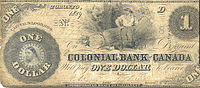
Canada's first paper money, denominated in dollars (then still American, since Canada officially had no currency), were British army banknotes issued between 1813 and 1815. Banknotes denominated in Canadian dollars were later issued by certified banks, starting in the 1830s, by some colonial administrations (primarily the Province of Canada in 1866), and later by the Confederation of Canada, starting in 1870. Some municipalities also issued their banknotes.
In 1935, the Bank of Canada was founded. He took over the federal issue of Canadian money and began issuing banknotes in denominations of 1, 2, 5, 10, 20, 25, 50, 100, 500 and 1000 dollars. In 1944, authorized banks were forbidden to issue their own money. The right to issue remained with Royal Bank of Canada and the Bank of Montreal .
After 1935 there were significant changes in the design of banknotes. Also in 1937, 1954, 1970, 1986, new series of paper money were introduced.
Beginning in 2011, the Bank of Canada began issuing polymer banknotes : November 15, 2011 - $ 100, March 26, 2012 - $ 50 [2] , November 7, 2012 - $ 20. Until the end of 2013, polymer banknotes in denominations of 10 and 5 dollars will be issued.
Currently, all Canadian banknotes are printed by Canadian Bank Note Company and BA International Inc under a contract with the Bank of Canada .
All Bank of Canada banknotes issued since 1935 are legal tender, however, banknotes of some denominations are practically not used in circulation. Thus, banknotes of 1 and 2 dollars have not been issued since 1989 and 1996, respectively, and are replaced by coins in circulation. 25 and 500 dollars have not been issued since 1935, 1000 dollars - since 2000 [3] . After the publication of the budget for 2018, it became known about the intention of the Bank of Canada to withdraw banknotes of $ 1,000, as well as virtually unused banknotes of $ 1, 2, 25 and 500, from circulation. The term for the withdrawal of these banknotes has not yet been announced, but it is assumed that it will be quite long [4] .
Coins
Traditionally, the following metals were used for coins:
- 1 cent (not issued since 2013, but formally remain legal tender) - copper, brass, steel plated with copper
- 5 cents - nickel, nickel plated steel
- 10 cents - silver, nickel-plated steel
- 25 cents - silver (until 1968), nickel (1968-1999), nickel-plated steel (since 1999)
- 50 cents - silver (until 1968), nickel, nickel-plated steel (since 1999). In fact, a coin with a face value of 50 cents is not a running coin and is being bought up by collectors
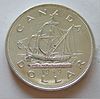
- 1 dollar - silver (1935-1967), nickel (1968-1986), brass plated nickel (1987-2011), brass plated steel (since 2012).
- $ 2 - bimetal: aluminum-bronze alloy in a nickel ring (since 1996).
Exchange Rate Mode
Due to its geographical proximity and Canada’s significant dependence on US imports , the Canadian dollar is heavily influenced by the US economy and, more recently, APEC economies . The cyclical fluctuations in the Canadian dollar rate have characterized and characterize the Canadian economy throughout the course of the 20th - beginning of the 21st centuries. So, until 1976, the Canadian dollar was slightly more expensive than the American one, and then weakened until 2003, when its growth was outlined. A cheap Canadian dollar was a lever for the competitiveness of Canadian goods (especially raw materials) in the US market. Gradually, with the development of negative trends in the US economy, a gradual depreciation of the dollar began in 2005-2007. In September 2007, the Canadian dollar caught up with the US dollar, which, however, hit Canadian consumers and exporters heavily.
Canada is currently using a free-floating exchange rate regime . The criterion for the effectiveness of the exchange rate policy ( exchange rate anchor ) are inflation indicators.
| Market rate | ||||||||
|---|---|---|---|---|---|---|---|---|
| ||||||||
Notes
- ↑ http://www.bis.org/publ/rpfxf07t.pdf (December 2007) Bank for International Settlements
- ↑ Canada released polymer 50 dollars
- ↑ Upcoming changes to legal tender status for older bank notes , Bank of Canada
- ↑ Canada retires $ 1,000 banknotes , Knopka.ca
Links
- Canadian dollars of all series of release. Banknotes and descriptions.
- Canadian Dollar Website
- Canadian Dollar Website (Fr.)
- Canadian dollar to US dollar quotes over the past two years
- Canada Cash Turnover History
- Canadian Dollar History
- Bank of Canada
- Royal Mint of Canada
- Coins of Canada (catalog and gallery)
- Coin 1 Canadian dollar: 1935 (silver), 1968 (nickel), 1986 (“looney”)
- Canadian Banknote Gallery (German )