The oath of More Judaico (the Jewish oath) was a special form of oath that the Jews were supposed to give in the courts of medieval Europe . This oath accompanied certain ceremonies and was often deliberately degrading or dangerous. More Judaico in Latin means "according to Jewish custom." The issue of the reliability of the oath of the Jews was closely related to the meaning that Christian authorities attributed to the Kol Nidra prayer, which the Jews read on Yom Kippur , and in general, the introduction of this oath was a characteristic indicator of the attitude of the Middle Ages to their subjects - the Jews. The self-determination of the Church and the state seemed to force various formulas for those outside the state church.

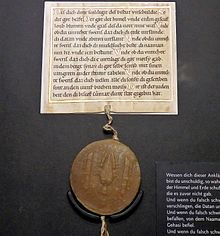
Historical Development
The restrictions imposed on Jews when participating in litigations with Christians date back to the Byzantine Empire during the reign of Justinian I , who ruled that neither Jews nor heretics can be admitted to court as witnesses against Christians, but a secular court does not recognized this limitation. Thus, the leadership of the Carolingian kings in the IX century. prescribed to treat Jews and Christians as equals, and therefore their testimony had legal force, regardless of whether they were given under oath or not. This was clearly indicated in a letter transmitted by the Roman Emperor Henry IV to the Speyer Jews in 1090. The law of Prince Frederick II (1244), which served as a model for many other laws for Jews, required only the oath “super Rodal” ( Torah ) from the Jews. Similar laws existed in England , Portugal, and Hungary ; Hungary canceled the oath on the Torah in trivial cases.
There were, however, some old laws prescribing certain acts designed to ridicule Jews in court. Here are examples illustrating the types of humiliating rituals that accompanied an oath:
- Byzantine Empire (X century): a Jew had to wear a crown of thorns around his belt, stand in water and swear an oath on the “Barase Baraa” ( Genesis ) so that if he tells a lie, he will be swallowed up by the earth like Dathan and Aviron in the Book of Numbers ( Chis . 16: 1–27 ).
- Arles (c. 1150): a thorn wreath was hung around the sworn neck, others fell to his knees, a five- elbow spike was placed between the witness’s legs, while he swore and invoked all the curses of the Torah.
- Swabia (XIII century): a Jew was supposed to stand on the bloodied skin of a lamb.
- Silesia (1422): a Jew had to stand on three legs of a chair and pay a penalty every time he fell, and if he fell for the fourth time, he lost the case.
- Dortmund : A Jew was fined every time he stopped while reading an oath.
Links
- Oath - article from the Electronic Jewish Encyclopedia