The big jerboa [1] , or the earthen hare [1] ( Allactaga major ) is the jerboa of the genus earthen hares .
| Big jerboa | ||||||||||||||
|---|---|---|---|---|---|---|---|---|---|---|---|---|---|---|
 | ||||||||||||||
| Scientific classification | ||||||||||||||
| ||||||||||||||
| Latin name | ||||||||||||||
| Allactaga major ( Kerr , 1792 ) | ||||||||||||||
| Synonyms | ||||||||||||||
|
Security status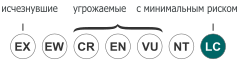 IUCN 3.1 Least Concern : 857 |
Content
Description
Large jerboa - the largest among jerboas. He has a relatively short body (18.7-26 cm long); the tail is 1.3 times longer than the body (25-30.5 cm). Body weight more than 300 g. The head is rounded with a well-defined neck interception. The muzzle is slightly elongated, but wide, ending with a patch. The ears are relatively short, 57-59 mm high. Feet are long, reach 45% of the body length. The hind legs of these rodents are long and strong. With their help, jerboas jump to a distance of three meters! This is 20 times the length of the body of the animal.
The color of the upper back varies from brownish-ocher or brownish-gray to pale sandy. Cheeks are light, almost white. The throat, chest, abdomen, forearms, and also the inner surfaces of the hips are pure white. The hips are rusty yellow on the outside, and a transverse white stripe runs along them. The tail “banner” is two-color with a black base and white top, well developed, has the shape of a bird feather.
Geographic dimorphism is characteristic: towards the south, the auricles of jerboas become longer, and the color of the back brightens from north to south and from west to east.
Distribution
Large jerboa is distributed from forest steppes to semi-deserts and the northern part of the desert zone in Eastern Europe , Kazakhstan and in the south of Western Siberia . It penetrates further north than other species of jerboa, going beyond 55 ° S.X.
The species range is represented by a continuous array and one isolate. The isolate is located south and southwest of Lake. Balkhash in the northern foothills of the Tien Shan ; its area is about 82,400 km 2 . The main range extends from the Black Sea to the river. Ob and Altai mountains . The northern border of the range basically coincides with the northern border of the forest-steppe and runs between 55 ° and 56 ° N, sometimes entering the forest zone. The southern border runs along the northern coast of the Black Sea , the foothills of the Caucasus , bends around the Caspian Sea , crosses the Mangyshlak Peninsula and goes east, bending around the Aral Sea , Lake. Balkhash and further to the Zaysan depression.
Lifestyle
The habitats of the big jerboa are diverse. In the north of the range, it keeps open areas with sparse grass stand. In the steppe zone, it is usual along roadsides of dirt roads, field edges, on pastures, along gentle slopes of beams and ravines. In the steppes of Kazakhstan and Western Siberia, low-grass meadows with solonetzic soils, shores of salt lakes and steppe rivers, and the edges of pine forests inhabit the steppes. In deserts it is not found only on moving sands; prefers sites with light loamy soils and thickets of cereals, wormwood and succulents . In the mountains rises to 1650 m above sea level.
Leads a solitary lifestyle, rarely in contact with relatives outside the breeding season. In captivity, adults display aggression towards each other. A large jerboa is active exclusively at night, coming to the surface 40–45 minutes after sunset and returning to a hole 30–50 minutes before sunrise. Compared with small jerboas, he is more careful - before leaving the hole, the animal sniffs and listens for a long time. In a calm state, a large jerboa moves on its hind legs in steps or trot. When running, it switches to an asynchronous ricochet (successive shocks, first with one, then with the other paw). The length of a normal jump is 80-125 cm; maximum running speed - 40-50 km / h. Large jerboas, while running, do not make sharp jumps and leave the pursuit with smooth, but powerful jerks, creating the impression that the jerboa literally flies above the ground.
The big jerboa digs complex permanent (summer and wintering) and simple temporary burrows. A constant burrow begins with a course densely clogged with earth that runs almost horizontally; its length can reach 6 m. An inclined course departs steeply down from the horizontal path in the middle, which leads to the nesting chamber at a depth of 40-110 cm. At its other end, the main horizontal path opens outward. The entrance used during the day is usually clogged with an earthen jam. From the main course, the snouts that are slightly unfinished to the surface of the earth and serve as emergency exits (usually 1, rarely 2-4) can depart. The spherical nest in the chamber is composed of dry blade of grass, moss, wool, fluff and feathers. Winter burrows deeper (1.5-2.5 m), with two nesting chambers at different depths. Temporary burrows are shallow, in the form of an obliquely going underground. In the north of the range, jerboa also lives in empty gopher burrows.
Nutrition
Large jerboa belongs to omnivorous rodents - in its diet, plant (seeds, roots, bulbs) and animal ( insects ) feeds can be equally present. It easily switches from one type of feed to another, depending on its availability and season. On agricultural lands, a large jerboa often collects the sown seeds of watermelons and melons , also feeds on grains of cultivated cereals, sunflower seeds, peas , but the damage is insignificant.
Life Cycle
A large jerboa emerges from hibernation in mid-March-April. One strongly extended breeding season is characteristic, whose peak falls on April-June. Broods in the year 1-2; pregnancy lasts about 25 days. In a brood from 1 to 8, usually 3–6 cubs. They live with a female for up to 1.5 months. They reach puberty in the 2nd year of life. The maximum life expectancy in nature is up to 3 years.
In the fall, with the onset of constant frost, jerboas hibernate. Usually this happens in September, less often in October. The duration of hibernation in different regions ranges from 4 to 6-6.5 months; during thaws it can be interrupted. Large jerboas do not stock food; before hibernation, they are very fat, sometimes doubling their body weight.
Strength
Within the range, a large jerboa is widespread, but not evenly. The reasons for this are the mosaic of suitable habitats and the anthropogenic transformations of the territory. The number and density of local populations increases from north to south: from 0.5-5 individuals / ha in the European part of the range to 6-7 individuals / ha in Semirechye. In the northern part of the range, while maintaining its borders in the second half of the XX century. local extinction of the species was noted as a result of plowing virgin areas of the steppe and a reduction in the area of pastures and pastures. So, until the mid-1990s, a large jerboa was found in the vicinity of Serpukhov , where it has now become extinct due to the destruction of suitable habitats.
In the 1920-1960s. in Kazakhstan, skins of a large jerboa were prepared, now the fishing has been stopped. It is a natural carrier of the causative agents of plague , tularemia , and Q fever .
Notes
- ↑ 1 2 Sokolov V.E. The Bilingual Dictionary of Animal Names. Mammals Latin, Russian, English, German, French. / edited by Acad. V. E. Sokolova. - M .: Rus. Yaz., 1984. - S. 193. - 10,000 copies.
Links
- Allactaga major Kerr, 1792 - Large jerboa . Vertebrate animals of Russia . Institute of Ecology and Evolution A.N. Severtsov Russian Academy of Sciences. Date of treatment April 16, 2013. Archived April 17, 2013.